Ciri dan struktur
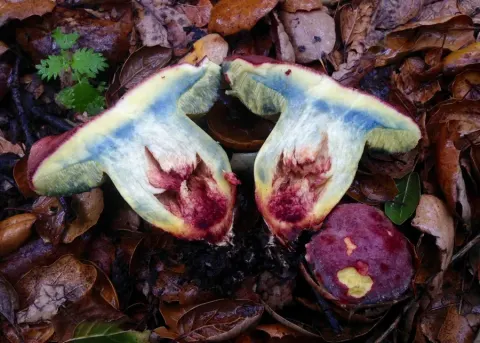
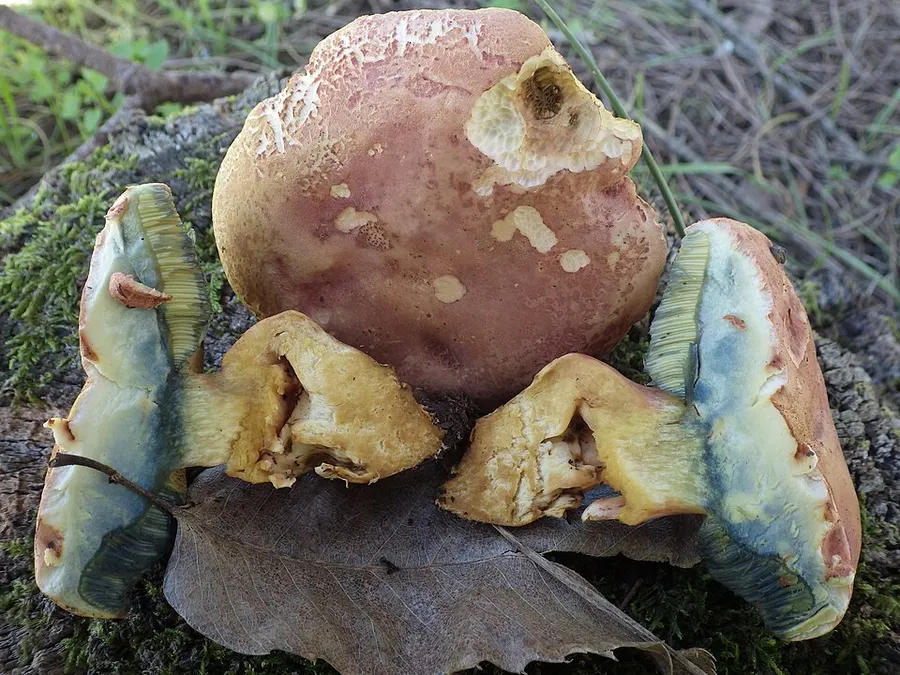
Rheubarbariboletus persicolor produces solitary or loosely clustered fruit bodies (basidiocarps) characterised by a distinct colour transition and blue‑bruising tissues. The cap (cap) measures 3.1–6.7 cm across, initially hemispherical before expanding to broadly convex and eventually flattening with maturity. Its surface is dry and finely velvety, often developing radial cracks or fissures near the margin. Young caps display apricot to peach shades—or occasionally vivid yellow‑orange—that age to ochre with a pinkish tinge. The margin starts inrolled, then straightens and may turn upward in older specimens. Underneath the cap cuticle, the flesh is pale yellow, gradually paling to a creamy‑pink at the centre and sometimes showing olive‑yellow tones in very young mushrooms. Beneath the cap surface lies a layer of short tubes up to 7 mm long, which are bright yellow at first and range through ochre to olive yellow. These tubes are adnate to the stipe and run slightly down its surface, forming a small tooth in mature specimens. When cut or bruised, both the tubes and the tiny, initially maze‑like pores bruise blue before fading to a sordid brown. Mature pore surfaces frequently bear scattered rusty‑red flecks. The stipe is 6.5–9.9 cm long and 0.9–3.1 cm thick, ranging from straight to curved and from uniformly cylindrical to somewhat swollen or spindle‑shaped. Its dry, smooth surface is bright yellow at the apex, becoming paler below, with orange‑rust spotting—sometimes extending along the upper stipe—and a bright yellow basal mycelium. Damage to the stipe also elicits a blue‑bruising reaction that later darkens to a blackish‑brown.
Habitat dan peran ekologis
Rheubarbariboletus persicolor typically fruits singly or in small clusters on well‑drained, sandy soils within open grassy clearings and along the margins of Mediterranean maquis shrubland. These habitats are dominated by holm oak (Quercus ilex) with an understory of tree heath (Erica arborea) and strawberry tree (Arbutus unedo), and may include stone pine (Pinus pinea) or narrow‑leaved mock privet (Phillyrea angustifolia) among dense, spiny shrubs. Fruiting occurs in autumn (October to early November), often when daytime temperatures range between about 5 °C and 17 °C. This bolete is known from coastal localities in the Lazio region of central Italy, such as the Macchia Grande reserve near Fregene and the Castel Fusano pine woods near Ostia, at only 10–15 m above sea level and typically less than one kilometre from the Tyrrhenian Sea. In these sites it coexists with a characteristic Mediterranean ectomycorrhizal fungal community, including species such as Amanita phalloides, Chroogomphus rutilus, Lactarius chrysorrheus, Russula adusta and Xerocomellus dryophilus.
- Habitat atau konteks temuan
- Informasi belum tersedia pada sumber rilis ini.
- Substrat
- Informasi belum tersedia pada sumber rilis ini.
- Peran atau konteks
- Mitra tumbuhan
Reproduksi
Rheubarbariboletus persicolor produces solitary or loosely clustered fruit bodies (basidiocarps) characterised by a distinct colour transition and blue‑bruising tissues. The cap (cap) measures 3.1–6.7 cm across, initially hemispherical before expanding to broadly convex and eventually flattening with maturity. Its surface is dry and finely velvety, often developing radial cracks or fissures near the margin. Young caps display apricot to peach shades—or occasionally vivid yellow‑orange—that age to ochre with a pinkish tinge. The margin starts inrolled, then straightens and may turn upward in older specimens. Underneath the cap cuticle, the flesh is pale yellow, gradually paling to a creamy‑pink at the centre and sometimes showing olive‑yellow tones in very young mushrooms.
Catatan identitas dan cakupan
- Nama diterima mengikuti Catalogue of Life Base2026-09-11; uraian mempertahankan konsep dan nama sumber aslinya.
- Original geographic, specimen and life-cycle scope retained; source import awaits individual editorial review.
- Impor dan terjemahan otomatis belum diperiksa editorial per profil. Struktur reproduktif yang disebutkan tidak membuktikan seluruh siklus hidup diketahui.
- Pengukuran pada uraian mengikuti spesimen, kultur, dan metode sumber; angka tidak diperluas ke semua populasi.
Catatan distribusi dalam narasi mengikuti sumbernya. Dokumentasi spesimen atau foto mengikuti catatan sumber. Bukti wilayah Indonesia dan penilaian konservasi tidak disimpulkan dari gambar.
Melihat dengan konteks
Dokumentasi Rheubarbariboletus persicolor dari Wikimedia Commons. Fruit bodies of the bolete fungus Rheubarbariboletus persicolor.. (H. Engel, Klofac, H. Grünert & R. Grünert) Vizzini, Simonini & Gelardi. Photographed in Serra de Montejunto, Portugal. Identifikasi mengikuti record berkas sumber.
- Jenis
- Fotografi
- Kredit
- zaca
- Lisensi
- CC BY-SA 3.0
- Sumber media
- Buka entri sumber
Sumber profil
- [1] Rheubarbariboletus persicolor — Wikipedia (en)
- [2] Catalogue of Life Base2026-09-11 — Xerocomellus persicolor
- [3] Dokumentasi visual — Rheubarbariboletus persicolor
Rujukan halaman ini
Fungi. Xerocomellus persicolor. Rilis data fungi-2026-10-12-expansion-2. https://fungi-atlas.mgadib.chatgpt.site/jamur/xerocomellus-persicolor/.
Status: impor sumber; pemeriksaan editorial per profil belum selesai. Untuk klaim biologis, gunakan rujukan pada bagian terkait dan periksa konteks sumber aslinya.