01 / Morfologi

Ciri dan struktur

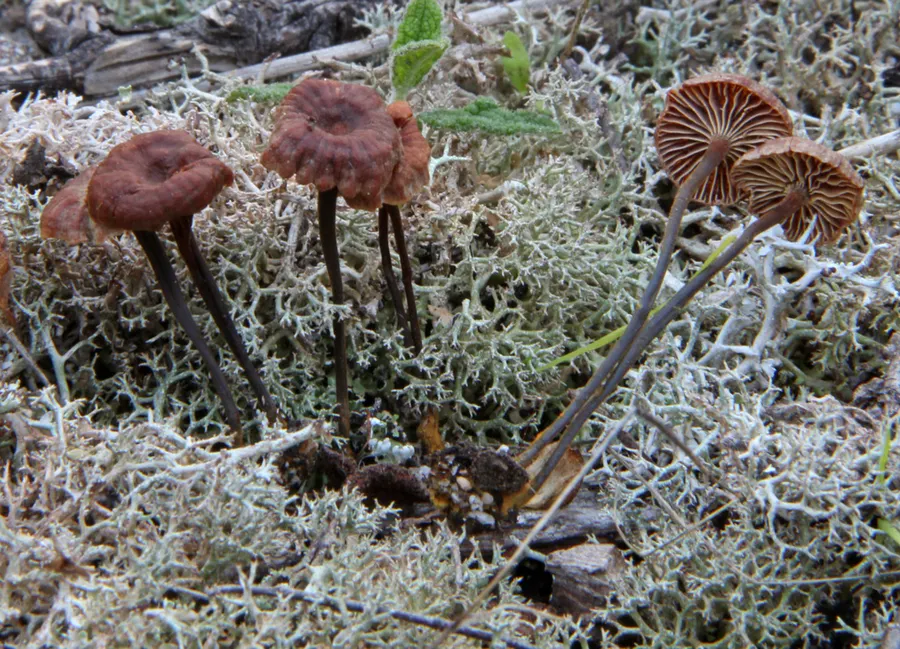
Xeromphalina setulipes produces basidiocarps in the form of mushrooms. Each mushroom has a flattened-convex cap of between 8 and 15 mm in diameter with a depressed centre. It is not particularly hygrophanous (it does not change color as it loses or absorbs water), and, unlike the caps of related species, is neither grooved nor translucent at the margin. The cap is dark brown, sometimes with reddish colouration. It becomes paler, turning tobacco-brown, when it dries; this change is more noticeable at the cap margin. The caps of young mushrooms are smooth and hairless, but they wrinkle as they age; however, fine, soft hairs are sometimes visible towards the margin (which is rolled inwards) when the cap is dry. The margin is typically not smooth; instead, it undulates. The cylindrical stem measures between 30 and 45 mm in length by 1 and 2 mm in width, though it is slightly thicker at the very bottom. It is stiff, but can be somewhat flexible. The colour is a dark brown, sometimes approaching black, with purplish hints. It appears smooth, but is actually covered in minute tufts. The hairs at the base of the stem are somewhat more visible, and are an amber colour. The gills are subdistant (neither close to, nor distant from, one another) and are of a distinctive shape; they are decurrent, that is, they extend down the stem, and are noticeably arched. The gills can be up to 2 mm thick, and sometimes split into two. The gills are a tobacco-brown no matter the age of the mushroom, though the edges can be paler (sometimes whitish) and crenulate. The flesh is firm but flexible, and the same colour as the surface.

Sebagian uraian ditampilkan dalam bahasa sumber; terjemahannya belum tersedia atau belum lolos pemeriksaan.

Rujukan: [1]

Pengukuran mengikuti objek, spesimen atau kultur, dan metode yang disebutkan sumber. Baca uraian asli untuk konteks lengkap.

02 / Kehidupan

Habitat dan peran ekologis

Xeromphalina setulipes hanya dikenal dari lokasi tipe di provinsi Ciudad Real, Spanyol. dan X. setulipes ditemukan di hutan yang terdiri dari kayu ek korek (Quercus suber) dan Portuguese oak (Quercus faginea), dengan tumbuhan yang terdiri dari gusi rockrose (Cistus ladanifer), juniper berpeluh (Juniperus oxycedrus), dan berbagai bulu (Erica species).

Rujukan: [1]

Habitat atau konteks temuan
hutan
Substrat
Informasi belum tersedia pada sumber rilis ini.
Peran atau konteks
Belum dikategorikan pada rilis ini.
Temukan hubungan serupa
03 / Siklus hidup

Reproduksi

Xeromphalina setulipes produces basidiocarps in the form of mushrooms. Each mushroom has a flattened-convex cap of between 8 and 15 mm in diameter with a depressed centre. It is not particularly hygrophanous (it does not change color as it loses or absorbs water), and, unlike the caps of related species, is neither grooved nor translucent at the margin. The cap is dark brown, sometimes with reddish colouration. It becomes paler, turning tobacco-brown, when it dries; this change is more noticeable at the cap margin. The caps of young mushrooms are smooth and hairless, but they wrinkle as they age; however, fine, soft hairs are sometimes visible towards the margin (which is rolled inwards) when the cap is dry.

Sebagian uraian ditampilkan dalam bahasa sumber; terjemahannya belum tersedia atau belum lolos pemeriksaan.

Rujukan: [1]

04 / Batas informasi

Catatan identitas dan cakupan

  • Nama diterima mengikuti Catalogue of Life Base2026-09-11; uraian mempertahankan konsep dan nama sumber aslinya.
  • Original geographic, specimen and life-cycle scope retained; source import awaits individual editorial review.
  • Impor dan terjemahan otomatis belum diperiksa editorial per profil. Struktur reproduktif yang disebutkan tidak membuktikan seluruh siklus hidup diketahui.
  • Pengukuran pada uraian mengikuti spesimen, kultur, dan metode sumber; angka tidak diperluas ke semua populasi.

Catatan distribusi dalam narasi mengikuti sumbernya. Dokumentasi spesimen atau foto mengikuti catatan sumber. Bukti wilayah Indonesia dan penilaian konservasi tidak disimpulkan dari gambar.

05 / Dokumentasi

Melihat dengan konteks

Dokumentasi Xeromphalina setulipes menurut asosiasi foto pada record takson iNaturalist. Kredit: Davide Puddu. Identitas mengikuti sumber; bukan penentuan spesimen independen.

Jenis
Fotografi
Kredit
(c) Davide Puddu, some rights reserved (CC BY), uploaded by Davide Puddu
Lisensi
CC BY 4.0
Sumber media
Buka entri sumber

Gambar menunjukkan objek menurut identifikasi sumber, bukan verifikasi independen spesimen oleh Fungi. Tidak ada skala baru yang ditambahkan.

06 / Rujukan

Sumber profil

  1. [1] Xeromphalina setulipes — Wikipedia (en)Bagian sumber: Frozen revision 1299949613
    Tanggal penghimpunan sumber: 2026-10-12
    Teks sumber: CC BY-SA4.0 · Wikipedia contributors
  2. [2] Catalogue of Life Base2026-09-11 — Xeromphalina setulipesBagian sumber: ColDP NameUsage.tsv ID 5CD3Z; accepted species; source 2073
    Tanggal penghimpunan sumber: 2026-10-12
  3. [3] Dokumentasi visual — Xeromphalina setulipesBagian sumber: Individual media record; identification follows the source, not independent determination
    Tanggal penghimpunan sumber: 2026-10-12
    Media sumber: CC BY 4.0 · (c) Davide Puddu, some rights reserved (CC BY), uploaded by Davide Puddu

Adaptasi teks: CC BY-SA 4.0. Wikipedia contributors — Xeromphalina setulipes — Wikipedia (en)

Uraian asli dan riwayat sumber

Riwayat atau halaman sumber

Ringkasan sumber

Xeromphalina setulipes is a species of fungus of the family Mycenaceae. First collected in 2005, it was described and named in 2010 by Fernando Esteve-Raventós and Gabriel Moreno, and is known only from oak forests in Ciudad Real Province, Spain. The species produces mushrooms with dark reddish-brown caps up to 15 mm across, dark purplish-brown stems up to 45 mm in height and distinctive, arched, brown gills. The mushrooms were found growing directly from the acidic soil of the forest floor, surrounded by plant waste, during November.

Revisi sumber

Morfologi sumber

Xeromphalina setulipes produces basidiocarps in the form of mushrooms. Each mushroom has a flattened-convex cap of between 8 and 15 mm in diameter with a depressed centre. It is not particularly hygrophanous (it does not change color as it loses or absorbs water), and, unlike the caps of related species, is neither grooved nor translucent at the margin. The cap is dark brown, sometimes with reddish colouration. It becomes paler, turning tobacco-brown, when it dries; this change is more noticeable at the cap margin. The caps of young mushrooms are smooth and hairless, but they wrinkle as they age; however, fine, soft hairs are sometimes visible towards the margin (which is rolled inwards) when the cap is dry. The margin is typically not smooth; instead, it undulates. The cylindrical stem measures between 30 and 45 mm in length by 1 and 2 mm in width, though it is slightly thicker at the very bottom. It is stiff, but can be somewhat flexible. The colour is a dark brown, sometimes approaching black, with purplish hints. It appears smooth, but is actually covered in minute tufts. The hairs at the base of the stem are somewhat more visible, and are an amber colour. The gills are subdistant (neither close to, nor distant from, one another) and are of a distinctive shape; they are decurrent, that is, they extend down the stem, and are noticeably arched. The gills can be up to 2 mm thick, and sometimes split into two. The gills are a tobacco-brown no matter the age of the mushroom, though the edges can be paler (sometimes whitish) and crenulate. The flesh is firm but flexible, and the same colour as the surface.

Revisi sumber

Ekologi sumber

Xeromphalina setulipes is only known from the type locality in the province of Ciudad Real, Spain. and X. setulipes was found in woodland made up of cork oak (Quercus suber) and Portuguese oak (Quercus faginea), with undergrowth consisting of gum rockrose (Cistus ladanifer), prickly juniper (Juniperus oxycedrus), and various heathers (Erica species).

Revisi sumber

Struktur reproduksi sumber

Xeromphalina setulipes produces basidiocarps in the form of mushrooms. Each mushroom has a flattened-convex cap of between 8 and 15 mm in diameter with a depressed centre. It is not particularly hygrophanous (it does not change color as it loses or absorbs water), and, unlike the caps of related species, is neither grooved nor translucent at the margin. The cap is dark brown, sometimes with reddish colouration. It becomes paler, turning tobacco-brown, when it dries; this change is more noticeable at the cap margin. The caps of young mushrooms are smooth and hairless, but they wrinkle as they age; however, fine, soft hairs are sometimes visible towards the margin (which is rolled inwards) when the cap is dry.

Revisi sumber

Rujukan halaman ini

Fungi. Xeromphalina setulipes. Rilis data fungi-2026-10-12-expansion-2. https://fungi-atlas.mgadib.chatgpt.site/jamur/xeromphalina-setulipes/.

Status: impor sumber; pemeriksaan editorial per profil belum selesai. Untuk klaim biologis, gunakan rujukan pada bagian terkait dan periksa konteks sumber aslinya.