Ciri dan struktur
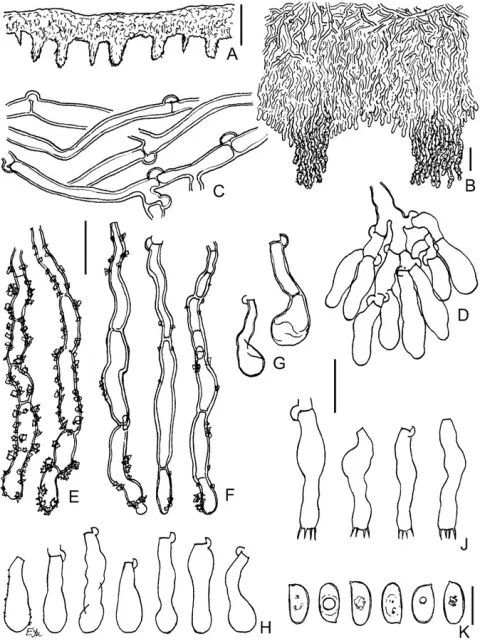
Basidiomata effused, odontioid, membranaceous, with a densely odontioid, ochraceous hymenial surface. Margin mostly abrupt, some parts thinning out. Hymenophoral aculei cylindrical to conical, acute apically, 130–350 μm long, 60–150 μm diam. at base, 4 per mm. Subiculum 100–150 μm thick, minutely cracking. Hyphal system monomitic; hyphae clamped at all primary septa. Subicular and tramal hyphae thick-walled (wall up to 1.5 μm), 2.5–4 μm wide, often with narrow lumen, smooth, colourless, looking faint yellowish in mass due to refractive walls. Subhymenium well developed; hyphae richly branched, thin- to slightly thick-walled, yellowish in mass. Aculei bearing skeletal-like, naked or poorly encrusted, immersed hyphal ends and variously encrusted, thick-walled, projecting hyphae in bunches, 3.5–5 μm wide. Capitate elements common, as lateral branches on tramal or subhymenial hyphae, (25–)30–55 × 6.5–10.5 μm, thin- to thick-walled, aseptate or with 1–2 adventitious septa. Basidioles clavate, subcylindrical, utriform. Basidia utriform to subcylindrical and clavate, 15–22 × 4–5 μm, thin-walled, smooth, with four sterigmata ca. 2 × 0.5 μm. Spores ellipsoid to narrowly ellipsoid or short cylindric, 5.3–6.3(–7) × 3–4 μm, holotype L = 5.9, W = 3.4, Q = 1.8 (n = 22), with adaxial side flat to convex, smooth, thin-walled, colourless, with minute apiculus, inamyloid, indextrinoid, acyanophilous.
Habitat dan peran ekologis
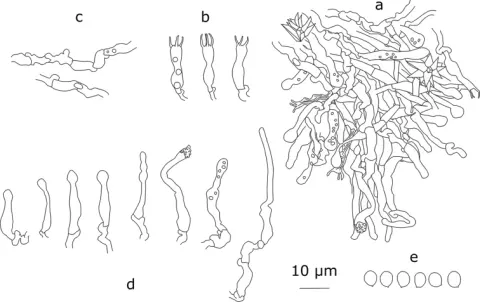
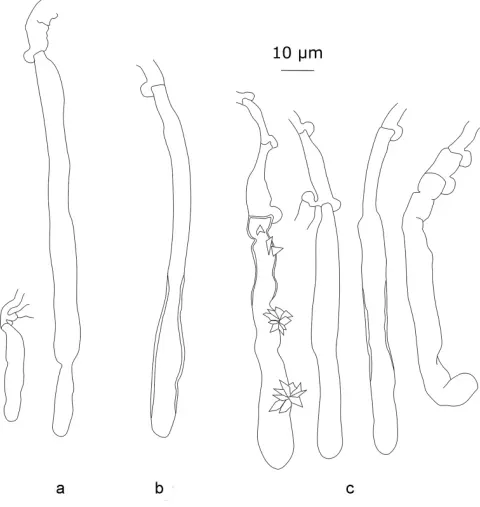
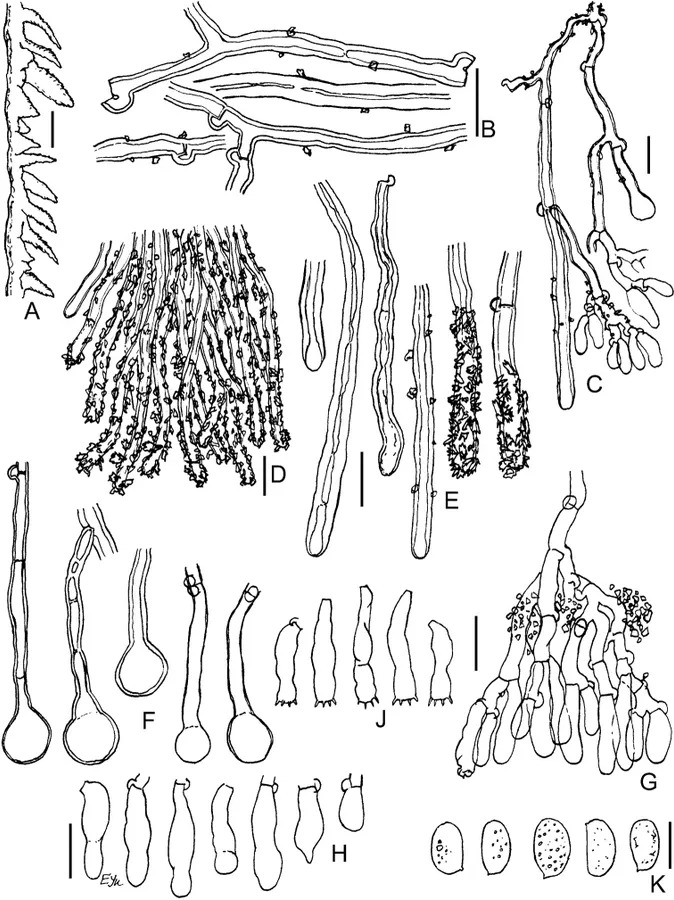
This species was considered conspecific with Xylodon lanatus from North America (Burdsall and Nakasone 1981, Wu 1990, Gorjón and Greslebin 2012), but we observed significant morphological differences. For example, in X. vesiculosus, the basidiomata have a denser, tough-membranaceous texture compared to the soft woolly basidiomata of X. lanatus. In addition, the aculei in X. vesiculosus are larger and the basidia are thin-walled in contrast to the smaller aculei and basally thick-walled basidia found in X. lanatus (compare Figs 9, 10). See Discussion for a key to X. lanatus, X. vesiculosus and allied taxa. Xylodon niemelaei (Sheng H.Wu) Hjortstam & Ryvarden, Synopsis Fungorum 26: 28 (2009) ≡ Hyphodontia niemelaei Sheng H. Wu, Acta Botanica Fennica 142:98 (1990). Xylodon rhizomorphus (C.L.Zhao, B.K.Cui & Y.C.Dai) Riebesehl, Yurchenko & Langer, Mycological Progress 16(6): 649 (2017). ≡ Hyphodontia rhizomorpha C.L.Zhao, B.K.Cui & Y.C.Dai, Cryptogamie, Mycologie 35(1):92 (2014).
- Habitat atau konteks temuan
- Informasi belum tersedia pada sumber rilis ini.
- Substrat
- Informasi belum tersedia pada sumber rilis ini.
- Peran atau konteks
- Belum dikategorikan pada rilis ini.
Reproduksi
Basidiomata effused, odontioid, membranaceous, with a densely odontioid, ochraceous hymenial surface. Margin mostly abrupt, some parts thinning out. Hymenophoral aculei cylindrical to conical, acute apically, 130–350 μm long, 60–150 μm diam. at base, 4 per mm. Subiculum 100–150 μm thick, minutely cracking. Hyphal system monomitic; hyphae clamped at all primary septa. Subicular and tramal hyphae thick-walled (wall up to 1.5 μm), 2.5–4 μm wide, often with narrow lumen, smooth, colourless, looking faint yellowish in mass due to refractive walls. Subhymenium well developed; hyphae richly branched, thin- to slightly thick-walled, yellowish in mass. Aculei bearing skeletal-like, naked or poorly encrusted, immersed hyphal ends and variously encrusted, thick-walled, projecting hyphae in bunches, 3.5–5 μm wide.
Catatan identitas dan cakupan
- Nama diterima mengikuti Catalogue of Life Base2026-09-11; uraian mempertahankan konsep dan nama sumber aslinya.
- Preserve original treatment localities, hosts and substrate scope. Materials examined describe documented specimens, not the full global range.
- Impor dan terjemahan otomatis belum diperiksa editorial per profil. Struktur reproduktif yang disebutkan tidak membuktikan seluruh siklus hidup diketahui.
- Pengukuran pada uraian mengikuti spesimen, kultur, dan metode sumber; angka tidak diperluas ke semua populasi.
Catatan distribusi dalam narasi mengikuti sumbernya. Dokumentasi spesimen atau foto mengikuti catatan sumber. Bukti wilayah Indonesia dan penilaian konservasi tidak disimpulkan dari gambar.
Melihat dengan konteks
Micromorphology of Xylodon vesiculosus (PDD-18112, isotype): A vertical section through basidioma B subicular hyphae C excerpt of tramal hyphae to hymenium and skeletoid hyphae D bundle of projecting aculeal hyphae E smooth and variously encrusted aculeal hyphae F capitate cystidia G portion of hymenium and subhymenium H basidioles J basidia K basidiospores. Scale bars: 250 µm (A); 10 μm (B–J); 5 μm (K).
- Jenis
- Pelat ilmiah
- Kredit
- Janett Riebesehl, Eugene Yurchenko, Karen K. Nakasone, Ewald Langer
- Lisensi
- CC BY 4.0
- Sumber media
- Buka entri sumber
Dokumentasi tambahan
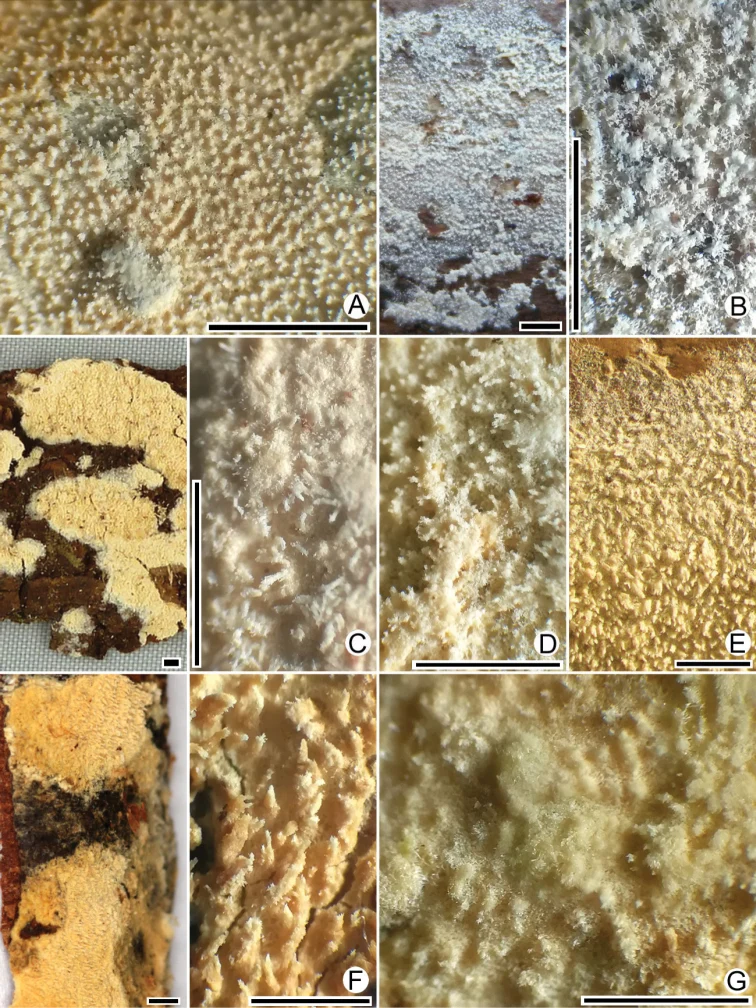
Basidiomata of Xylodon spp. A X. exilis (TUB-FO 42565, holotype) B X. filicinus (MSK-F 12369, holotype) C X. follis (FR-0249814, holotype) D X. pseudolanatus (FP-150922, holotype) E X. pseudolanatus (HHB-6925, paratype) F X. vesiculosus (PDD-18112, isotype) G X. lanatus (CFMR HHB-8925, holotype). Scale bars: 1 mm.
Kredit dan penggunaan
Janett Riebesehl, Eugene Yurchenko, Karen K. Nakasone, Ewald Langer
Ukuran dan format gambar disesuaikan tanpa pemotongan, retus, atau penambahan skala. Lisensi sumber dipertahankan.
Sumber profil
- [1] Phylogenetic and morphological studies in Xylodon (Hymenochaetales, Basidiomycota) with the addition of four new species — Xylodon vesiculosus
- [2] Catalogue of Life Base2026-09-11 — Xylodon vesiculosus
- [3] Dokumentasi visual — Xylodon vesiculosus
- [4] Dokumentasi visual — Xylodon vesiculosus
Rujukan halaman ini
Fungi. Xylodon vesiculosus. Rilis data fungi-2026-10-12-expansion-2. https://fungi-atlas.mgadib.chatgpt.site/jamur/xylodon-vesiculosus/.
Status: impor sumber; pemeriksaan editorial per profil belum selesai. Untuk klaim biologis, gunakan rujukan pada bagian terkait dan periksa konteks sumber aslinya.