Ciri dan struktur
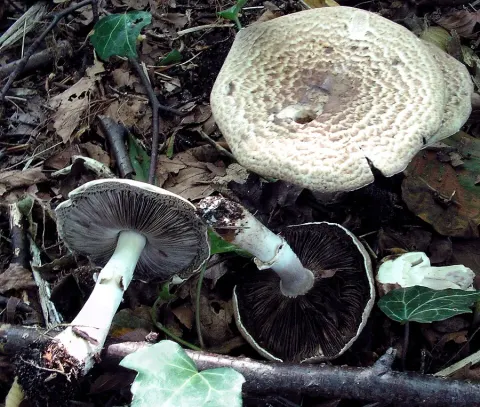
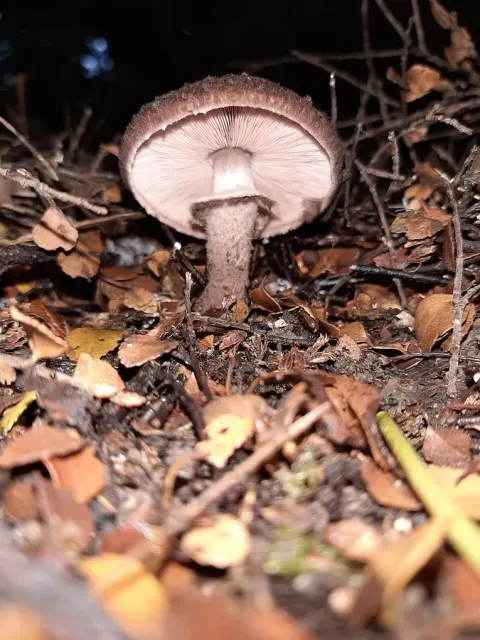
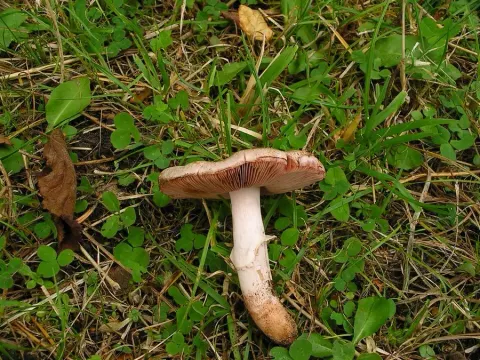
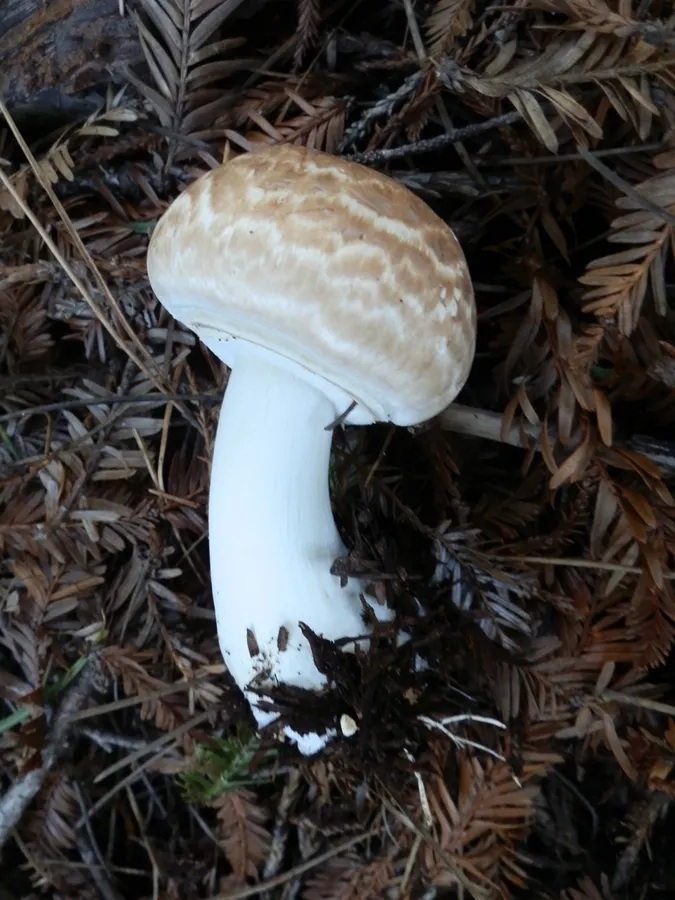
The cap is initially globose, then convex and sometimes flattening out, with a diameter of 6–15 cm. The dry and smooth cap surface is whitish or has pale pinkish-brown to pinkish-gray to fawn-colored flattened fibrils or fine fibrillose scales (at least in the center). In maturity, the fibrils usually darken to brown, reddish-brown, or reddish-gray, but in one northern form the fibrils are darker brown from the beginning. The flesh is thick and white. When bruised or injured, the flesh either does not change color, or may stain pale yellowish, then often slowly discolors pinkish. The odor of the crushed flesh is mild or faintly phenolic, but is usually distinctly phenolic in the base of the stipe. Firm, smooth, and lacking the scales found on the cap, the stipe is white but discolors dingy pinkish or brownish in age or after handling. The flesh in the extreme base usually stains pale yellowish when bruised. The partial veil is membranous, white, and forms a thick, felt-like ring on the upper portion of the stipe. The ring is skirtlike but often flares outward instead of collapsing against the stipe. A drop of dilute potassium hydroxide placed on the cap turns yellow. Spore prints are purplish brown to chocolate brown. The smooth, thick-walled spores are broadly ellipsoidal, and typically measure 5.8–7.3 by 3.7–4.4 μm. The basidia (spore-bearing cells) are four-spored, club-shaped, hyaline (translucent, and measure 20–21.3 by 5.8–7.0 μm. Cystidia on the gill edge (cheilocystidia) are sac-shaped to club-shaped, hyaline to pale yellowish brown in color, and have dimensions of 18.3–25.6 by 7.3–11.0 μm; there are no cystidia on the gill face (pleurocystidia).
Habitat dan peran ekologis
A saprobic species, the fruit bodies of A. hondensis grow scattered or in groups under conifers or in mixed forests. They have juga dilaporkan tumbuh di cincin peri. Jamur ini ditemukan di Amerika Utara Pasifik Coast of, dari Inggris Columbia in Canada south ke California, tetapi paling umum di California. Buah jamur pada musim gugur dari September to October throughout sebagian besar kisaran, tetapi pada musim berbuah California the cenderung dari November to Februari.
- Habitat atau konteks temuan
- hutan
- Substrat
- Informasi belum tersedia pada sumber rilis ini.
- Peran atau konteks
- Pengurai
Reproduksi
Spore prints are purplish brown to chocolate brown. The smooth, thick-walled spores are broadly ellipsoidal, and typically measure 5.8–7.3 by 3.7–4.4 μm. The basidia (spore-bearing cells) are four-spored, club-shaped, hyaline (translucent, and measure 20–21.3 by 5.8–7.0 μm. Cystidia on the gill edge (cheilocystidia) are sac-shaped to club-shaped, hyaline to pale yellowish brown in color, and have dimensions of 18.3–25.6 by 7.3–11.0 μm; there are no cystidia on the gill face (pleurocystidia).
Catatan identitas dan cakupan
- Nama diterima mengikuti Catalogue of Life Base2026-09-11; uraian mempertahankan konsep dan nama sumber aslinya.
- Original geographic, specimen and life-cycle scope retained; source import awaits individual editorial review.
- Impor dan terjemahan otomatis belum diperiksa editorial per profil. Struktur reproduktif yang disebutkan tidak membuktikan seluruh siklus hidup diketahui.
- Pengukuran pada uraian mengikuti spesimen, kultur, dan metode sumber; angka tidak diperluas ke semua populasi.
Catatan distribusi dalam narasi mengikuti sumbernya. Dokumentasi spesimen atau foto mengikuti catatan sumber. Bukti wilayah Indonesia dan penilaian konservasi tidak disimpulkan dari gambar.
Melihat dengan konteks
Dokumentasi Agaricus hondensis menurut asosiasi foto pada record takson iNaturalist. Kredit: pinonbistro. Identitas mengikuti sumber; bukan penentuan spesimen independen.
- Jenis
- Fotografi
- Kredit
- (c) pinonbistro, some rights reserved (CC BY-SA), uploaded by pinonbistro
- Lisensi
- CC BY-SA 4.0
- Sumber media
- Buka entri sumber
Dokumentasi tambahan
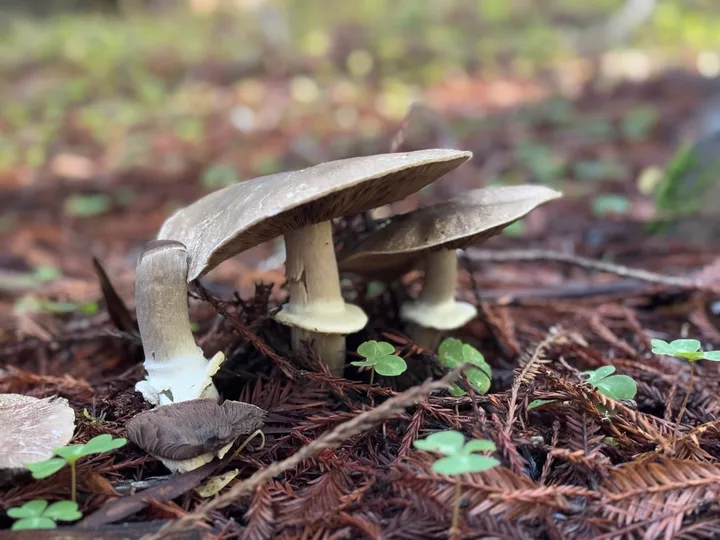
Foto yang diasosiasikan dengan Agaricus hondensis pada iNaturalist. Identifikasi mengikuti sumber; bukan penentuan spesimen independen.
Kredit dan penggunaan
(c) Sarah Stierch, some rights reserved (CC BY-SA), uploaded by Sarah Stierch
Ukuran dan format gambar disesuaikan tanpa pemotongan, retus, atau penambahan skala. Lisensi sumber dipertahankan.
Sumber profil
- [1] Agaricus hondensis — Wikipedia (en)
- [2] Catalogue of Life Base2026-09-11 — Agaricus hondensis
- [3] Dokumentasi visual — Agaricus hondensis
- [4] Dokumentasi visual — Agaricus hondensis
Rujukan halaman ini
Fungi. Agaricus hondensis. Rilis data fungi-2026-10-12-expansion-2. https://fungi-atlas.mgadib.chatgpt.site/jamur/agaricus-hondensis/.
Status: impor sumber; pemeriksaan editorial per profil belum selesai. Untuk klaim biologis, gunakan rujukan pada bagian terkait dan periksa konteks sumber aslinya.