01 / Morfologi

Ciri dan struktur

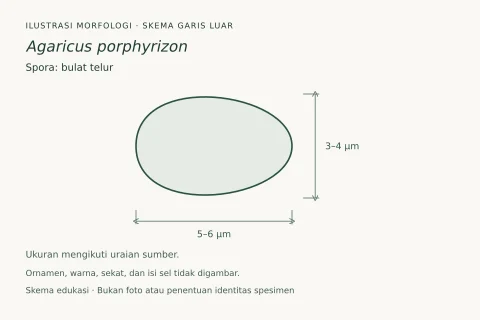
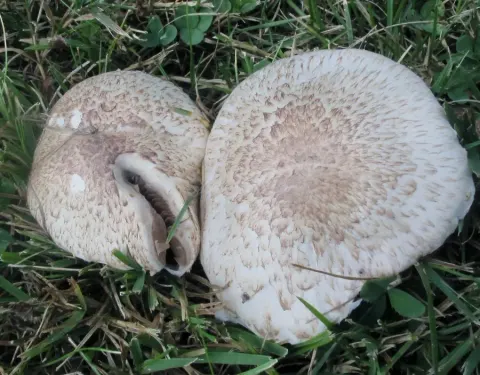
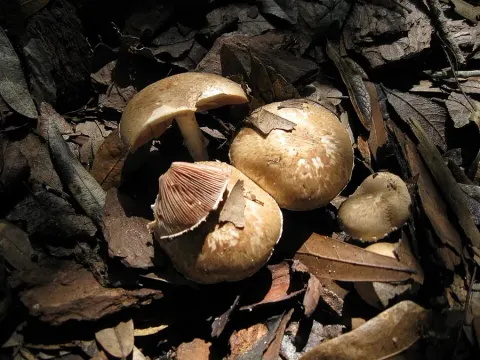
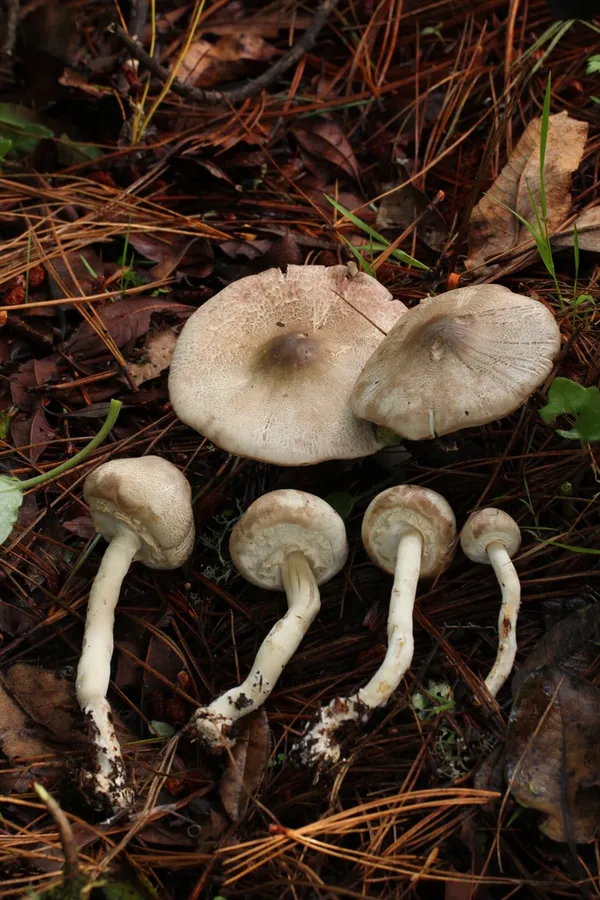
Their cap is 3–10 cm, convex to broadly convex or nearly flat in age, sometimes with an obscure, darker bump, and dry. The top is mainly whitish to dingy, developing vaguely concentric brownish to grayish scales towards the center. Their gills are free from the stem, close, and white, becoming pinkish, then brown. The stem is 4–8 cm long, 0.5–1 cm thick, more or less equal, and contains a small bulbous base that bruises yellow. In addition, it has a ring that typically persists into maturity, and a partial veil when covering the gills not developing dark droplets. The flesh is white throughout and staining bright yellow in the base. The taste is not distinctive or somewhat unpleasant. In contrast, the odor is often unpleasant (phenolic), but sometimes not distinctive. The spore print is brown. Chemical reactions involve combining the cap and flesh yellow with potassium hydroxide (KOH). The spores are 4.5–6 x 3–3.8 μm and elliptical.

Sebagian uraian ditampilkan dalam bahasa sumber; terjemahannya belum tersedia atau belum lolos pemeriksaan.

Rujukan: [1]

Pengukuran mengikuti objek, spesimen atau kultur, dan metode yang disebutkan sumber. Baca uraian asli untuk konteks lengkap.

02 / Kehidupan

Habitat dan peran ekologis

They are saprobik, yang berarti mereka bertahan hidup dengan membusuk mati atau membusuk bahan organik. They often tumbuh sendiri atau bersekutu di bawah kayu keras dan di hutan campuran di seluruh tenggara Amerika Utara.

Rujukan: [1]

Habitat atau konteks temuan
Informasi belum tersedia pada sumber rilis ini.
Substrat
Informasi belum tersedia pada sumber rilis ini.
Peran atau konteks
Pengurai
Temukan hubungan serupa
03 / Siklus hidup

Reproduksi

The spores are 4.5–6 x 3–3.8 μm and elliptical.

Sebagian uraian ditampilkan dalam bahasa sumber; terjemahannya belum tersedia atau belum lolos pemeriksaan.

Rujukan: [1]

04 / Batas informasi

Catatan identitas dan cakupan

  • Nama diterima mengikuti Catalogue of Life Base2026-09-11; uraian mempertahankan konsep dan nama sumber aslinya.
  • Original geographic, specimen and life-cycle scope retained; source import awaits individual editorial review.
  • Impor dan terjemahan otomatis belum diperiksa editorial per profil. Struktur reproduktif yang disebutkan tidak membuktikan seluruh siklus hidup diketahui.
  • Pengukuran pada uraian mengikuti spesimen, kultur, dan metode sumber; angka tidak diperluas ke semua populasi.

Catatan distribusi dalam narasi mengikuti sumbernya. Dokumentasi spesimen atau foto mengikuti catatan sumber. Bukti wilayah Indonesia dan penilaian konservasi tidak disimpulkan dari gambar.

05 / Dokumentasi

Melihat dengan konteks

Dokumentasi Agaricus pocillator menurut asosiasi foto pada record takson iNaturalist. Kredit: Alan Rockefeller. Identitas mengikuti sumber; bukan penentuan spesimen independen.

Jenis
Fotografi
Kredit
(c) Alan Rockefeller, some rights reserved (CC BY), uploaded by Alan Rockefeller
Lisensi
CC BY 4.0
Sumber media
Buka entri sumber

Gambar menunjukkan objek menurut identifikasi sumber, bukan verifikasi independen spesimen oleh Fungi. Tidak ada skala baru yang ditambahkan.

06 / Rujukan

Sumber profil

  1. [1] Agaricus pocillator — Wikipedia (en)Bagian sumber: Frozen revision 1219804083
    Tanggal penghimpunan sumber: 2026-10-12
    Teks sumber: CC BY-SA4.0 · Wikipedia contributors
  2. [2] Catalogue of Life Base2026-09-11 — Agaricus pocillatorBagian sumber: ColDP NameUsage.tsv ID 5TP4L; accepted species; source 2073
    Tanggal penghimpunan sumber: 2026-10-12
  3. [3] Dokumentasi visual — Agaricus pocillatorBagian sumber: Individual media record; identification follows the source, not independent determination
    Tanggal penghimpunan sumber: 2026-10-12
    Media sumber: CC BY 4.0 · (c) Alan Rockefeller, some rights reserved (CC BY), uploaded by Alan Rockefeller

Adaptasi teks: CC BY-SA 4.0. Wikipedia contributors — Agaricus pocillator — Wikipedia (en)

Uraian asli dan riwayat sumber

Riwayat atau halaman sumber

Ringkasan sumber

Agaricus pocillator, a woodland mushroom, is distributed through southeastern North America in ranges at least as far north as Illinois. It can be distinguished in the field by its dark center, its small, bulbous base, which stains yellow, and its relatively slight stature. It is very similar to Agaricus placomyces, but is a slightly smaller mushroom with a scalier cap and a more northern range within the United States. A. pocillator is inedible, and several other yellow-staining Agaricus species are poisonous.

Revisi sumber

Morfologi sumber

Their cap is 3–10 cm, convex to broadly convex or nearly flat in age, sometimes with an obscure, darker bump, and dry. The top is mainly whitish to dingy, developing vaguely concentric brownish to grayish scales towards the center. Their gills are free from the stem, close, and white, becoming pinkish, then brown. The stem is 4–8 cm long, 0.5–1 cm thick, more or less equal, and contains a small bulbous base that bruises yellow. In addition, it has a ring that typically persists into maturity, and a partial veil when covering the gills not developing dark droplets. The flesh is white throughout and staining bright yellow in the base. The taste is not distinctive or somewhat unpleasant. In contrast, the odor is often unpleasant (phenolic), but sometimes not distinctive. The spore print is brown. Chemical reactions involve combining the cap and flesh yellow with potassium hydroxide (KOH). The spores are 4.5–6 x 3–3.8 μm and elliptical.

Revisi sumber

Ekologi sumber

They are saprobic, meaning that they survive by decomposing dead or decaying organic material. They often grow alone or gregariously under hardwoods and in mixed woods throughout the southeast of North America.

Revisi sumber

Struktur reproduksi sumber

The spores are 4.5–6 x 3–3.8 μm and elliptical.

Revisi sumber

Rujukan halaman ini

Fungi. Agaricus pocillator. Rilis data fungi-2026-10-12-expansion-2. https://fungi-atlas.mgadib.chatgpt.site/jamur/agaricus-pocillator/.

Status: impor sumber; pemeriksaan editorial per profil belum selesai. Untuk klaim biologis, gunakan rujukan pada bagian terkait dan periksa konteks sumber aslinya.