Ciri dan struktur
Description. Basidiomata small to large. Pileus 30–170 mm diam., initially subglobose, hemispherical to campanulate, white (1A1), smooth, with mouse-gray (3C1), pale brown to dark brown (6E6–6F8) shallow scales at center; margin entire, sometimes with white veil remnants; at maturity, flattened hemispherical, convex to plano-convex, with grayish brown (5D1) scales splitting into flaky dark brown (6F8) scales at center and smaller, block-like, pale brown (6E6) scales toward margin, margin sometimes yellowish brown (3B4). In overmature or sun-exposed basidiomata, pileus dry and cracked, with silver-gray (1D1), reddish brown to dark brown (8A6–8F8), radial or irregular patches, margin often reflexed and split, exposing white to orange-red (1A1–6A7) context. Pileus surface rapidly staining bright to vivid yellow (1A5–8) when scratched or bruised, especially at the margin. Lamellae free, crowded, unequal, 3–6 mm wide, initially white to dirty white, then pink, becoming reddish brown to dark brown at maturity; in sun-exposed specimens, sometimes orange-red, with lamellae partially appressed. Stipe 20–150 × 3–30 mm, clavate, sometimes slightly curved, initially solid, hollow at maturity; base slightly bulbous to 33 mm wide; above annulus white, smooth; below annulus white to pale brown, slightly yellowing when scratched or bruised. Annulus median, simple, membranous, soft, 1–3 mm thick, 2–9 mm wide, descending; upper surface smooth; lower surface squamulose, white to grayish white. In dried specimens, annulus thickened, pendent, appressed to stipe, bright yellowish brown (6A6). Context white, 3–7 mm thick, pileus context pale yellow in section, stipe context vivid to bright yellow, especially at base.
Habitat dan peran ekologis
Habitat: Scattered to gregarious on relatively dry litter under or near P. schrenkiana forests, and at edges of grazing areas, sometimes forming arcs or fairy rings, fruiting from early June to early September.
- Habitat atau konteks temuan
- hutan
- Substrat
- Informasi belum tersedia pada sumber rilis ini.
- Peran atau konteks
- Belum dikategorikan pada rilis ini.
Reproduksi
Description. Basidiomata small to large. Pileus 30–170 mm diam., initially subglobose, hemispherical to campanulate, white (1A1), smooth, with mouse-gray (3C1), pale brown to dark brown (6E6–6F8) shallow scales at center; margin entire, sometimes with white veil remnants; at maturity, flattened hemispherical, convex to plano-convex, with grayish brown (5D1) scales splitting into flaky dark brown (6F8) scales at center and smaller, block-like, pale brown (6E6) scales toward margin, margin sometimes yellowish brown (3B4). In overmature or sun-exposed basidiomata, pileus dry and cracked, with silver-gray (1D1), reddish brown to dark brown (8A6–8F8), radial or irregular patches, margin often reflexed and split, exposing white to orange-red (1A1–6A7) context.
Catatan identitas dan cakupan
- Nama diterima mengikuti Catalogue of Life Base2026-09-11; uraian mempertahankan konsep dan nama sumber aslinya.
- Preserve original treatment localities, hosts and substrate scope. Materials examined describe documented specimens, not the full global range.
- Impor dan terjemahan otomatis belum diperiksa editorial per profil. Struktur reproduktif yang disebutkan tidak membuktikan seluruh siklus hidup diketahui.
- Pengukuran pada uraian mengikuti spesimen, kultur, dan metode sumber; angka tidak diperluas ke semua populasi.
Catatan distribusi dalam narasi mengikuti sumbernya. Dokumentasi spesimen atau foto mengikuti catatan sumber. Bukti wilayah Indonesia dan penilaian konservasi tidak disimpulkan dari gambar.
Melihat dengan konteks
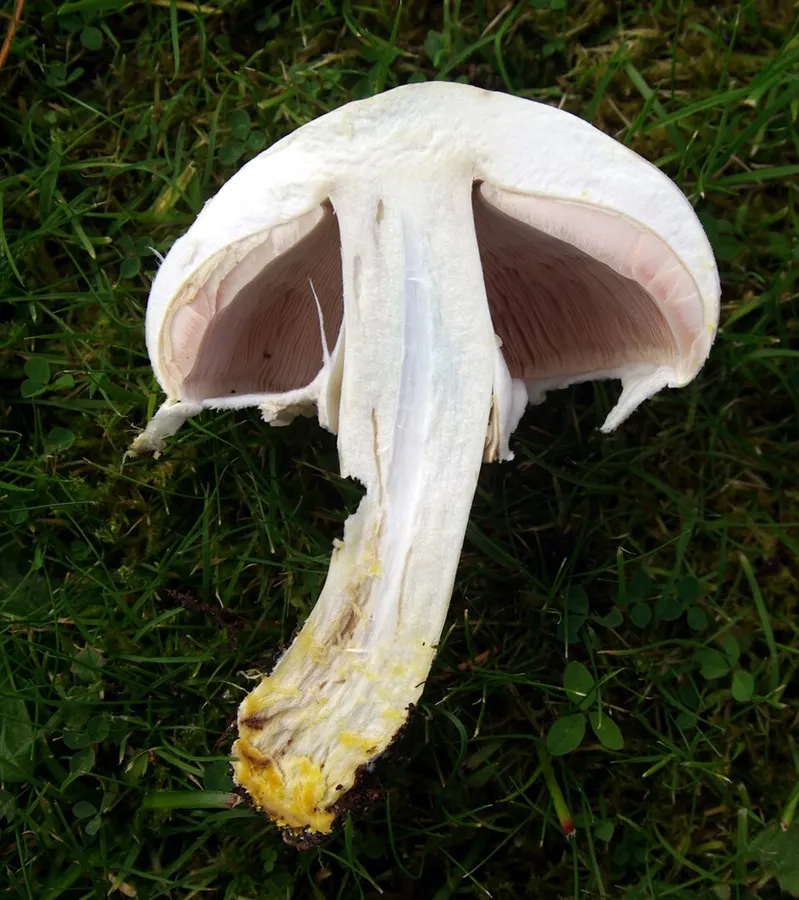
Dokumentasi Agaricus xanthodermus dari Wikimedia Commons. Yellow staining mushroom growing in Wales, November 2011 Identifikasi mengikuti record berkas sumber.
- Jenis
- Fotografi
- Kredit
- Velella
- Lisensi
- CC BY-SA 3.0
- Sumber media
- Buka entri sumber
Dokumentasi tambahan
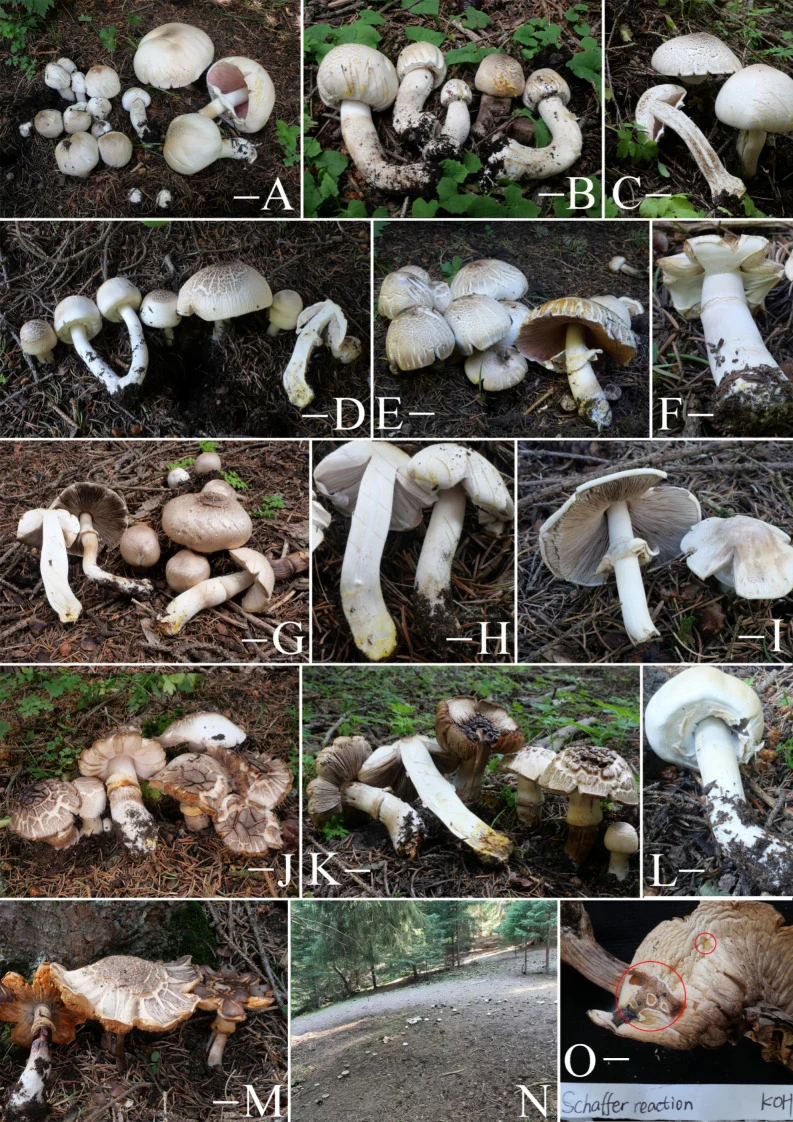
Agaricus xanthodermus in situ. (A – I): Morphological features under normal environmental conditions. (J – M): Morphological features under extreme environmental conditions. (N): Fairy ring formation. (O): Chemical reactions (left: Schäffer’s reaction; right: KOH reaction). (A – O): Photographs by Qi ZX. Scale bars: (A – M, O) = 10 mm.
Kredit dan penggunaan
© 2026 by the authors.
Ukuran dan format gambar disesuaikan tanpa pemotongan, retus, atau penambahan skala. Lisensi sumber dipertahankan.
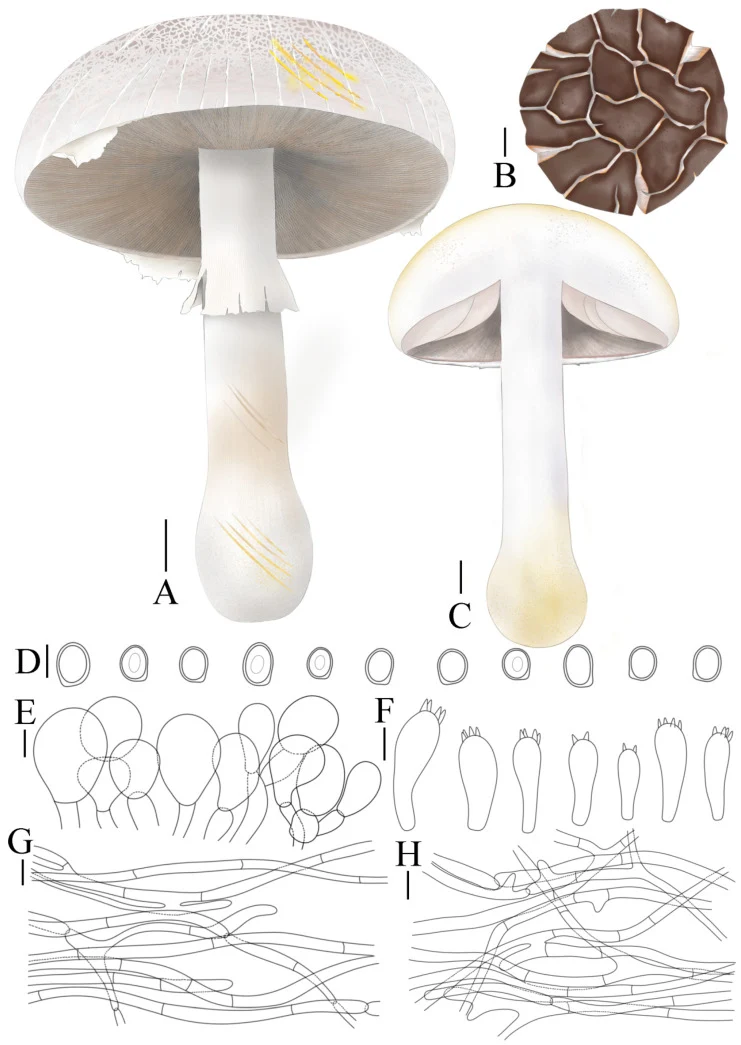
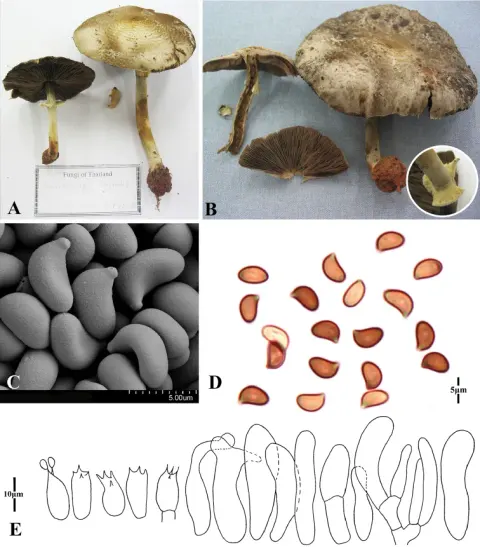
Macro- and micromorphology of Agaricus xanthodermus. (A): Basidiomata. (B): Close-up of pileus. (C): Longitudinal section. (D): Basidiospores. (E): Cheilocystidia. (F): Basidia. (G): Pileipellis hyphae. (H): Annulus hyphae. Scale bars: (A – C) = 10 mm, (D) = 5 μm, (E – H) = 10 μm.
Kredit dan penggunaan
© 2026 by the authors.
Ukuran dan format gambar disesuaikan tanpa pemotongan, retus, atau penambahan skala. Lisensi sumber dipertahankan.
Sumber profil
- [1] Integrative Taxonomy of Agaricus subgen. Pseudochitonia in Arid Northwestern China: Species Diversity and Habitat-Associated Morphological Differentiation — Agaricus xanthodermus
- [2] Catalogue of Life Base2026-09-11 — Agaricus xanthodermus
- [3] Dokumentasi visual — Agaricus xanthodermus
- [4] Dokumentasi visual — Agaricus xanthodermus
- [5] Dokumentasi visual — Agaricus xanthodermus
Rujukan halaman ini
Fungi. Agaricus xanthodermus. Rilis data fungi-2026-10-12-expansion-2. https://fungi-atlas.mgadib.chatgpt.site/jamur/agaricus-xanthodermus/.
Status: impor sumber; pemeriksaan editorial per profil belum selesai. Untuk klaim biologis, gunakan rujukan pada bagian terkait dan periksa konteks sumber aslinya.