Ciri dan struktur
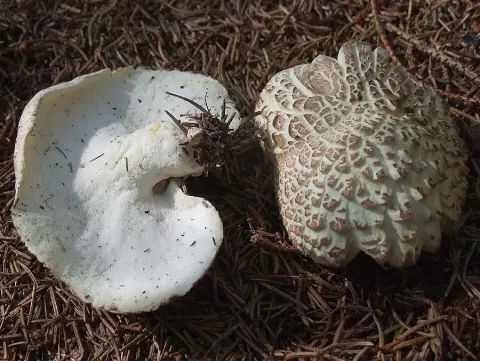
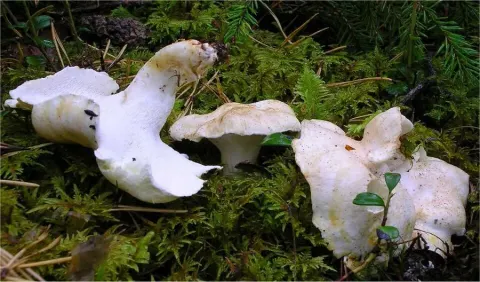
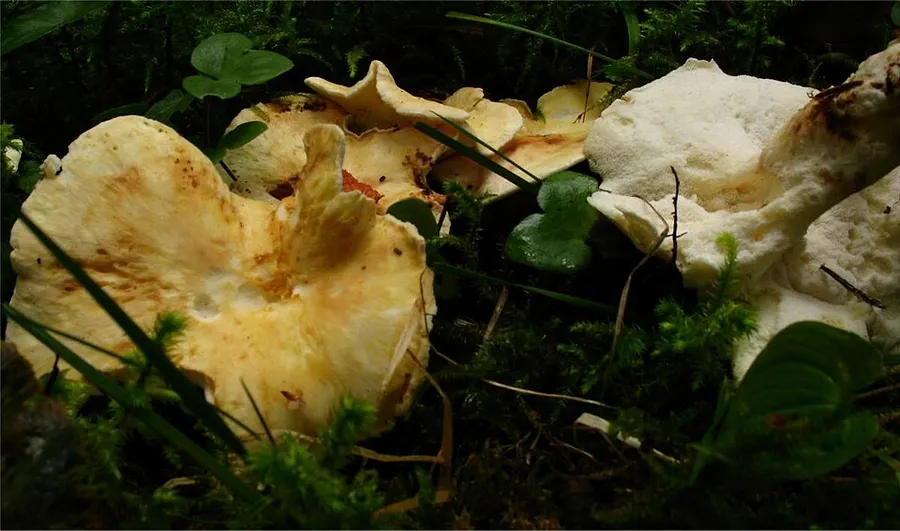
Albatrellus citrinus produces fleshy, annual fruiting bodies that are stool-like or bracket-like. The cap is initially pale cream but becomes light yellow to yellow-orange with age (often with a slight brown bruising). Caps range from 5–15 cm across, convex to flat, with a smooth to slightly cracked surface. Unlike A. subrubescens, it lacks dark reddish spots on the cap; instead it often shows uniform yellowing with age. The pore surface underneath is whitish to pale yellow, with small round pores (3–4 per mm). The stipe, if present, is short and off-centre. The flesh is white, turning yellowish on exposure. The taste is mild (distinguishing it from the bitter A. subrubescens). Microscopically it has generative hyphae with clamps and ellipsoid, hyaline spores about 4–5 by 3–4 μm.
Habitat dan peran ekologis
Albatrellus citrinus is an ectomycorrhizal fungus associated mainly with spruce (Picea abies) in calcareous soils. It has been found in montane coniferous forests and alvar (limestone) woodlands in northern Europe. The species was first identified in Sweden, where it occurs in lime-rich spruce forests (type locality in Dalarna, Sweden). A year later, the fungus was later reported from Tibet at an elevation of 3200 m, where it was growing under Picea. In 2018, it was recorded in the Czech Republic.
- Habitat atau konteks temuan
- hutan
- Substrat
- Informasi belum tersedia pada sumber rilis ini.
- Peran atau konteks
- Mitra tumbuhan
Reproduksi
Albatrellus citrinus produces fleshy, annual fruiting bodies that are stool-like or bracket-like. The cap is initially pale cream but becomes light yellow to yellow-orange with age (often with a slight brown bruising). Caps range from 5–15 cm across, convex to flat, with a smooth to slightly cracked surface. Unlike A. subrubescens, it lacks dark reddish spots on the cap; instead it often shows uniform yellowing with age. The pore surface underneath is whitish to pale yellow, with small round pores (3–4 per mm). The stipe, if present, is short and off-centre. The flesh is white, turning yellowish on exposure. The taste is mild (distinguishing it from the bitter A. subrubescens). Microscopically it has generative hyphae with clamps and ellipsoid, hyaline spores about 4–5 by 3–4 μm.
Catatan identitas dan cakupan
- Nama diterima mengikuti Catalogue of Life Base2026-09-11; uraian mempertahankan konsep dan nama sumber aslinya.
- Original geographic, specimen and life-cycle scope retained; source import awaits individual editorial review.
- Impor dan terjemahan otomatis belum diperiksa editorial per profil. Struktur reproduktif yang disebutkan tidak membuktikan seluruh siklus hidup diketahui.
- Pengukuran pada uraian mengikuti spesimen, kultur, dan metode sumber; angka tidak diperluas ke semua populasi.
Catatan distribusi dalam narasi mengikuti sumbernya. Dokumentasi spesimen atau foto mengikuti catatan sumber. Bukti wilayah Indonesia dan penilaian konservasi tidak disimpulkan dari gambar.
Melihat dengan konteks
Dokumentasi Albatrellus citrinus dari Wikimedia Commons. Fruit bodies of the fungus Albatrellus citrinus Ryman. Photographed in Gotland, Sweden. Identifikasi mengikuti record berkas sumber.
- Jenis
- Fotografi
- Kredit
- Irene Andersson (irenea)
- Lisensi
- CC BY-SA 3.0
- Sumber media
- Buka entri sumber
Sumber profil
- [1] Albatrellus citrinus — Wikipedia (en)
- [2] Catalogue of Life Base2026-09-11 — Albatrellus citrinus
- [3] Dokumentasi visual — Albatrellus citrinus
Rujukan halaman ini
Fungi. Albatrellus citrinus. Rilis data fungi-2026-10-12-expansion-2. https://fungi-atlas.mgadib.chatgpt.site/jamur/albatrellus-citrinus/.
Status: impor sumber; pemeriksaan editorial per profil belum selesai. Untuk klaim biologis, gunakan rujukan pada bagian terkait dan periksa konteks sumber aslinya.