Ciri dan struktur
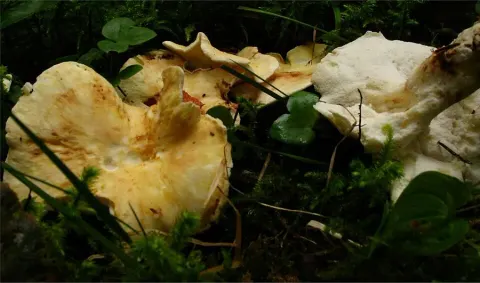
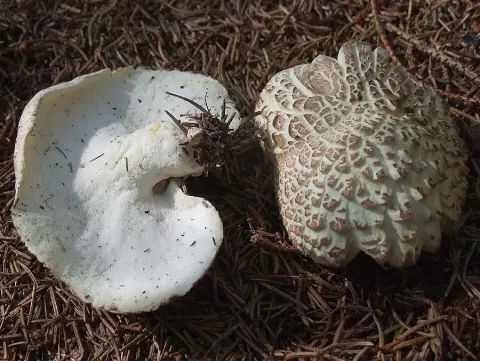
The cap of A. subrubescens is between 6 and 14.5 cm in diameter, with a central, eccentric (away from the center), or rarely lateral (attached to the edge of cap) stem. Initially, the cap is convex with an involute margin, flattening out with age. The cap margin may be folded or flat. The cap surface in young specimens is smooth but soon forms appressed scale-like spots, which may transform into scales in age. Initially, the cap has white margins and a brownish-violet center with scale-like spots; the center later becomes orange-brownish or ochraceous brown. According to Canadian mycologist James Ginns, who described North American Albatrellus species in 1997, some North American specimens may be covered with blackish-gray to purple-gray fibrils, In deposit, the spores are white. The spores are 3.4–4.7 by 2.2–3.4 μm, ellipsoid to ovoid in shape, and amyloid (absorbing iodine when stained with Melzer's reagent). Most have a single large oil drop. The spore-bearing cells (the basidia) are club-shaped, 12–16 μm long by 5.7–7.7 μm thick, and have four thin, slightly curved sterigmata that are 3.4–4.3 μm long. The hymenium lacks any cystidia. The hyphal system is monomitic, meaning that the context is made of thin-walled generative hyphae. These hyphae have lengths in the range of 3.5–30 μm (most commonly 6–17 μm), with thin walls (up to 1 μm thick), and are hyaline (translucent). Although they are inamyloid, some hyphae have internal masses that are colored pale bluish-gray to black, which makes them appear collectively grayish-black under the microscope. Gloeoporous hyphae (wide and thin-walled with refractive contents) are also scattered throughout the context, as well as some hyphae with expanded tips that are thick-walled and amyloid.
Habitat dan peran ekologis
Fruit bodies dari A. subrubescens biasanya bersendirian, tetapi kadang-kadang beberapa (biasanya antara dua dan delapan) terjebak bersama oleh dasar batang atau di sisi topi mereka. Spesies yang sangat darat, tidak ditemukan berbuah di atas kayu. Ia lebih memilih tumbuh di hutan pinus, tetapi terkadang dikaitkan dengan pinus perak di Eropa; tubuh buah yang terkait dengan spesies pohon terakhir cenderung kurang kuat daripada yang ditemukan tumbuh dengan pinus. Diperkirakan bahwa A. subrubescens mungkin mikoriza dengan pinus dua dan tiga jarum (yaitu, spesies yang memiliki jarum mereka terpasang dalam bundel dua atau tiga), meskipun preferensi ekologi tidak diketahui dengan pasti. Ginns, yang menceritakan komunikasi pribadi dengan David Arora, menulis bahwa Arora encountered beberapa kelompok tubuh buah di suatu daerah di California containing sebagian besar knobcone pine (piun tiga jarum), manzanita, huckleberry dan beberapa mandrone. Spesies ini telah dilaporkan dari berbagai lokasi di wilayah temperat Asia, Eropa, dan Amerika Utara. Di Amerika Utara, distribusi ini mencakup Alberta, Quebec, dan Kanada Barat Laut Territories in. Di Amerika Serikat, ia ditemukan di Alabama, Arizona, California, Florida, New York, Texas, Washington, dan Wisconsin.
- Habitat atau konteks temuan
- Informasi belum tersedia pada sumber rilis ini.
- Substrat
- Informasi belum tersedia pada sumber rilis ini.
- Peran atau konteks
- Belum dikategorikan pada rilis ini.
Reproduksi
In deposit, the spores are white. The spores are 3.4–4.7 by 2.2–3.4 μm, ellipsoid to ovoid in shape, and amyloid (absorbing iodine when stained with Melzer's reagent). Most have a single large oil drop. The spore-bearing cells (the basidia) are club-shaped, 12–16 μm long by 5.7–7.7 μm thick, and have four thin, slightly curved sterigmata that are 3.4–4.3 μm long. The hymenium lacks any cystidia. The hyphal system is monomitic, meaning that the context is made of thin-walled generative hyphae. These hyphae have lengths in the range of 3.5–30 μm (most commonly 6–17 μm), with thin walls (up to 1 μm thick), and are hyaline (translucent). Although they are inamyloid, some hyphae have internal masses that are colored pale bluish-gray to black, which makes them appear collectively grayish-black under the microscope.
Catatan identitas dan cakupan
- Nama diterima mengikuti Catalogue of Life Base2026-09-11; uraian mempertahankan konsep dan nama sumber aslinya.
- Original geographic, specimen and life-cycle scope retained; source import awaits individual editorial review.
- Impor dan terjemahan otomatis belum diperiksa editorial per profil. Struktur reproduktif yang disebutkan tidak membuktikan seluruh siklus hidup diketahui.
- Pengukuran pada uraian mengikuti spesimen, kultur, dan metode sumber; angka tidak diperluas ke semua populasi.
Catatan distribusi dalam narasi mengikuti sumbernya. Dokumentasi spesimen atau foto mengikuti catatan sumber. Bukti wilayah Indonesia dan penilaian konservasi tidak disimpulkan dari gambar.
Melihat dengan konteks
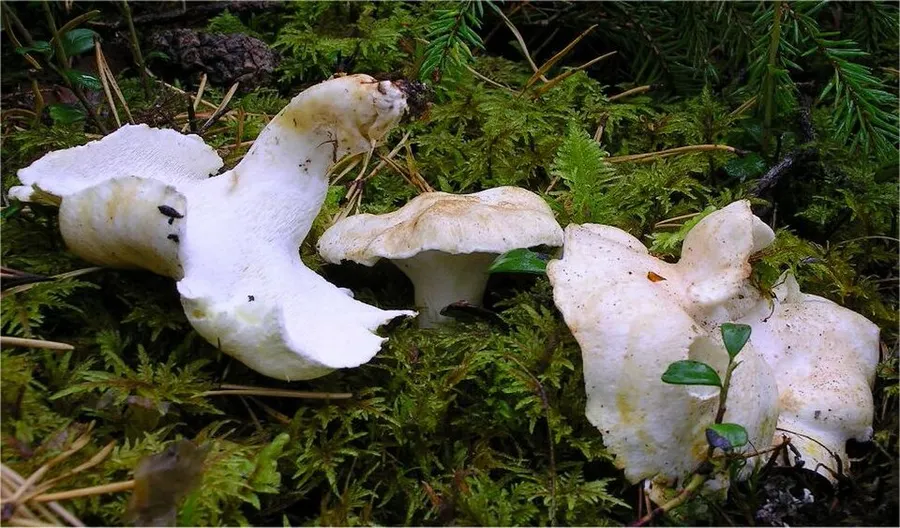
Dokumentasi Albatrellus subrubescens dari Wikimedia Commons. Albatrellus subrubescens (Murrill) Pouzar photographed in Dalarna, Sweden. Identifikasi mengikuti record berkas sumber.
- Jenis
- Fotografi
- Kredit
- Irene Andersson (irenea)
- Lisensi
- CC BY-SA 3.0
- Sumber media
- Buka entri sumber
Sumber profil
- [1] Albatrellus subrubescens — Wikipedia (en)
- [2] Catalogue of Life Base2026-09-11 — Albatrellus subrubescens
- [3] Dokumentasi visual — Albatrellus subrubescens
Rujukan halaman ini
Fungi. Albatrellus subrubescens. Rilis data fungi-2026-10-12-expansion-2. https://fungi-atlas.mgadib.chatgpt.site/jamur/albatrellus-subrubescens/.
Status: impor sumber; pemeriksaan editorial per profil belum selesai. Untuk klaim biologis, gunakan rujukan pada bagian terkait dan periksa konteks sumber aslinya.