Ciri dan struktur
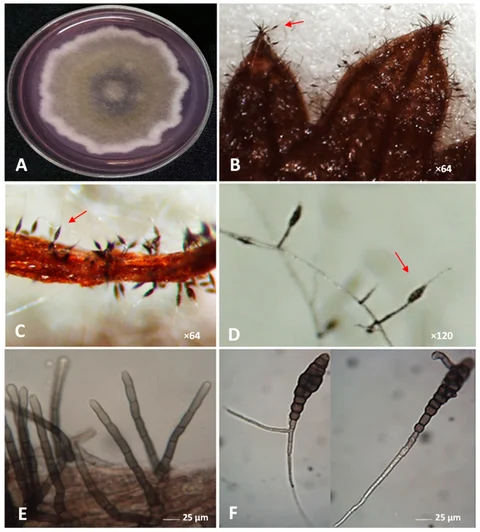
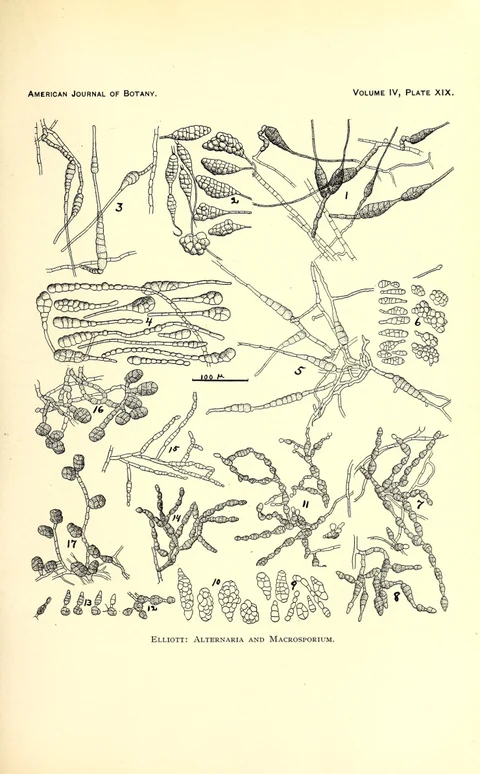
The teleomorph of U. chartarum is unknown. The colonies can range from velvety to floccose with coloration ranging from olivaceous brown to black. They grow rapidly. Conidia can range from obovoid to short ellipsoidal, with colors of golden brown to blackish brown, roughened with 1–5 oblique or longitudinal septa and 1–5 lateral septa. It can be born singly or in short chains from sympodial conidiophores. The colonies grow rapidly, and range from powdery to lanose and black or olivaceous black. Conidiophores are erect, straight or flexuose; often somewhat geniculate, but mostly unbranched. They can be up to 50 x 4–5 um, golden brown, smooth-walled, conidial scars brown. The conidia commonly form in chains of 2–10, with ellipsoidal or obovoidal shapes and often with short peaks. Its colors can range from medium brown to olivaceous, or black and verrucose. It is 18–38 x 11–20 um, with 1–5 (commonly 3) transfers and several oblique or longitudinal septa. Secondary conidiophores are often present on conidia. Conidiophores septate can be simple or branched, straight, flexuous. They often geniculate with 1–8 pores up to 40–50 x 5–7 um that are golden brown and smooth-walled. Conidia are solitary or in chains of 2–10, obovoid to short ellipsoidal, 18–38 x 11–20 um, with 1–5 (commonly 3) transfers and 1–5 longitudinal or oblique septa, medium brown to olivaceous, smooth walled or verrucose, base conical at first (becoming round with age), apex broadly rounded before "false beak" production. Each "false beak" is in form and function a conidiophore forming secondary conidia and is therefore distinct from the gradually tapering true beaks of Alternaria.
Habitat dan peran ekologis
U. chartarum has been reported in Canada, Europe (Great Britain), India, Iraq, Israel, Kuwait, Pakistan, Saudi Arabia and South Africa. It has been isolated from soil, dung, emulsion paint, grasses, fibers, wood, paper, and fibres. A necrosis of leaves of Quercus pubescens caused by the fungus U. chartarum has been reported. This fungus causes leaf spots under natural conditions and also following artificial inoculation of unwounded attached leaves.
- Habitat atau konteks temuan
- Informasi belum tersedia pada sumber rilis ini.
- Substrat
- Informasi belum tersedia pada sumber rilis ini.
- Peran atau konteks
- Belum dikategorikan pada rilis ini.
Reproduksi
Conidia can range from obovoid to short ellipsoidal, with colors of golden brown to blackish brown, roughened with 1–5 oblique or longitudinal septa and 1–5 lateral septa. It can be born singly or in short chains from sympodial conidiophores. The colonies grow rapidly, and range from powdery to lanose and black or olivaceous black. Conidiophores are erect, straight or flexuose; often somewhat geniculate, but mostly unbranched. They can be up to 50 x 4–5 um, golden brown, smooth-walled, conidial scars brown. The conidia commonly form in chains of 2–10, with ellipsoidal or obovoidal shapes and often with short peaks. Its colors can range from medium brown to olivaceous, or black and verrucose.
Catatan identitas dan cakupan
- Nama diterima mengikuti Catalogue of Life Base2026-09-11; uraian mempertahankan konsep dan nama sumber aslinya.
- Original geographic, specimen and life-cycle scope retained; source import awaits individual editorial review.
- Impor dan terjemahan otomatis belum diperiksa editorial per profil. Struktur reproduktif yang disebutkan tidak membuktikan seluruh siklus hidup diketahui.
- Pengukuran pada uraian mengikuti spesimen, kultur, dan metode sumber; angka tidak diperluas ke semua populasi.
Catatan distribusi dalam narasi mengikuti sumbernya. Dokumentasi spesimen atau foto mengikuti catatan sumber. Bukti wilayah Indonesia dan penilaian konservasi tidak disimpulkan dari gambar.
Melihat dengan konteks
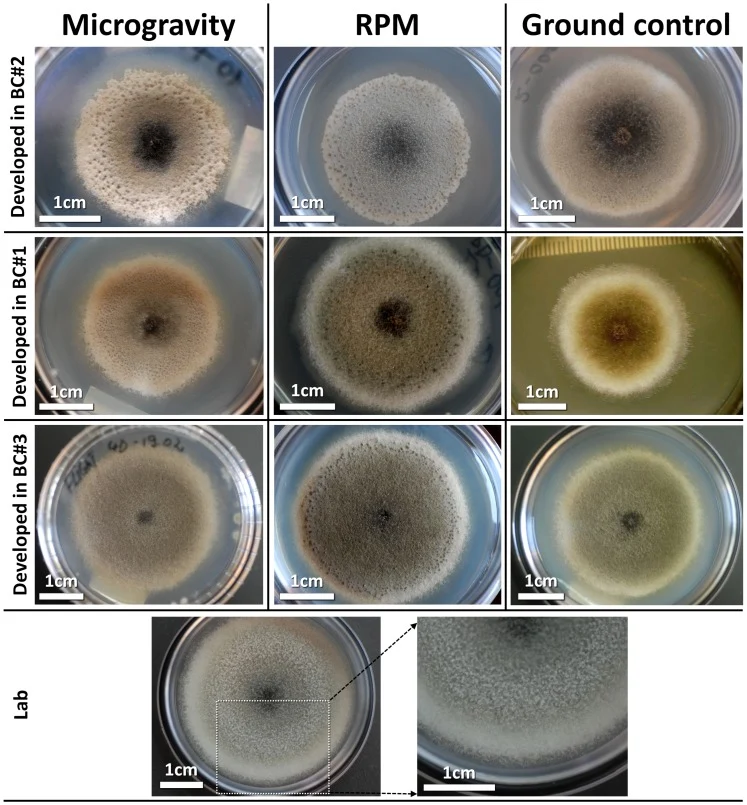
Koloni Alternaria chartarum dalam kondisi penelitian yang berbeda. Sumber memakai nama Ulocladium chartarum; identifikasi dan keterangan mengikuti Gambar 3 pada sumber.
- Jenis
- Pelat ilmiah
- Kredit
- Ioana Gomoiu; Elias Chatzitheodoridis; Sonia Vadrucci; Isabelle Walther
- Lisensi
- CC BY 4.0
- Sumber media
- Buka entri sumber
Sumber profil
- [1] Ulocladium chartarum — Wikipedia (en)
- [2] Catalogue of Life Base2026-09-11 — Alternaria chartarum
- [3] Dokumentasi visual — Alternaria chartarum
Rujukan halaman ini
Fungi. Alternaria chartarum. Rilis data fungi-2026-10-12-expansion-2. https://fungi-atlas.mgadib.chatgpt.site/jamur/alternaria-chartarum/.
Status: impor sumber; pemeriksaan editorial per profil belum selesai. Untuk klaim biologis, gunakan rujukan pada bagian terkait dan periksa konteks sumber aslinya.