Ciri dan struktur
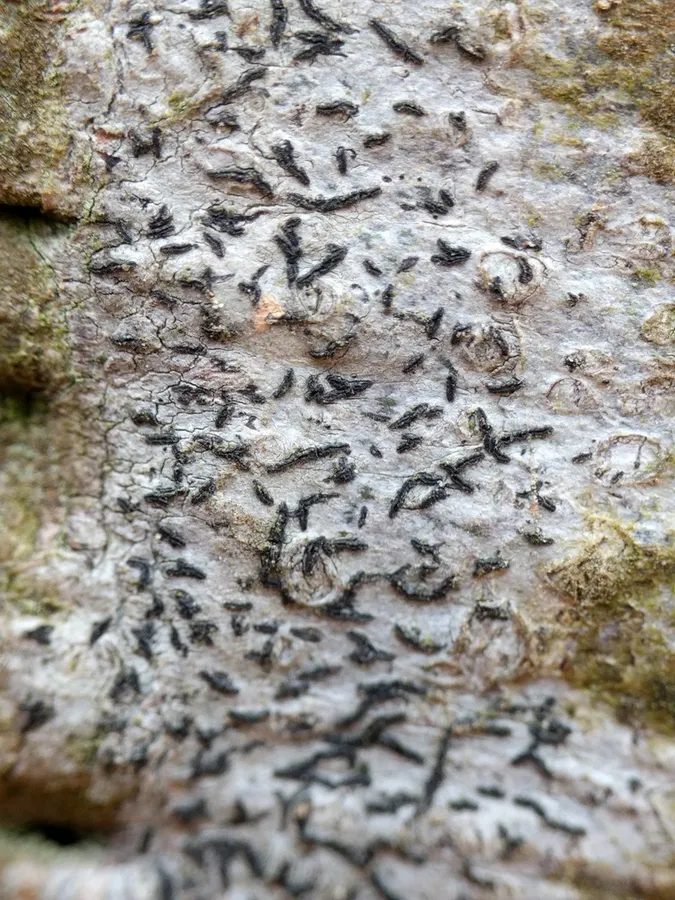
The thallus of Alyxoria culmigena is very thin and may be barely visible, forming a smooth film that can be ash-grey, brown, or a dull olive-green; in some specimens it is largely immersed in the substrate and only weakly delimited. The fruiting bodies are the narrow, script-like apothecia () typical of the genus, appearing as scattered, dark lines about 0.5–1 (occasionally to 1.6) mm long and 0.15–0.3 mm wide, and standing only 0.04–0.10 mm high. They are usually simple but can occasionally fork, and lie directly on the thallus without a stalk. When young, the is visible only as a narrow slit, but it soon opens out to expose the interior and may sometimes carry a faint greenish dusting (). In section, the margin () is red-brown and does not react with potassium hydroxide (K–), while the uppermost layer () is brown and turns red-brown or remains brownish in this test; the hymenium beneath is 70–90 μm tall and stains red with iodine (I+). Ascospores are hyaline and three-septate, measuring (16–)18–24(–26) μm in length and (4–)5–7(–8) μm in width. They are somewhat club-shaped (), with one of the internal cells often slightly swollen, and have rounded ends. Each spore is surrounded by a thin but clearly visible outer layer () 0.5–1 μm thick, which is colourless when fresh but can become red-brown in over-mature material. Asexual structures are very rarely seen: pycnidia, when present, produce straight, rod-like conidia that are 3–6 × 0.5–1 μm. Standard spot tests on the thallus are all negative (C−, K−, KC−, Pd−, and UV−), and thin-layer chromatography has not revealed any lichen substances, indicating that the species lacks detectable secondary metabolites.
Habitat dan peran ekologis
Alyxoria culmigena is a crustose epiphyte that usually grows on smooth, often shaded bark of shrubs and trees, for example in hedgerows and other sheltered stands near the coast. It is most frequently recorded from acidic to basic, smooth bark in shady situations, but also occurs on plant litter, soil, ground-dwelling mosses, plant stems such as brambles, and occasionally on wood or sandstone. Regional lichen floras describe it as a lowland species of mild, humid climates, growing below the montane belt in areas with relatively warm winters, particularly in coastal and sub-Mediterranean districts. In Europe, the species has been documented from several western and southern countries, including Italy, France, Britain and Ireland. Italian records place it mainly in Tyrrhenian regions with mild winters, below the montane belt, while atlases and online accounts report it on smooth bark in coastal areas of France and on trees in the British Isles and Ireland. Beyond Europe, Alyxoria culmigena has been recorded from oceanic islands in warm climates, including the Andaman and Nicobar Islands of India, where it was described as a new national record, and the Caribbean island of Sint Eustatius and other Dutch Caribbean localities.
- Habitat atau konteks temuan
- Informasi belum tersedia pada sumber rilis ini.
- Substrat
- kayu
- Peran atau konteks
- Pembentuk liken
Reproduksi
Ascospores are hyaline and three-septate, measuring (16–)18–24(–26) μm in length and (4–)5–7(–8) μm in width. They are somewhat club-shaped (), with one of the internal cells often slightly swollen, and have rounded ends. Each spore is surrounded by a thin but clearly visible outer layer () 0.5–1 μm thick, which is colourless when fresh but can become red-brown in over-mature material. Asexual structures are very rarely seen: pycnidia, when present, produce straight, rod-like conidia that are 3–6 × 0.5–1 μm. Standard spot tests on the thallus are all negative (C−, K−, KC−, Pd−, and UV−), and thin-layer chromatography has not revealed any lichen substances, indicating that the species lacks detectable secondary metabolites.
Catatan identitas dan cakupan
- Nama diterima mengikuti Catalogue of Life Base2026-09-11; uraian mempertahankan konsep dan nama sumber aslinya.
- Original geographic, specimen and life-cycle scope retained; source import awaits individual editorial review.
- Impor dan terjemahan otomatis belum diperiksa editorial per profil. Struktur reproduktif yang disebutkan tidak membuktikan seluruh siklus hidup diketahui.
- Pengukuran pada uraian mengikuti spesimen, kultur, dan metode sumber; angka tidak diperluas ke semua populasi.
Catatan distribusi dalam narasi mengikuti sumbernya. Dokumentasi spesimen atau foto mengikuti catatan sumber. Bukti wilayah Indonesia dan penilaian konservasi tidak disimpulkan dari gambar.
Melihat dengan konteks
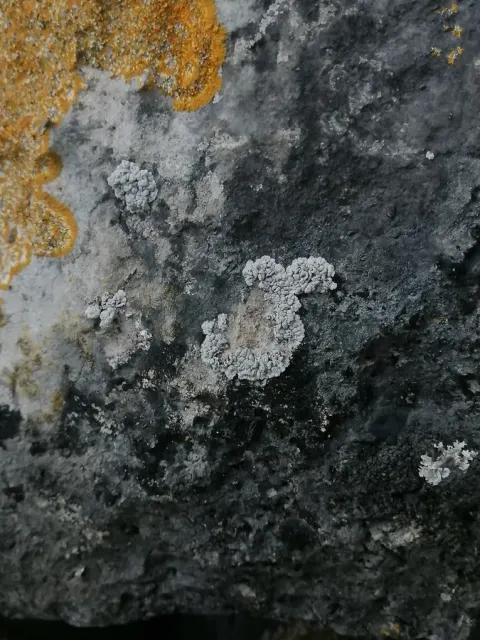
Dokumentasi Alyxoria culmigena menurut asosiasi foto pada record takson iNaturalist. Kredit: Michel Langeveld. Identitas mengikuti sumber; bukan penentuan spesimen independen.
- Jenis
- Fotografi
- Kredit
- (c) Michel Langeveld, some rights reserved (CC BY), uploaded by Michel Langeveld
- Lisensi
- CC BY 4.0
- Sumber media
- Buka entri sumber
Sumber profil
- [1] Alyxoria culmigena — Wikipedia (en)
- [2] Catalogue of Life Base2026-09-11 — Alyxoria culmigena
- [3] Dokumentasi visual — Alyxoria culmigena
Rujukan halaman ini
Fungi. Alyxoria culmigena. Rilis data fungi-2026-10-12-expansion-2. https://fungi-atlas.mgadib.chatgpt.site/jamur/alyxoria-culmigena/.
Status: impor sumber; pemeriksaan editorial per profil belum selesai. Untuk klaim biologis, gunakan rujukan pada bagian terkait dan periksa konteks sumber aslinya.