Ciri dan struktur
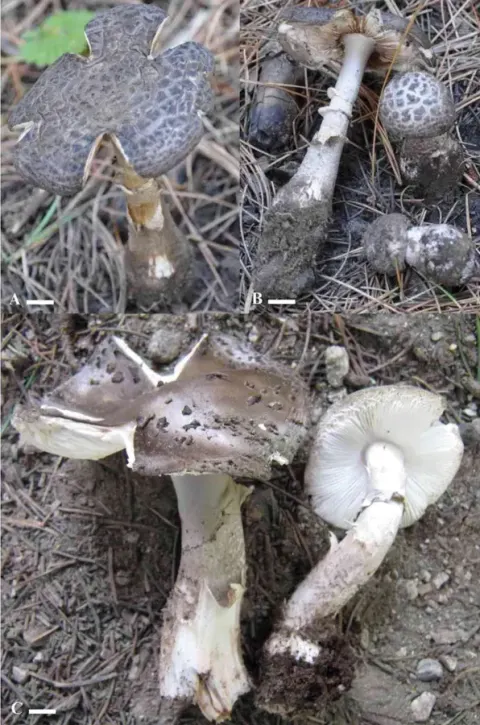
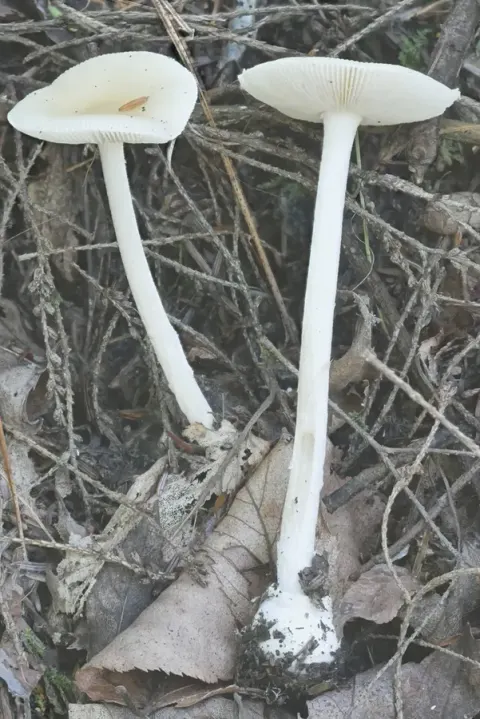
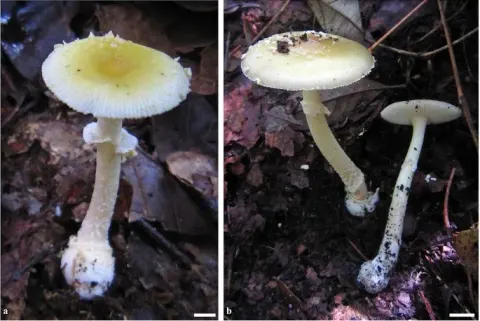
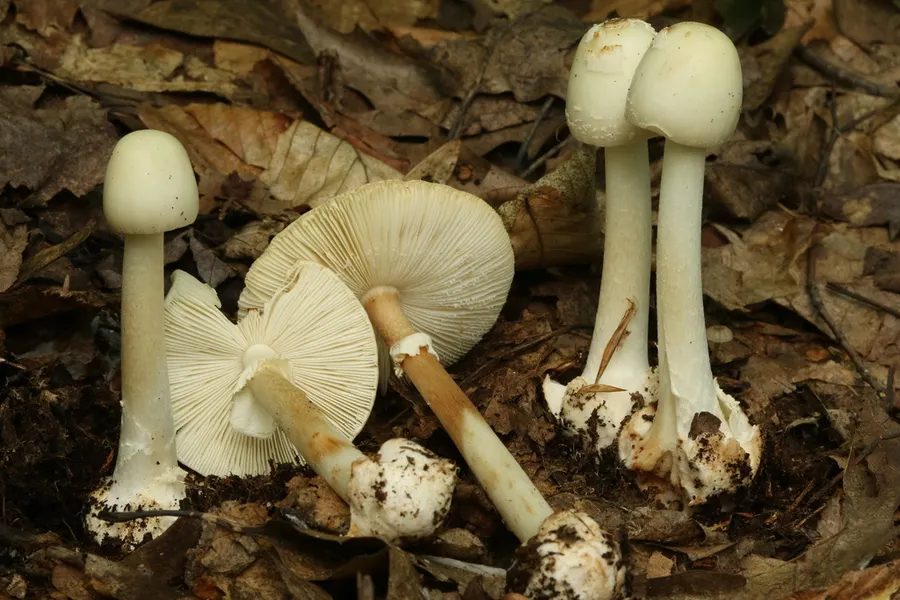
The cap of the fruit body is 5 to 8.5 cm in diameter, and depending on its age, may range from egg-shaped to convex to somewhat flattened. Older specimens may have edges that are curved upwards. The color is white or pale tan in the center of the cap; older specimens may have areas of discolored tissue colored brownish-red shades. Sometimes, the edge of the cap has radial grooves—up to 4 mm long—that mirror the position of the underlying gills. When moist, the cap is sticky to the touch; when dry, it is shiny, usually without any remnants of the thin volva. The white gills are crowded close together, and are free from attachment to the stem. They are subventricose: slightly swollen in the middle, and tapering near the ends. The stem is 8.5 to 16 cm long by 0.9 to 1.6 cm thick, and slightly thicker at the base than at the top. It is stuffed with whitish hyphae that resemble cotton. The surface of the stem is smooth or has delicate tufts of soft, white, woolly hairs. There is a rimmed bulb at the base of the stem, which can reach a diameter of over 3 cm. The ring—located on the upper portion of the stem, 1.2 - 1.7 cm from the top—is white, membranous, and long-lasting. The volva remains closely attached to the bulb, although a portion may stretch out like a thin membrane and adhere to the base of the stem before collapsing. The flesh will slowly turn pinkish-brown to chocolate-brown when it has been injured or bruised. Young specimens do not have any distinct odor, but fruit bodies may smell slightly of onions or garlic in age. Viewed in deposit, like with a spore print, the basidiospores of A. aestivalis are white.
Habitat dan peran ekologis
Fruit bodies biasanya muncul dari akhir musim gugur June until. Di Amerika Utara, telah ditemukan di negara bagian New England, serta Alabama, New York, dan Virginia. Distribusi ini membentang di utara ke provinsi-provinsi tenggara Canada and selatan ke Florida. Fruit bodies of the fungus grow on the ground in deciduous, coniferous, and mixed forests. Ada yang lebih suka kayu ek yang mengandung Tsuga or Pinus species, serta kayu bayak dengan Picea, Abies, dan Betula. A. aestivalis adalah spesies mikoriza, yang berarti membentuk hubungan yang saling menguntungkan di mana vegetatif hifa jamur tumbuh di sekitar dan mengetuk akar pohon dan semak kecil. Dengan cara ini, tanaman lebih mampu menyerap fosfor dan nutrisi tanah lainnya, sementara jamur menerima kelembaban, perlindungan, dan produk sampingan gizi dari metabolisme tanaman.
- Habitat atau konteks temuan
- hutan
- Substrat
- tanah
- Peran atau konteks
- Mitra tumbuhan
Reproduksi
Viewed in deposit, like with a spore print, the basidiospores of A. aestivalis are white. Examination with a microscope reveals further details: they are roughly spherical, hyaline (translucent) and thin-walled, with dimensions of 7.8–8.8 μm. The spores are amyloid, meaning that they will absorb iodine when stained with Melzer's reagent and appear blue to blackish-blue. The spore-bearing cells, the basidia, are four-spored, thin-walled, and measure 32–60 long by 4–13 μm thick. There are no clamps present at the bases of the basidia.
Catatan identitas dan cakupan
- Nama diterima mengikuti Catalogue of Life Base2026-09-11; uraian mempertahankan konsep dan nama sumber aslinya.
- Original geographic, specimen and life-cycle scope retained; source import awaits individual editorial review.
- Impor dan terjemahan otomatis belum diperiksa editorial per profil. Struktur reproduktif yang disebutkan tidak membuktikan seluruh siklus hidup diketahui.
- Pengukuran pada uraian mengikuti spesimen, kultur, dan metode sumber; angka tidak diperluas ke semua populasi.
Catatan distribusi dalam narasi mengikuti sumbernya. Dokumentasi spesimen atau foto mengikuti catatan sumber. Bukti wilayah Indonesia dan penilaian konservasi tidak disimpulkan dari gambar.
Melihat dengan konteks
Dokumentasi Amanita aestivalis menurut asosiasi foto pada record takson iNaturalist. Kredit: Garrett Taylor. Identitas mengikuti sumber; bukan penentuan spesimen independen.
- Jenis
- Fotografi
- Kredit
- no rights reserved, uploaded by Garrett Taylor
- Lisensi
- CC0 1.0
- Sumber media
- Buka entri sumber
Sumber profil
- [1] Amanita aestivalis — Wikipedia (en)
- [2] Catalogue of Life Base2026-09-11 — Amanita aestivalis
- [3] Dokumentasi visual — Amanita aestivalis
Rujukan halaman ini
Fungi. Amanita aestivalis. Rilis data fungi-2026-10-12-expansion-2. https://fungi-atlas.mgadib.chatgpt.site/jamur/amanita-aestivalis/.
Status: impor sumber; pemeriksaan editorial per profil belum selesai. Untuk klaim biologis, gunakan rujukan pada bagian terkait dan periksa konteks sumber aslinya.