Ciri dan struktur
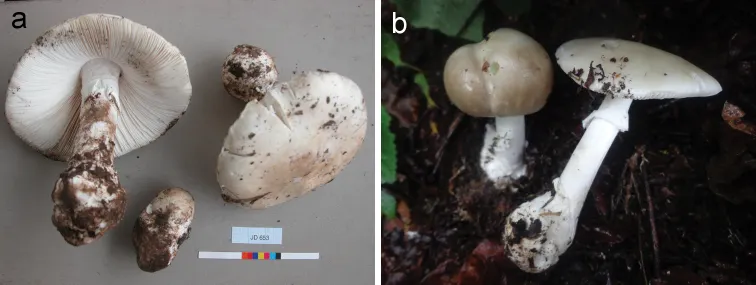
Amanita bweyeyensis differs from the closest Amanita species by: pileus first pale brownish-grey then entirely whitish or with a faintly yellowish or pale beige shade, basal bulb of the stipe globose, neither pointed nor rooting, basidiospores subglobose to widely ellipsoid (Q = 1.10–1.17–1.28), absence of α- and β-amanitin, phalloidin and phallacidin in its basidiomata, connection with the genus Eucalyptus and distribution in Burundi, Rwanda and Tanzania. Primordium subglobose, smooth, whitish or with a weak olive tint. Pileus 40–73–120 mm diam., first hemispherical then expanding to regularly convex or applanate, without umbo; margin even, not striate nor appendiculate, in some mature specimens the pileipellis does not reach the edge of the pileus, leaving free the extreme tip of the lamellae; first pale brownish-grey (close to 6B2 or 6C2–3), then often entirely whitish or with a faintly yellowish or pale beige shade (between 4A2 and 5B2); somewhat viscid, smooth, devoid of veil remnants. Lamellae free, white, becoming slightly yellowish when old and ochraceous, pinkish-beige to pale pinkish-brown on the exsiccates with a narrow white and fluffy edge; mixed with an equal number of lamellulae which are very variable in length and are usually truncated; sub-distant, 8–9 lamellae and lamellulae per cm at 1 cm from the edge of the pileus, about 120–160 lamellae and lamellulae in total (counts on 5 basidiomata), 3–14 mm broad, serrate when seen with a magnifying glass. Stipe 65–95–152 × 7–25 mm, ratio length of the stipe/diam. of pileus = 1.04–1.25–1.38; sub-cylindrical, slightly wider just under lamellae, gradually and slightly widened from top to bottom, white, with finely fibrillose surface, hollow (at least on exsiccates).
Habitat dan peran ekologis
At present, the species is only known from Burundi, Rwanda and Tanzania but, according to its ecology, it could probably be observed in all Eucalyptus plantations in tropical Africa and possibly in South Africa as well. Consequently, if the species is collected for consumption, care should be taken to avoid confusion with A. marmorata, a species growing in the same biotopes and suspected to be highly toxic. On the ground, under Eucalyptus. The label of Saarimäki 591 indicates “in Acacia and Eucalyptus forest” whereas the legend of the associated picture (Härkönen et al. 2003: 62) indicates “growing in an Acacia mearnsii plantation”. However, the litter visible on that picture does not correspond to the latter species but looks like Eucalyptus leaves.
- Habitat atau konteks temuan
- hutan
- Substrat
- tanah
- Peran atau konteks
- Belum dikategorikan pada rilis ini.
Reproduksi
Amanita bweyeyensis differs from the closest Amanita species by: pileus first pale brownish-grey then entirely whitish or with a faintly yellowish or pale beige shade, basal bulb of the stipe globose, neither pointed nor rooting, basidiospores subglobose to widely ellipsoid (Q = 1.10–1.17–1.28), absence of α- and β-amanitin, phalloidin and phallacidin in its basidiomata, connection with the genus Eucalyptus and distribution in Burundi, Rwanda and Tanzania. Primordium subglobose, smooth, whitish or with a weak olive tint. Pileus 40–73–120 mm diam., first hemispherical then expanding to regularly convex or applanate, without umbo; margin even, not striate nor appendiculate, in some mature specimens the pileipellis does not reach the edge of the pileus, leaving free the extreme tip of the lamellae; first pale brownish-grey (close to 6B2 or 6C2–3), then often entirely whitish or with a faintly yellowish or pale beige shade (between 4A2 and 5B2); somewhat viscid, smooth, devoid of veil remnants.
Catatan identitas dan cakupan
- Nama diterima mengikuti Catalogue of Life Base2026-09-11; uraian mempertahankan konsep dan nama sumber aslinya.
- Preserve original treatment localities, hosts and substrate scope. Materials examined describe documented specimens, not the full global range.
- Impor dan terjemahan otomatis belum diperiksa editorial per profil. Struktur reproduktif yang disebutkan tidak membuktikan seluruh siklus hidup diketahui.
- Pengukuran pada uraian mengikuti spesimen, kultur, dan metode sumber; angka tidak diperluas ke semua populasi.
Catatan distribusi dalam narasi mengikuti sumbernya. Dokumentasi spesimen atau foto mengikuti catatan sumber. Bukti wilayah Indonesia dan penilaian konservasi tidak disimpulkan dari gambar.
Melihat dengan konteks
Basidiomata of Amanita bweyeyensis. a Degreef 653 b Degreef 1257.
- Jenis
- Pelat ilmiah
- Kredit
- André Fraiture, Mario Amalfi, Olivier Raspé, Ertugrul Kaya, Ilgaz Akata, Jérôme Degreef
- Lisensi
- CC BY 4.0
- Sumber media
- Buka entri sumber
Dokumentasi tambahan
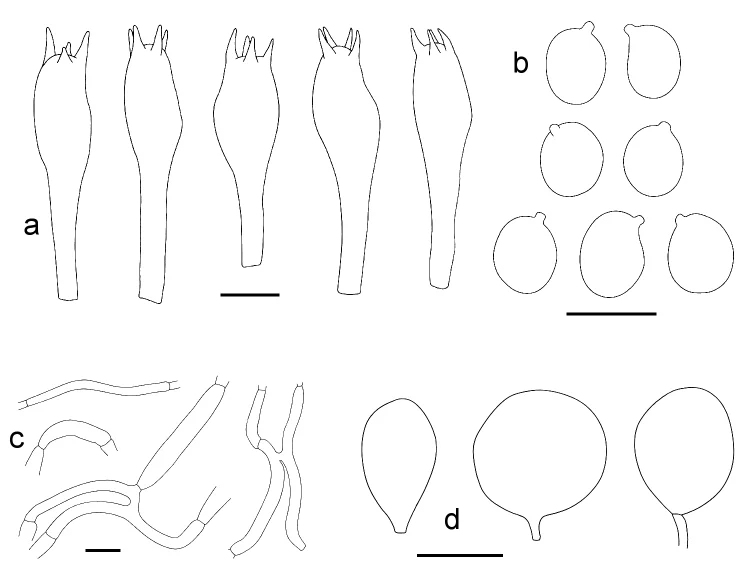
Amanita bweyeyensis a Basidia (from Degreef 1257, scale bar: 10 µm) b Spores (from Saarimäki et al. 591, scale bar: 10 µm) c Filamentous hyphae from the volva (from Degreef 1304, holotypus, scale bar: 20 µm) d Sphaerocysts from the volva (from Degreef 1304, holotypus, scale bar: 50 µm).
Kredit dan penggunaan
André Fraiture, Mario Amalfi, Olivier Raspé, Ertugrul Kaya, Ilgaz Akata, Jérôme Degreef
Ukuran dan format gambar disesuaikan tanpa pemotongan, retus, atau penambahan skala. Lisensi sumber dipertahankan.
Sumber profil
- [1] Two new species of Amanita sect. Phalloideae from Africa, one of which is devoid of amatoxins and phallotoxins — Amanita bweyeyensis
- [2] Catalogue of Life Base2026-09-11 — Amanita bweyeyensis
- [3] Dokumentasi visual — Amanita bweyeyensis
- [4] Dokumentasi visual — Amanita bweyeyensis
Rujukan halaman ini
Fungi. Amanita bweyeyensis. Rilis data fungi-2026-10-12-expansion-2. https://fungi-atlas.mgadib.chatgpt.site/jamur/amanita-bweyeyensis/.
Status: impor sumber; pemeriksaan editorial per profil belum selesai. Untuk klaim biologis, gunakan rujukan pada bagian terkait dan periksa konteks sumber aslinya.