01 / Morfologi

Ciri dan struktur

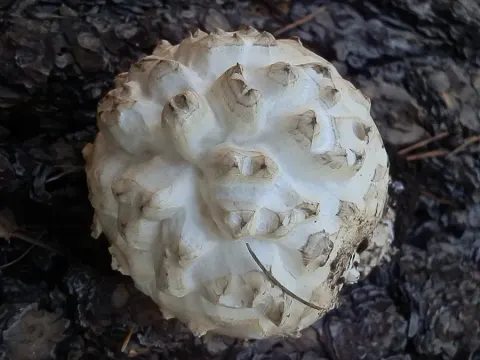
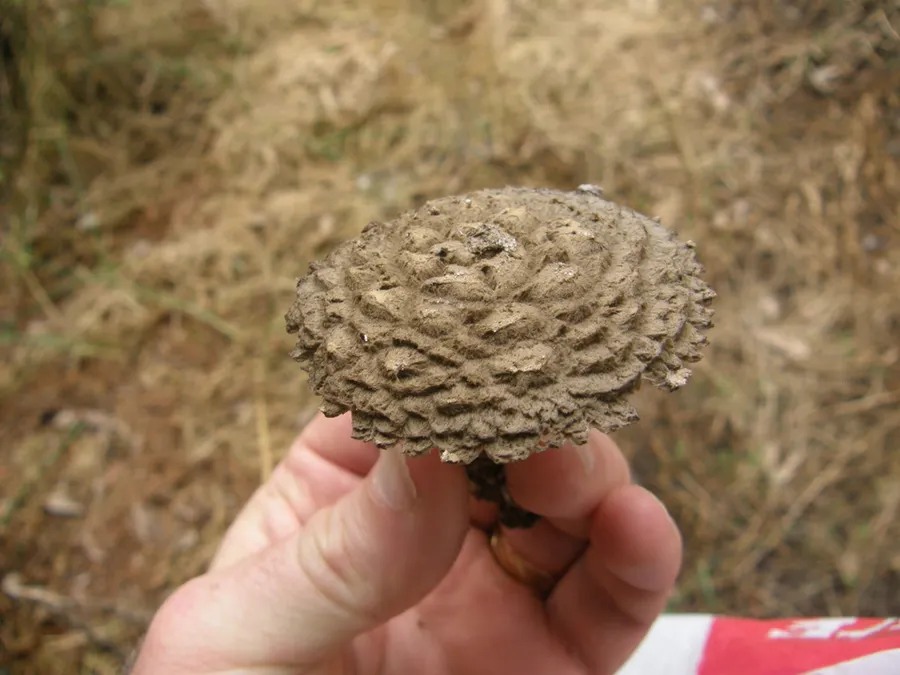
The pileus are 2-8 cm in diameter, convex or applanate, finally shallowly concave with a downward curved margin, entirely covered by a thick cottony pale grey-brown felt which disrupts into very prominent darker pyramidal warts to 0-5 cm high. The stipe is 4-7 cm tall, 0.5-2 cm wide, cylindric to slightly enlarged below before tapering to a rooting base, apex seemingly sheathed by a closely adpressed, pale grey annulus which becomes darker downward to the narrow, black, free margin. With age the portion above this black band disrupts into pale grey zig-zag bands of scales on a pale pinkish salmon-coloured background. Below the black annulus the stem of young fruitbodies is at first densely spotted with very dark grey to almost black floccose scales, which soon disappear leaving the lower part of the stem densely flecked with delicate, dark blackish brown, hair-like fibrils with recurved tips on a dirty salmon to bright tawny background, finally passing into blackish grey-brown on the rooting base. Volva not visible. The lamellae are 1 cm broad, rounded at the margin, salmon coloured. Flesh white in pileus with a slight to prominent pale grey region beneath cuticle; white in upper part of stipe passing into cream or pale salmon below. The spores very variable in shape and size, typically broadly elliptic to ovate, thin walled, hyaline, strongly amyloid, 8–9 x 6–1 pm (in fruitbodies with 4-spored basidia) on some specimens varying from subglobose to ovate, broadly elliptic, elliptic or pip-shaped, and when there is a mixture of 2- and 4-spored basidia on the same gill the range is 8–12 x 6–8^m.

Sebagian uraian ditampilkan dalam bahasa sumber; terjemahannya belum tersedia atau belum lolos pemeriksaan.

Rujukan: [1]

Pengukuran mengikuti objek, spesimen atau kultur, dan metode yang disebutkan sumber. Baca uraian asli untuk konteks lengkap.

02 / Kehidupan

Habitat dan peran ekologis

S. inopinata was first found in Europe in 1916, and 1986 in Britain. However this is thought to be introduced because of the human intervention in the sites as well as many avid mushroom hunters whom would have found the mushroom if it had been present previously. It is now known to be saprotrophic.

Sebagian uraian ditampilkan dalam bahasa sumber; terjemahannya belum tersedia atau belum lolos pemeriksaan.

Rujukan: [1]

Habitat atau konteks temuan
Informasi belum tersedia pada sumber rilis ini.
Substrat
Informasi belum tersedia pada sumber rilis ini.
Peran atau konteks
Pengurai
Temukan hubungan serupa
03 / Siklus hidup

Reproduksi

The spores very variable in shape and size, typically broadly elliptic to ovate, thin walled, hyaline, strongly amyloid, 8–9 x 6–1 pm (in fruitbodies with 4-spored basidia) on some specimens varying from subglobose to ovate, broadly elliptic, elliptic or pip-shaped, and when there is a mixture of 2- and 4-spored basidia on the same gill the range is 8–12 x 6–8^m. Basidia clavate or lanceolate, 43–56 x 6–8/mi, thin-walled, hyaline, either 2- or 4-spored, often on the same gill, and with a basal clamp-connection. Cheilocystidia not recovered.

Sebagian uraian ditampilkan dalam bahasa sumber; terjemahannya belum tersedia atau belum lolos pemeriksaan.

Rujukan: [1]

Sinonim menurut acuan taksonomi rilis: Aspidella inopinata; Saproamanita inopinata
04 / Batas informasi

Catatan identitas dan cakupan

  • Nama diterima mengikuti Catalogue of Life Base2026-09-11; uraian mempertahankan konsep dan nama sumber aslinya.
  • Original geographic, specimen and life-cycle scope retained; source import awaits individual editorial review.
  • Impor dan terjemahan otomatis belum diperiksa editorial per profil. Struktur reproduktif yang disebutkan tidak membuktikan seluruh siklus hidup diketahui.
  • Pengukuran pada uraian mengikuti spesimen, kultur, dan metode sumber; angka tidak diperluas ke semua populasi.

Catatan distribusi dalam narasi mengikuti sumbernya. Dokumentasi spesimen atau foto mengikuti catatan sumber. Bukti wilayah Indonesia dan penilaian konservasi tidak disimpulkan dari gambar.

05 / Dokumentasi

Melihat dengan konteks

Dokumentasi Saproamanita inopinata menurut asosiasi foto pada record takson iNaturalist. Kredit: David Whyte. Identitas mengikuti sumber; bukan penentuan spesimen independen.

Jenis
Fotografi
Kredit
(c) David Whyte, kai kurios teisės saugomos (CC BY-SA), uploaded by David Whyte
Sumber media
Buka entri sumber

Gambar menunjukkan objek menurut identifikasi sumber, bukan verifikasi independen spesimen oleh Fungi. Tidak ada skala baru yang ditambahkan.

06 / Rujukan

Sumber profil

  1. [1] Saproamanita inopinata — Wikipedia (en)Bagian sumber: Frozen revision 1324289378
    Tanggal penghimpunan sumber: 2026-10-12
    Teks sumber: CC BY-SA4.0 · Wikipedia contributors
  2. [2] Catalogue of Life Base2026-09-11 — Amanita inopinataBagian sumber: ColDP NameUsage.tsv ID 5TZHP; accepted species; source 2073
    Tanggal penghimpunan sumber: 2026-10-12
  3. [3] Dokumentasi visual — Saproamanita inopinataBagian sumber: Individual media record; identification follows the source, not independent determination
    Tanggal penghimpunan sumber: 2026-10-12
    Media sumber: CC BY-SA 4.0 · (c) David Whyte, kai kurios teisės saugomos (CC BY-SA), uploaded by David Whyte

Adaptasi teks: CC BY-SA 4.0. Wikipedia contributors — Saproamanita inopinata — Wikipedia (en)

Uraian asli dan riwayat sumber

Riwayat atau halaman sumber

Ringkasan sumber

The pileus are 2-8 cm in diameter, convex or applanate, finally shallowly concave with a downward curved margin, entirely covered by a thick cottony pale grey-brown felt which disrupts into very prominent darker pyramidal warts to 0-5 cm high. The stipe is 4-7 cm tall, 0.5-2 cm wide, cylindric to slightly enlarged below before tapering to a rooting base, apex seemingly sheathed by a closely adpressed, pale grey annulus which becomes darker downward to the narrow, black, free margin. With age the portion above this black band disrupts into pale grey zig-zag bands of scales on a pale pinkish salmon-coloured background.

Revisi sumber

Morfologi sumber

The pileus are 2-8 cm in diameter, convex or applanate, finally shallowly concave with a downward curved margin, entirely covered by a thick cottony pale grey-brown felt which disrupts into very prominent darker pyramidal warts to 0-5 cm high. The stipe is 4-7 cm tall, 0.5-2 cm wide, cylindric to slightly enlarged below before tapering to a rooting base, apex seemingly sheathed by a closely adpressed, pale grey annulus which becomes darker downward to the narrow, black, free margin. With age the portion above this black band disrupts into pale grey zig-zag bands of scales on a pale pinkish salmon-coloured background. Below the black annulus the stem of young fruitbodies is at first densely spotted with very dark grey to almost black floccose scales, which soon disappear leaving the lower part of the stem densely flecked with delicate, dark blackish brown, hair-like fibrils with recurved tips on a dirty salmon to bright tawny background, finally passing into blackish grey-brown on the rooting base. Volva not visible. The lamellae are 1 cm broad, rounded at the margin, salmon coloured. Flesh white in pileus with a slight to prominent pale grey region beneath cuticle; white in upper part of stipe passing into cream or pale salmon below. The spores very variable in shape and size, typically broadly elliptic to ovate, thin walled, hyaline, strongly amyloid, 8–9 x 6–1 pm (in fruitbodies with 4-spored basidia) on some specimens varying from subglobose to ovate, broadly elliptic, elliptic or pip-shaped, and when there is a mixture of 2- and 4-spored basidia on the same gill the range is 8–12 x 6–8^m.

Revisi sumber

Ekologi sumber

S. inopinata was first found in Europe in 1916, and 1986 in Britain. However this is thought to be introduced because of the human intervention in the sites as well as many avid mushroom hunters whom would have found the mushroom if it had been present previously. It is now known to be saprotrophic.

Revisi sumber

Struktur reproduksi sumber

The spores very variable in shape and size, typically broadly elliptic to ovate, thin walled, hyaline, strongly amyloid, 8–9 x 6–1 pm (in fruitbodies with 4-spored basidia) on some specimens varying from subglobose to ovate, broadly elliptic, elliptic or pip-shaped, and when there is a mixture of 2- and 4-spored basidia on the same gill the range is 8–12 x 6–8^m. Basidia clavate or lanceolate, 43–56 x 6–8/mi, thin-walled, hyaline, either 2- or 4-spored, often on the same gill, and with a basal clamp-connection. Cheilocystidia not recovered.

Revisi sumber

Rujukan halaman ini

Fungi. Amanita inopinata. Rilis data fungi-2026-10-12-expansion-2. https://fungi-atlas.mgadib.chatgpt.site/jamur/amanita-inopinata/.

Status: impor sumber; pemeriksaan editorial per profil belum selesai. Untuk klaim biologis, gunakan rujukan pada bagian terkait dan periksa konteks sumber aslinya.