01 / Morfologi

Ciri dan struktur

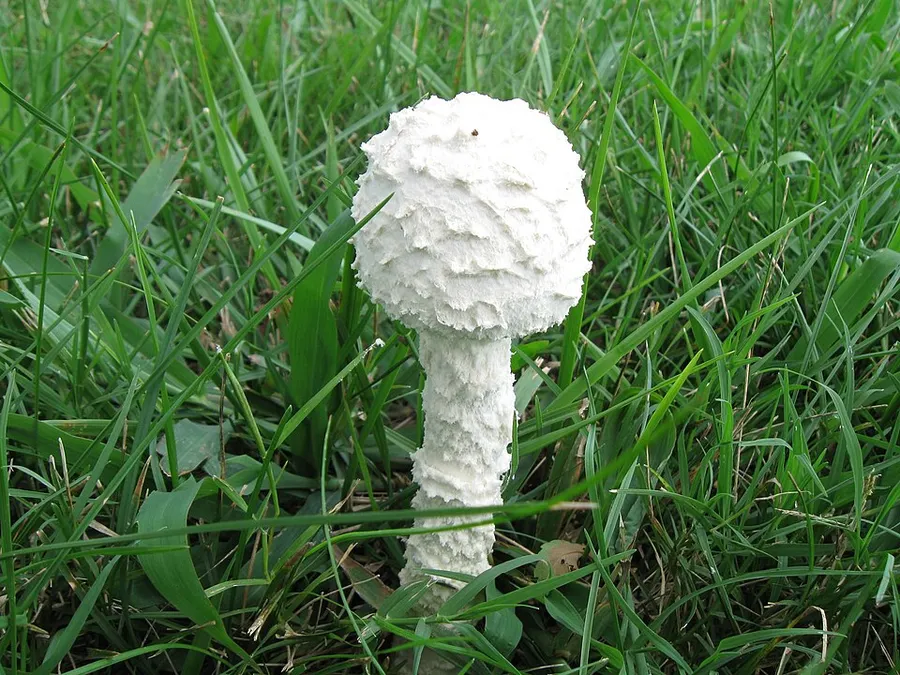
The cap is white and dry, measuring 3.5-10 cm wide, and convex in shape (conico- or plano-convex). It often has a broad low umbo. The cap's flesh may be 10 mm thick. At first the cap is covered by the soft, white fragmentary remains of the universal veil, which become more widely separated as the cap expands. They are shaggy and somewhat sticky. The gills are of varying lengths. They are free from the stipe and vary from crowded to widely spaced. They may be narrow or broad and are white to creamy yellow in color. The stipe is white and is 8-20 cm long and 10 - 20 mm wide. In some specimens, the stipe bruises to a yellow color. It is either hollow or lightly stuffed with a cottony tissue. The bulb at the base is slightly broader than the rest of the stipe. The bulb is 2.5 cm long and 2.2 cm wide. A shaggy, drooping ring is present which is often shed before maturity. Spores of S. thiersii are white and roughly spherical. They measure approximately 7.8–9.8 by 7.3–9.0 μm and are amyloid. In an analysis, both monokaryotic (one nucleus per cell) and dikaryotic (two nuclei per cell) strains were isolated from fruit bodies. All the spores were found to be binucleate but the researchers believed that in the monokaryotic strain, the second nucleus had failed to pass through the germ tube. The odor of this mushroom is indistinct but with age can become unpleasant, like that of decay or cheese. The fungus is said to taste oily bitter or bitter metallic.

Sebagian uraian ditampilkan dalam bahasa sumber; terjemahannya belum tersedia atau belum lolos pemeriksaan.

Rujukan: [1]

Pengukuran mengikuti objek, spesimen atau kultur, dan metode yang disebutkan sumber. Baca uraian asli untuk konteks lengkap.

02 / Kehidupan

Habitat dan peran ekologis

Saproamanita thiersii menempati rumput, padang rumput dan praya di seluruh Basin Sungai Mississippi. Ini sering membentuk cincin peri atau busur tetapi juga kadang-kadang buah sebagai spesimen terisolasi. Hal ini telah ditemukan tumbuh di rumput yang sama dengan Chlorophyllum molybdites. Analysis using isotop karbon yang stabil telah membuktikan bahwa jamur ini adalah saprotrof dalam alam, tidak seperti Amanitas mikoriza lainnya. The fruit bodies of S. thiersii grow during the mid or late summer until early fall. Since it pertama kali dilaporkan di 1952 di Texas, spesies ini telah memperluas jangkauannya. Ini muncul di selatan Illinois in tahun 1990-an dan sejak itu telah menyebar ke Illinois tengah, di mana ini adalah jamur paling umum ditemukan di rumput selama July and Agustus. Today it terjadi di sembilan negara bagian termasuk Missouri, Oklahoma, Texas, Kentucky, Ohio, Kansas, Iowa, Indiana, Illinois. Hal ini juga terjadi di Meksiko.

Sebagian uraian ditampilkan dalam bahasa sumber; terjemahannya belum tersedia atau belum lolos pemeriksaan.

Rujukan: [1]

Habitat atau konteks temuan
Informasi belum tersedia pada sumber rilis ini.
Substrat
Informasi belum tersedia pada sumber rilis ini.
Peran atau konteks
Pengurai; Mitra tumbuhan
Temukan hubungan serupa
03 / Siklus hidup

Reproduksi

Spores of S. thiersii are white and roughly spherical. They measure approximately 7.8–9.8 by 7.3–9.0 μm and are amyloid. In an analysis, both monokaryotic (one nucleus per cell) and dikaryotic (two nuclei per cell) strains were isolated from fruit bodies. All the spores were found to be binucleate but the researchers believed that in the monokaryotic strain, the second nucleus had failed to pass through the germ tube.

Sebagian uraian ditampilkan dalam bahasa sumber; terjemahannya belum tersedia atau belum lolos pemeriksaan.

Rujukan: [1]

Sinonim menurut acuan taksonomi rilis: Amanita alba; Aspidella alba; Aspidella thiersii; Saproamanita thiersii
04 / Batas informasi

Catatan identitas dan cakupan

  • Nama diterima mengikuti Catalogue of Life Base2026-09-11; uraian mempertahankan konsep dan nama sumber aslinya.
  • Original geographic, specimen and life-cycle scope retained; source import awaits individual editorial review.
  • Impor dan terjemahan otomatis belum diperiksa editorial per profil. Struktur reproduktif yang disebutkan tidak membuktikan seluruh siklus hidup diketahui.
  • Pengukuran pada uraian mengikuti spesimen, kultur, dan metode sumber; angka tidak diperluas ke semua populasi.

Catatan distribusi dalam narasi mengikuti sumbernya. Dokumentasi spesimen atau foto mengikuti catatan sumber. Bukti wilayah Indonesia dan penilaian konservasi tidak disimpulkan dari gambar.

05 / Dokumentasi

Melihat dengan konteks

Dokumentasi Saproamanita thiersii dari Wikimedia Commons. For more information about this, see the observation page at Mushroom Observer. Identifikasi mengikuti record berkas sumber.

Jenis
Fotografi
Kredit
This image was created by user Brian Adamo (adamo588) at Mushroom Observer , a source for mycological images. You can contact this user here .
Sumber media
Buka entri sumber

Gambar menunjukkan objek menurut identifikasi sumber, bukan verifikasi independen spesimen oleh Fungi. Tidak ada skala baru yang ditambahkan.

06 / Rujukan

Sumber profil

  1. [1] Saproamanita thiersii — Wikipedia (en)Bagian sumber: Frozen revision 1259298777
    Tanggal penghimpunan sumber: 2026-10-12
    Teks sumber: CC BY-SA4.0 · Wikipedia contributors
  2. [2] Catalogue of Life Base2026-09-11 — Amanita thiersiiBagian sumber: ColDP NameUsage.tsv ID 5TZ3W; accepted species; source 2073
    Tanggal penghimpunan sumber: 2026-10-12
  3. [3] Dokumentasi visual — Saproamanita thiersiiBagian sumber: Individual media record; identification follows the source, not independent determination
    Tanggal penghimpunan sumber: 2026-10-12
    Media sumber: CC BY-SA 3.0 · This image was created by user Brian Adamo (adamo588) at Mushroom Observer , a source for mycological images. You can contact this user here .

Adaptasi teks: CC BY-SA 4.0. Wikipedia contributors — Saproamanita thiersii — Wikipedia (en)

Uraian asli dan riwayat sumber

Riwayat atau halaman sumber

Ringkasan sumber

Saproamanita thiersii (formerly Amanita thiersii), commonly called Thiers' lepidella, is a North American saprotrophic basidiomycete fungus in the genus Saproamanita. It is a white, small mushroom. Its cap is convex, measuring 3.5-10 cm across, and the stipe is 8 – 20 cm long. The spore print is white. Originally described from Texas but today found in ten states of North America, the mushroom grows in lawns, pastures and prairies. It is a saprotroph, living on decaying plant material, and not mycorrhizal as is the case with species of Amanita, where it was previously placed.

Revisi sumber

Morfologi sumber

The cap is white and dry, measuring 3.5-10 cm wide, and convex in shape (conico- or plano-convex). It often has a broad low umbo. The cap's flesh may be 10 mm thick. At first the cap is covered by the soft, white fragmentary remains of the universal veil, which become more widely separated as the cap expands. They are shaggy and somewhat sticky. The gills are of varying lengths. They are free from the stipe and vary from crowded to widely spaced. They may be narrow or broad and are white to creamy yellow in color. The stipe is white and is 8-20 cm long and 10 - 20 mm wide. In some specimens, the stipe bruises to a yellow color. It is either hollow or lightly stuffed with a cottony tissue. The bulb at the base is slightly broader than the rest of the stipe. The bulb is 2.5 cm long and 2.2 cm wide. A shaggy, drooping ring is present which is often shed before maturity. Spores of S. thiersii are white and roughly spherical. They measure approximately 7.8–9.8 by 7.3–9.0 μm and are amyloid. In an analysis, both monokaryotic (one nucleus per cell) and dikaryotic (two nuclei per cell) strains were isolated from fruit bodies. All the spores were found to be binucleate but the researchers believed that in the monokaryotic strain, the second nucleus had failed to pass through the germ tube. The odor of this mushroom is indistinct but with age can become unpleasant, like that of decay or cheese. The fungus is said to taste oily bitter or bitter metallic.

Revisi sumber

Ekologi sumber

Saproamanita thiersii inhabits lawns, pastures and prairies throughout the Mississippi River Basin. It often forms fairy rings or arcs but also sometimes fruits as isolated specimens. It has been found growing in the same lawn as Chlorophyllum molybdites. Analysis using stable carbon isotopes has proved that this mushroom is saprotrophic in nature, unlike the other mycorrhizal Amanitas. The fruit bodies of S. thiersii grow during the mid or late summer until early fall. Since it was first reported in 1952 in Texas, this species has been expanding its range. It appeared in southern Illinois in the 1990s and has since spread to central Illinois, where it is the most common mushroom found in lawns during July and August. Today it occurs in nine states including Missouri, Oklahoma, Texas, Kentucky, Ohio, Kansas, Iowa, Indiana, Illinois. It also occurs in Mexico.

Revisi sumber

Struktur reproduksi sumber

Spores of S. thiersii are white and roughly spherical. They measure approximately 7.8–9.8 by 7.3–9.0 μm and are amyloid. In an analysis, both monokaryotic (one nucleus per cell) and dikaryotic (two nuclei per cell) strains were isolated from fruit bodies. All the spores were found to be binucleate but the researchers believed that in the monokaryotic strain, the second nucleus had failed to pass through the germ tube.

Revisi sumber

Rujukan halaman ini

Fungi. Amanita thiersii. Rilis data fungi-2026-10-12-expansion-2. https://fungi-atlas.mgadib.chatgpt.site/jamur/amanita-thiersii/.

Status: impor sumber; pemeriksaan editorial per profil belum selesai. Untuk klaim biologis, gunakan rujukan pada bagian terkait dan periksa konteks sumber aslinya.