01 / Morfologi

Ciri dan struktur

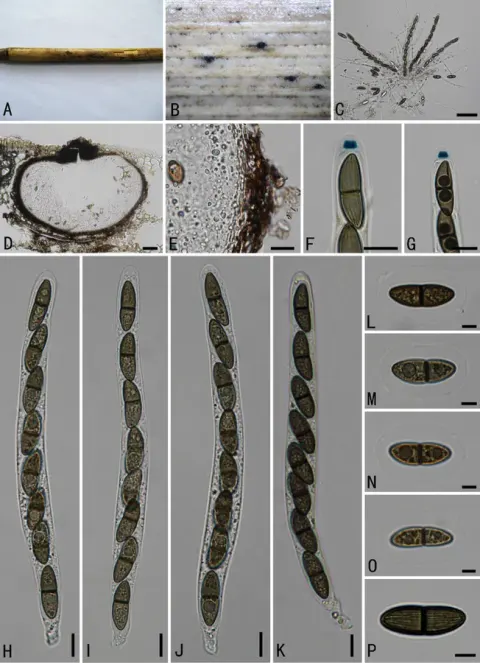
Arecophila australis differs from similar species by its dimension of ascospores (22.5–29 × 8–11 µm) covered by striations and ascomata with a disc area surrounding the ostioles. Holotype. China, Guizhou Province, Guiyang City, Forest Park of Guiyang (26°32'55"N, 106°45'25"E), on dead culm of Phragmites australis (Cav.) Steud., 15 March 2014, Q.R. Li, GZ58 (GZUH0112, holotype, ex-type: GZUCC0112; GACP QR0152, isotype). Saprobic on dead culm of gramineous host. Sexual morph: Ascomata 420–560 × 290–380 µm (x̄ = 495 × 325 µm, n = 10), immersed under a clypeus, solitary, slightly raised, blackened, dome-shaped areas, scattered or gregarious, globose to subglobose, with a central, erumpent, cone-shaped papilla in vertical section. Clypeus black, comprising host cells and intracellular brown hyphae. Ostioles papillate, black. Peridium 15–25 µm (x̄ = 21 µm, n = 15) wide, comprising several layers, outer layer brown, thick-walled angular cells, inner layer hyaline. Paraphyses 3.3–5 μm (x̄ = 3.5 µm, n = 15) wide, hyaline, unbranched, septate. Asci 140–230 × 15.5–24 µm (x̄ = 183.5 × 19 µm, n = 30), 8-spored, unitunicate, long-cylindrical, short-pedicellate, apically rounded, with a 4–5 × 2.5–3 μm (x̄ = 4.5 × 2.7 μm, n = 20), trapezoidal, J+, apical ring. Ascospores 22.5–29 × 8–11 µm (x̄ = 25.5 × 9 µm, n = 30), overlapping uniseriate, 2-celled, light brown to brown, equilateral ellipsoidal, constricted at the septum, longitudinal with sulcate striations, along the entire spore length, surrounded by a mucilaginous sheath, lacking germ slits and appendages. Asexual morph: undetermined. Colonies on PDA, reached 3 cm diam. after one week at 25 °C, white, cottony, flat, low, dense, with slightly wavy margin.

Sebagian uraian ditampilkan dalam bahasa sumber; terjemahannya belum tersedia atau belum lolos pemeriksaan.

Rujukan: [1]

Pengukuran mengikuti objek, spesimen atau kultur, dan metode yang disebutkan sumber. Baca uraian asli untuk konteks lengkap.

02 / Kehidupan

Habitat dan peran ekologis

Arecophila australis differs from similar species by its dimension of ascospores (22.5–29 × 8–11 µm) covered by striations and ascomata with a disc area surrounding the ostioles. Holotype. China, Guizhou Province, Guiyang City, Forest Park of Guiyang (26°32'55"N, 106°45'25"E), on dead culm of Phragmites australis (Cav.) Steud., 15 March 2014, Q.R. Li, GZ58 (GZUH0112, holotype, ex-type: GZUCC0112; GACP QR0152, isotype). Saprobic on dead culm of gramineous host. Sexual morph: Ascomata 420–560 × 290–380 µm (x̄ = 495 × 325 µm, n = 10), immersed under a clypeus, solitary, slightly raised, blackened, dome-shaped areas, scattered or gregarious, globose to subglobose, with a central, erumpent, cone-shaped papilla in vertical section. Clypeus black, comprising host cells and intracellular brown hyphae. Ostioles papillate, black. Peridium 15–25 µm (x̄ = 21 µm, n = 15) wide, comprising several layers, outer layer brown, thick-walled angular cells, inner layer hyaline. Paraphyses 3.3–5 μm (x̄ = 3.5 µm, n = 15) wide, hyaline, unbranched, septate. Asci 140–230 × 15.5–24 µm (x̄ = 183.5 × 19 µm, n = 30), 8-spored, unitunicate, long-cylindrical, short-pedicellate, apically rounded, with a 4–5 × 2.5–3 μm (x̄ = 4.5 × 2.7 μm, n = 20), trapezoidal, J+, apical ring.

Sebagian uraian ditampilkan dalam bahasa sumber; terjemahannya belum tersedia atau belum lolos pemeriksaan.

Rujukan: [1]

Habitat atau konteks temuan
hutan
Substrat
Informasi belum tersedia pada sumber rilis ini.
Peran atau konteks
Pengurai
Temukan hubungan serupa
03 / Siklus hidup

Reproduksi

Arecophila australis differs from similar species by its dimension of ascospores (22.5–29 × 8–11 µm) covered by striations and ascomata with a disc area surrounding the ostioles. Holotype. China, Guizhou Province, Guiyang City, Forest Park of Guiyang (26°32'55"N, 106°45'25"E), on dead culm of Phragmites australis (Cav.) Steud., 15 March 2014, Q.R. Li, GZ58 (GZUH0112, holotype, ex-type: GZUCC0112; GACP QR0152, isotype). Saprobic on dead culm of gramineous host. Sexual morph: Ascomata 420–560 × 290–380 µm (x̄ = 495 × 325 µm, n = 10), immersed under a clypeus, solitary, slightly raised, blackened, dome-shaped areas, scattered or gregarious, globose to subglobose, with a central, erumpent, cone-shaped papilla in vertical section.

Sebagian uraian ditampilkan dalam bahasa sumber; terjemahannya belum tersedia atau belum lolos pemeriksaan.

Rujukan: [1]

04 / Batas informasi

Catatan identitas dan cakupan

  • Nama diterima mengikuti Catalogue of Life Base2026-09-11; uraian mempertahankan konsep dan nama sumber aslinya.
  • Preserve original treatment localities, hosts and substrate scope. Materials examined describe documented specimens, not the full global range.
  • Impor dan terjemahan otomatis belum diperiksa editorial per profil. Struktur reproduktif yang disebutkan tidak membuktikan seluruh siklus hidup diketahui.
  • Pengukuran pada uraian mengikuti spesimen, kultur, dan metode sumber; angka tidak diperluas ke semua populasi.

Catatan distribusi dalam narasi mengikuti sumbernya. Dokumentasi spesimen atau foto mengikuti catatan sumber. Bukti wilayah Indonesia dan penilaian konservasi tidak disimpulkan dari gambar.

05 / Dokumentasi

Melihat dengan konteks

Arecophila australis (holotype) A material B ascoma on the surface of host C section of ascoma D peridium E paraphyses F, G ascus apex with a J+, apical ring (stained in Melzer’s reagent) H–K asci with ascospores L–O ascospores surrounded by a wide mucilaginous sheath (O stained in India ink). Scale bars: 300 μm (B); 50 μm (C); 5 μm (D–O).

Jenis
Pelat ilmiah
Kredit
Qi Rui Li, Xu Zhang, Yan Lin, Milan C. Samarakoon, Kevin David Hyde, Xiang Chun Shen, Wan Qing Liao, Anuruddha Karunarathna, Si Han Long, Ying Qian Kang, Ji Chuan Kang
Lisensi
CC BY 4.0
Sumber media
Buka entri sumber

Gambar menunjukkan objek menurut identifikasi sumber, bukan verifikasi independen spesimen oleh Fungi. Tidak ada skala baru yang ditambahkan.

06 / Rujukan

Sumber profil

  1. [1] Morpho-molecular characterisation of Arecophila, with A. australis and A. clypeata sp. nov. and A. miscanthi comb. nov. — Arecophila australisBagian sumber: PMC9021158_section_11
    Tanggal penghimpunan sumber: 2026-10-12
    Teks sumber: CC BY 4.0 · Li QR, Zhang X, Lin Y, Samarakoon MC, Hyde KD, Shen XC, Liao WQ, Karunarathna A, Long SH, Kang YQ, Kang JC.
  2. [2] Catalogue of Life Base2026-09-11 — Arecophila australisBagian sumber: ColDP NameUsage.tsv ID B2MZ5; accepted species; source 2073
    Tanggal penghimpunan sumber: 2026-10-12
  3. [3] Dokumentasi visual — Arecophila australisBagian sumber: Individual media record; identification follows the source, not independent determination
    Tanggal penghimpunan sumber: 2026-10-12
    Media sumber: CC BY 4.0 · Qi Rui Li, Xu Zhang, Yan Lin, Milan C. Samarakoon, Kevin David Hyde, Xiang Chun Shen, Wan Qing Liao, Anuruddha Karunarathna, Si Han Long, Ying Qian Kang, Ji Chuan Kang

Adaptasi teks: CC BY 4.0. Li QR, Zhang X, Lin Y, Samarakoon MC, Hyde KD, Shen XC, Liao WQ, Karunarathna A, Long SH, Kang YQ, Kang JC. — Morpho-molecular characterisation of Arecophila, with A. australis and A. clypeata sp. nov. and A. miscanthi comb. nov. — Arecophila australis

Uraian asli dan riwayat sumber

Riwayat atau halaman sumber

Ringkasan sumber

Arecophila australis differs from similar species by its dimension of ascospores (22.5–29 × 8–11 µm) covered by striations and ascomata with a disc area surrounding the ostioles. Holotype. China, Guizhou Province, Guiyang City, Forest Park of Guiyang (26°32'55"N, 106°45'25"E), on dead culm of Phragmites australis (Cav.) Steud., 15 March 2014, Q.R. Li, GZ58 (GZUH0112, holotype, ex-type: GZUCC0112; GACP QR0152, isotype). Saprobic on dead culm of gramineous host. Sexual morph: Ascomata 420–560 × 290–380 µm (x̄ = 495 × 325 µm, n = 10), immersed under a clypeus, solitary, slightly raised, blackened, dome-shaped areas, scattered or gregarious, globose to subglobose, with a central, erumpent, cone-shaped papilla in vertical section.

Revisi sumber

Morfologi sumber

Arecophila australis differs from similar species by its dimension of ascospores (22.5–29 × 8–11 µm) covered by striations and ascomata with a disc area surrounding the ostioles. Holotype. China, Guizhou Province, Guiyang City, Forest Park of Guiyang (26°32'55"N, 106°45'25"E), on dead culm of Phragmites australis (Cav.) Steud., 15 March 2014, Q.R. Li, GZ58 (GZUH0112, holotype, ex-type: GZUCC0112; GACP QR0152, isotype). Saprobic on dead culm of gramineous host. Sexual morph: Ascomata 420–560 × 290–380 µm (x̄ = 495 × 325 µm, n = 10), immersed under a clypeus, solitary, slightly raised, blackened, dome-shaped areas, scattered or gregarious, globose to subglobose, with a central, erumpent, cone-shaped papilla in vertical section. Clypeus black, comprising host cells and intracellular brown hyphae. Ostioles papillate, black. Peridium 15–25 µm (x̄ = 21 µm, n = 15) wide, comprising several layers, outer layer brown, thick-walled angular cells, inner layer hyaline. Paraphyses 3.3–5 μm (x̄ = 3.5 µm, n = 15) wide, hyaline, unbranched, septate. Asci 140–230 × 15.5–24 µm (x̄ = 183.5 × 19 µm, n = 30), 8-spored, unitunicate, long-cylindrical, short-pedicellate, apically rounded, with a 4–5 × 2.5–3 μm (x̄ = 4.5 × 2.7 μm, n = 20), trapezoidal, J+, apical ring. Ascospores 22.5–29 × 8–11 µm (x̄ = 25.5 × 9 µm, n = 30), overlapping uniseriate, 2-celled, light brown to brown, equilateral ellipsoidal, constricted at the septum, longitudinal with sulcate striations, along the entire spore length, surrounded by a mucilaginous sheath, lacking germ slits and appendages. Asexual morph: undetermined. Colonies on PDA, reached 3 cm diam. after one week at 25 °C, white, cottony, flat, low, dense, with slightly wavy margin.

Revisi sumber

Ekologi sumber

Arecophila australis differs from similar species by its dimension of ascospores (22.5–29 × 8–11 µm) covered by striations and ascomata with a disc area surrounding the ostioles. Holotype. China, Guizhou Province, Guiyang City, Forest Park of Guiyang (26°32'55"N, 106°45'25"E), on dead culm of Phragmites australis (Cav.) Steud., 15 March 2014, Q.R. Li, GZ58 (GZUH0112, holotype, ex-type: GZUCC0112; GACP QR0152, isotype). Saprobic on dead culm of gramineous host. Sexual morph: Ascomata 420–560 × 290–380 µm (x̄ = 495 × 325 µm, n = 10), immersed under a clypeus, solitary, slightly raised, blackened, dome-shaped areas, scattered or gregarious, globose to subglobose, with a central, erumpent, cone-shaped papilla in vertical section. Clypeus black, comprising host cells and intracellular brown hyphae. Ostioles papillate, black. Peridium 15–25 µm (x̄ = 21 µm, n = 15) wide, comprising several layers, outer layer brown, thick-walled angular cells, inner layer hyaline. Paraphyses 3.3–5 μm (x̄ = 3.5 µm, n = 15) wide, hyaline, unbranched, septate. Asci 140–230 × 15.5–24 µm (x̄ = 183.5 × 19 µm, n = 30), 8-spored, unitunicate, long-cylindrical, short-pedicellate, apically rounded, with a 4–5 × 2.5–3 μm (x̄ = 4.5 × 2.7 μm, n = 20), trapezoidal, J+, apical ring.

Revisi sumber

Struktur reproduksi sumber

Arecophila australis differs from similar species by its dimension of ascospores (22.5–29 × 8–11 µm) covered by striations and ascomata with a disc area surrounding the ostioles. Holotype. China, Guizhou Province, Guiyang City, Forest Park of Guiyang (26°32'55"N, 106°45'25"E), on dead culm of Phragmites australis (Cav.) Steud., 15 March 2014, Q.R. Li, GZ58 (GZUH0112, holotype, ex-type: GZUCC0112; GACP QR0152, isotype). Saprobic on dead culm of gramineous host. Sexual morph: Ascomata 420–560 × 290–380 µm (x̄ = 495 × 325 µm, n = 10), immersed under a clypeus, solitary, slightly raised, blackened, dome-shaped areas, scattered or gregarious, globose to subglobose, with a central, erumpent, cone-shaped papilla in vertical section.

Revisi sumber

Rujukan halaman ini

Fungi. Arecophila australis. Rilis data fungi-2026-10-12-expansion-2. https://fungi-atlas.mgadib.chatgpt.site/jamur/arecophila-australis/.

Status: impor sumber; pemeriksaan editorial per profil belum selesai. Untuk klaim biologis, gunakan rujukan pada bagian terkait dan periksa konteks sumber aslinya.