Ciri dan struktur
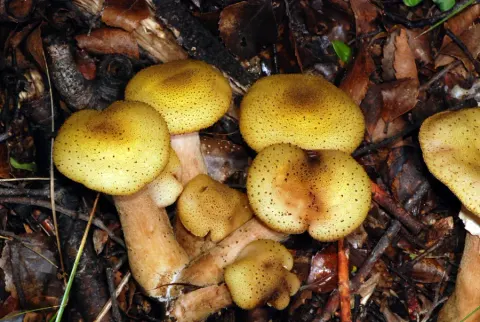
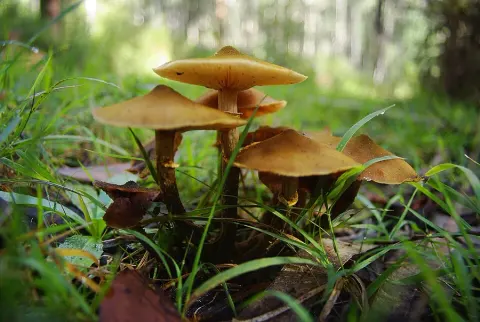
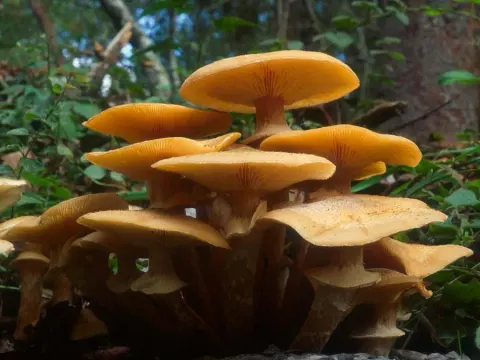
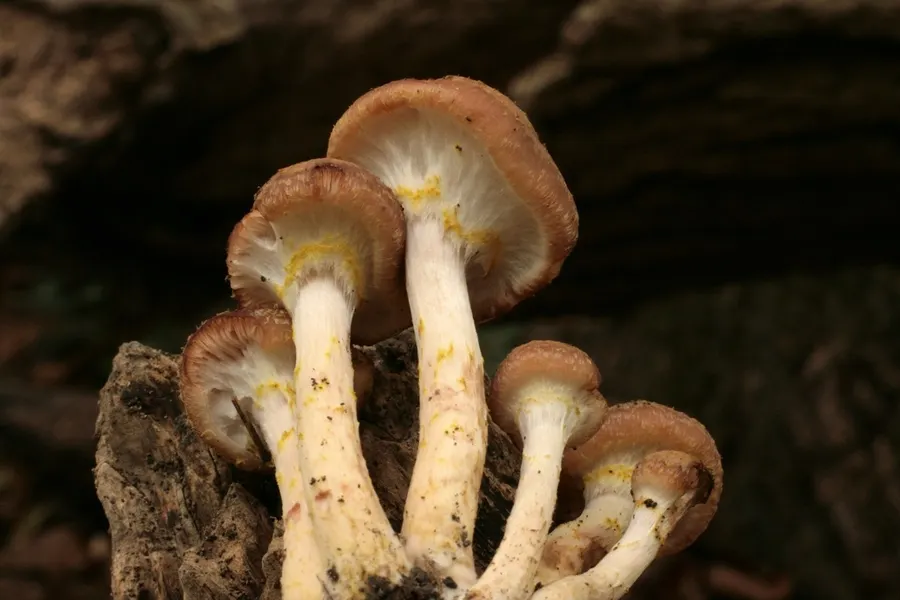
The fruit bodies of Armillaria gallica have caps that are 2.5 – 9.5 cm broad, and depending on their age, may range in shape from conical to convex to flattened. The caps are brownish-yellow to brown when moist, often with a darker-colored center; the color tends to fade upon drying. The cap surface is covered with slender fibers (same color as the cap) that are erect, or sloping upwards. When the fruit bodies are young, the underside of the caps have a cottony layer of tissue stretching from the edge of the cap to the stem—a partial veil—which serves to protect the developing gills. As the cap grows in size the membrane is eventually pulled away from the cap to expose the gills. The gills have an adnate (squarely attached) to somewhat decurrent (extending down the length of the stem) attachment to the stem. They are initially white, but age to a creamy or pale orange covered with rust-colored spots. The stem is 4 – 10 cm long and 0.6 – 1.8 cm thick, and almost club-shaped with the base up to 1.3 – 2.7 cm thick. Above the level of the ring, the stem is pale orange to brown, while below it is whitish or pale pink, becoming grayish-brown at the base. The ring is positioned about 0.4 – 0.9 cm below the level of the cap, and may be covered with yellowish to pale-brownish woolly cottony mycelia. The base of the stem is attached to rhizomorphs, black root-like structures 1–3 mm in diameter. While the primary function of the below-ground mycelia is to absorb nutrients from the soil, the rhizomorphs serve a more exploratory function, to locate new food bases. When the spores are seen in deposit, such as with a spore print, they appear whitish.
Habitat dan peran ekologis
Armillaria gallica can normally be found on the ground, but sometimes on stumps and logs. Mushrooms that appear to be terrestrial are attached to plant roots underneath the surface. It is widely distributed and has been collected in North America, Europe, and Asia (China, Iran, and Japan). The species has also been found in the Western Cape Province of South Africa, where it is thought to have been introduced from potted plants imported from Europe during the early colonization of Cape Town. In Scandinavia, it is absent in areas with very cold climates, like Finland or Norway, but it is found in southern Sweden. It is thought to be the most prevalent low altitude species of Armillaria in Great Britain and France. The upper limits of its altitude vary by region. In the French Massif Central, it is found up to 1100 m, while in Bavaria, which has a more continental climate, the upper limit of distribution reaches 600 m. In Serbian forests, it is the most common Armillaria between elevations of 70 to 1450 m. Field studies suggest that A. gallica prefers sites that are low in organic matter and have high soil pHs. In North America, it is common east of the Rocky Mountains, but rare in the Pacific Northwest.
- Habitat atau konteks temuan
- hutan
- Substrat
- tanah
- Peran atau konteks
- Belum dikategorikan pada rilis ini.
Reproduksi
When the spores are seen in deposit, such as with a spore print, they appear whitish. They have an ellipsoid or oblong shape, usually contain an oil droplet, and have dimensions of 7–8.5 by 5–6 μm. The spore-bearing cells, the basidia, are club-shaped, four-spored (rarely two-spored), and measure 32–43 by 7–8.7 μm. Other cells present in the fertile hymenium include the cheilocystidia (cystidia present on the edge of a gill), which are club-shaped, roughly cylindrical and 15–25 by 5.0–12 μm. Cystidia are also present on the stem (called caulocystidia), and are broadly club-shaped, measuring 20–55 by 11–23 μm. The cap cuticle is made of hyphae that are irregularly interwoven and project upward to form the scales seen on the surface.
Catatan identitas dan cakupan
- Nama diterima mengikuti Catalogue of Life Base2026-09-11; uraian mempertahankan konsep dan nama sumber aslinya.
- Original geographic, specimen and life-cycle scope retained; source import awaits individual editorial review.
- Impor dan terjemahan otomatis belum diperiksa editorial per profil. Struktur reproduktif yang disebutkan tidak membuktikan seluruh siklus hidup diketahui.
- Pengukuran pada uraian mengikuti spesimen, kultur, dan metode sumber; angka tidak diperluas ke semua populasi.
Catatan distribusi dalam narasi mengikuti sumbernya. Dokumentasi spesimen atau foto mengikuti catatan sumber. Bukti wilayah Indonesia dan penilaian konservasi tidak disimpulkan dari gambar.
Melihat dengan konteks
Dokumentasi Armillaria gallica menurut asosiasi foto pada record takson iNaturalist. Kredit: Rocky Houghtby. Identitas mengikuti sumber; bukan penentuan spesimen independen.
- Jenis
- Fotografi
- Kredit
- (c) Rocky Houghtby, some rights reserved (CC BY)
- Lisensi
- CC BY 4.0
- Sumber media
- Buka entri sumber
Sumber profil
- [1] Armillaria gallica — Wikipedia (en)
- [2] Catalogue of Life Base2026-09-11 — Armillaria gallica
- [3] Dokumentasi visual — Armillaria gallica
Rujukan halaman ini
Fungi. Armillaria gallica. Rilis data fungi-2026-10-12-expansion-2. https://fungi-atlas.mgadib.chatgpt.site/jamur/armillaria-gallica/.
Status: impor sumber; pemeriksaan editorial per profil belum selesai. Untuk klaim biologis, gunakan rujukan pada bagian terkait dan periksa konteks sumber aslinya.