01 / Morfologi

Ciri dan struktur

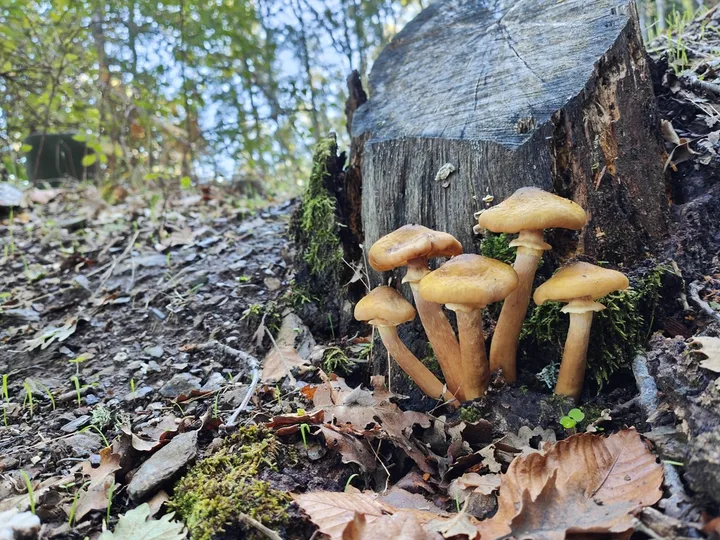
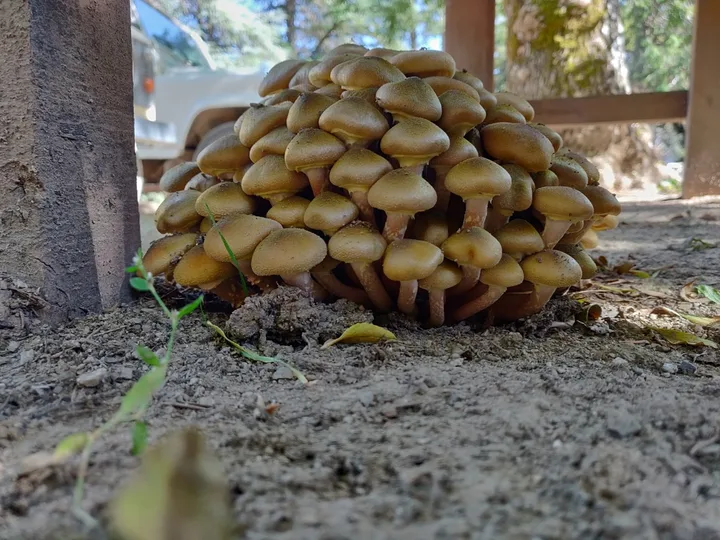
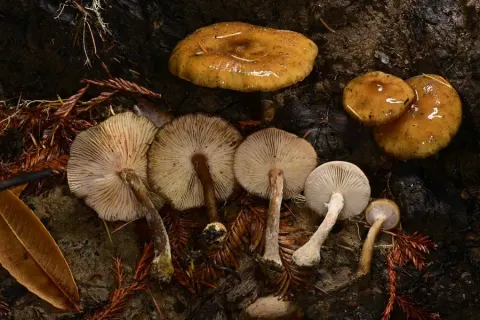
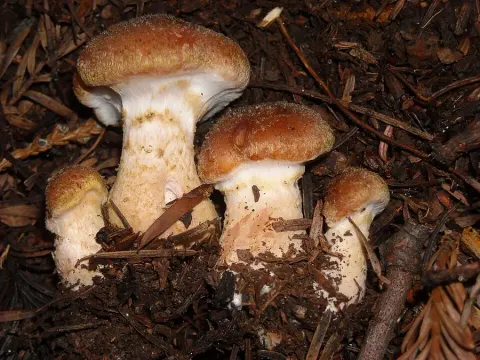
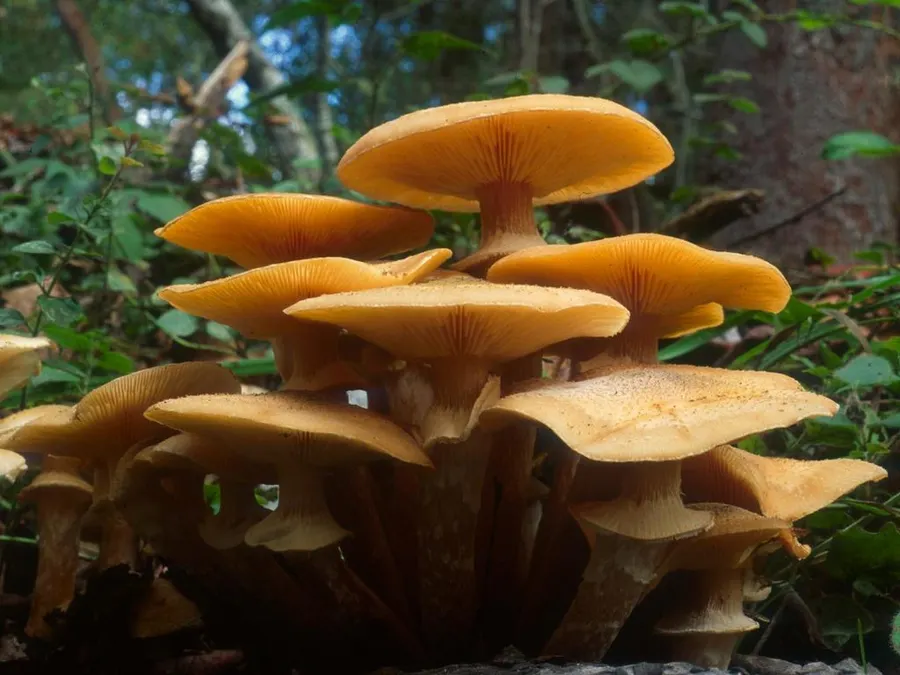
The basidiocarp of each has a smooth cap 3 to 15 cm in diameter, convex at first but becoming flattened with age often with a central raised umbo, later becoming somewhat dish-shaped. The margins of the cap are often arched at maturity and the surface is sticky when wet. Though typically honey-coloured, this fungus is rather variable in appearance and sometimes has a few dark, hairy scales near the centre somewhat radially arranged. The gills are white at first, sometimes becoming pinkish-yellow or discoloured with age, broad and fairly distant, attached to the stipe at right angles or are slightly decurrent. The flesh of the cap is whitish and has a sweetish odour and flavour with a tinge of bitterness. The stipe is 5-20 cm long and 0.5-3.5 cm in diameter. It is fibrillose and of a firm spongy consistency at first but later becomes hollow. It is cylindrical and tapers to a point at its base where it is fused to the stipes of other mushrooms in the clump. It is whitish at the upper end and brownish-yellow below, often with a very dark-coloured base. The main part of the fungus is underground where a mat of mycelial threads may extend for great distances. They are bundled together in rhizomorphs that are black in this species.

Sebagian uraian ditampilkan dalam bahasa sumber; terjemahannya belum tersedia atau belum lolos pemeriksaan.

Rujukan: [1]

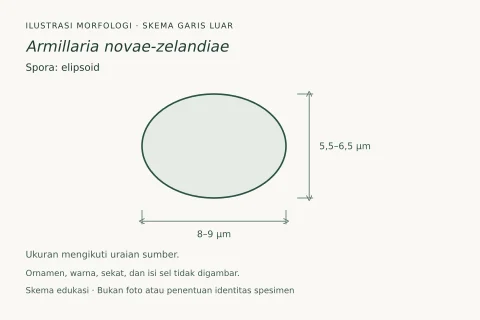
Pengukuran mengikuti objek, spesimen atau kultur, dan metode yang disebutkan sumber. Baca uraian asli untuk konteks lengkap.

02 / Kehidupan

Habitat dan peran ekologis

Armillaria mellea is widespread in northern temperate zones. It has been found throughout North America, and in Europe and northern Asia. It has been introduced to South Africa. It grows parasitically on a large number of broadleaf trees. It fruits in dense clusters at the base of trunks or stumps. Armillaria mellea prefers moist soil and lower soil temperatures, as soil temperatures exceeding 79 °F (26 °C) can inhibit its growth. It is found in many kinds of landscapes, including gardens, parks, vineyards, tree production areas, and natural landscapes. and a few herbaceous plants. It is rare for basidiospores to be successful in infecting new hosts and often colonize woody debris instead, Additional signs include white, fan-shaped mycelia and black rhizomorphs with diameters between 1/32 and 1/8 in. The symptoms are much more numerous, including slower growth, dieback of branches, yellowing foliage, However, it is not quite clear whether such records in older sources refer to this honey mushroom species in its present more restricted delimitation, or to some other species of Armillaria or even related genera such as Desarmillaria. Armillaria mellea is capable of infecting hundreds of woody plant species, including trees, hedges, shrubs, and vines.

Sebagian uraian ditampilkan dalam bahasa sumber; terjemahannya belum tersedia atau belum lolos pemeriksaan.

Rujukan: [1]

Habitat atau konteks temuan
Informasi belum tersedia pada sumber rilis ini.
Substrat
Informasi belum tersedia pada sumber rilis ini.
Peran atau konteks
Belum dikategorikan pada rilis ini.
Temukan hubungan serupa
03 / Siklus hidup

Reproduksi

The basidiocarp of each has a smooth cap 3 to 15 cm in diameter, convex at first but becoming flattened with age often with a central raised umbo, later becoming somewhat dish-shaped. The margins of the cap are often arched at maturity and the surface is sticky when wet. Though typically honey-coloured, this fungus is rather variable in appearance and sometimes has a few dark, hairy scales near the centre somewhat radially arranged. The gills are white at first, sometimes becoming pinkish-yellow or discoloured with age, broad and fairly distant, attached to the stipe at right angles or are slightly decurrent. The flesh of the cap is whitish and has a sweetish odour and flavour with a tinge of bitterness.

Sebagian uraian ditampilkan dalam bahasa sumber; terjemahannya belum tersedia atau belum lolos pemeriksaan.

Rujukan: [1]

Sinonim menurut acuan taksonomi rilis: Agaricites melleus; Agaricus melleus; Agaricus melleus var. fuscopallidus; Armillaria mellea f. sabulicola; Armillaria mellea subsp. nipponica; Armillaria mellea var. exannulata; Armillaria mellea var. flava; Armillaria mellea var. glabra; Armillaria mellea var. javanica; Armillaria mellea var. maxima; Armillaria mellea var. minor; Armillaria mellea var. nipponica; Armillaria mellea var. radicata; Armillaria mellea var. sulfurea; Armillaria mellea var. versicolor; Armillaria mellea var. viridiflava; Armillariella mellea; Armillariella mellea f. gigantea; Armillariella puiggarii f. olivacea; Clitocybe mellea; Fungus versicolor; Geophila versicolor; Lepiota mellea; Mastoleucomyces melleus; Polymyces melleus; Stropharia versicolor
04 / Batas informasi

Catatan identitas dan cakupan

  • Nama diterima mengikuti Catalogue of Life Base2026-09-11; uraian mempertahankan konsep dan nama sumber aslinya.
  • Original geographic, specimen and life-cycle scope retained; source import awaits individual editorial review.
  • Impor dan terjemahan otomatis belum diperiksa editorial per profil. Struktur reproduktif yang disebutkan tidak membuktikan seluruh siklus hidup diketahui.
  • Pengukuran pada uraian mengikuti spesimen, kultur, dan metode sumber; angka tidak diperluas ke semua populasi.

Catatan distribusi dalam narasi mengikuti sumbernya. Dokumentasi spesimen atau foto mengikuti catatan sumber. Bukti wilayah Indonesia dan penilaian konservasi tidak disimpulkan dari gambar.

05 / Dokumentasi

Melihat dengan konteks

Dokumentasi Armillaria mellea menurut asosiasi foto pada record takson iNaturalist. Kredit: Nathan Wilson. Identitas mengikuti sumber; bukan penentuan spesimen independen.

Jenis
Fotografi
Kredit
(c) Nathan Wilson, some rights reserved (CC BY-SA)
Sumber media
Buka entri sumber

Gambar menunjukkan objek menurut identifikasi sumber, bukan verifikasi independen spesimen oleh Fungi. Tidak ada skala baru yang ditambahkan.

Dokumentasi tambahan

06 / Rujukan

Sumber profil

  1. [1] Armillaria mellea — Wikipedia (en)Bagian sumber: Frozen revision 1379821696
    Tanggal penghimpunan sumber: 2026-10-12
    Teks sumber: CC BY-SA4.0 · Wikipedia contributors
  2. [2] Catalogue of Life Base2026-09-11 — Armillaria melleaBagian sumber: ColDP NameUsage.tsv ID GSMV; accepted species; source 2073
    Tanggal penghimpunan sumber: 2026-10-12
  3. [3] Dokumentasi visual — Armillaria melleaBagian sumber: Identitas mengikuti sumber dokumentasi; bukan penentuan spesimen independen.
    Tanggal penghimpunan sumber: 2026-10-17
    Media sumber: CC BY-SA 4.0 · (c) Nathan Wilson, some rights reserved (CC BY-SA)
  4. [4] Dokumentasi visual — Armillaria melleaBagian sumber: Identitas mengikuti sumber dokumentasi; bukan penentuan spesimen independen.
    Tanggal penghimpunan sumber: 2026-10-17
    Teks sumber: CC BY 4.0 · (c) Davide Puddu, some rights reserved (CC BY), uploaded by Davide Puddu
  5. [5] Dokumentasi visual — Armillaria melleaBagian sumber: Identitas mengikuti sumber dokumentasi; bukan penentuan spesimen independen.
    Tanggal penghimpunan sumber: 2026-10-17
    Teks sumber: CC BY 4.0 · (c) Davide Puddu, some rights reserved (CC BY), uploaded by Davide Puddu

Adaptasi teks: CC BY-SA 4.0. Wikipedia contributors — Armillaria mellea — Wikipedia (en)

Uraian asli dan riwayat sumber

Riwayat atau halaman sumber

Ringkasan sumber

The basidiocarp of each has a smooth cap 3 to 15 cm in diameter, convex at first but becoming flattened with age often with a central raised umbo, later becoming somewhat dish-shaped. The margins of the cap are often arched at maturity and the surface is sticky when wet. Though typically honey-coloured, this fungus is rather variable in appearance and sometimes has a few dark, hairy scales near the centre somewhat radially arranged. The gills are white at first, sometimes becoming pinkish-yellow or discoloured with age, broad and fairly distant, attached to the stipe at right angles or are slightly decurrent.

Revisi sumber

Morfologi sumber

The basidiocarp of each has a smooth cap 3 to 15 cm in diameter, convex at first but becoming flattened with age often with a central raised umbo, later becoming somewhat dish-shaped. The margins of the cap are often arched at maturity and the surface is sticky when wet. Though typically honey-coloured, this fungus is rather variable in appearance and sometimes has a few dark, hairy scales near the centre somewhat radially arranged. The gills are white at first, sometimes becoming pinkish-yellow or discoloured with age, broad and fairly distant, attached to the stipe at right angles or are slightly decurrent. The flesh of the cap is whitish and has a sweetish odour and flavour with a tinge of bitterness. The stipe is 5-20 cm long and 0.5-3.5 cm in diameter. It is fibrillose and of a firm spongy consistency at first but later becomes hollow. It is cylindrical and tapers to a point at its base where it is fused to the stipes of other mushrooms in the clump. It is whitish at the upper end and brownish-yellow below, often with a very dark-coloured base. The main part of the fungus is underground where a mat of mycelial threads may extend for great distances. They are bundled together in rhizomorphs that are black in this species.

Revisi sumber

Ekologi sumber

Armillaria mellea is widespread in northern temperate zones. It has been found throughout North America, and in Europe and northern Asia. It has been introduced to South Africa. It grows parasitically on a large number of broadleaf trees. It fruits in dense clusters at the base of trunks or stumps. Armillaria mellea prefers moist soil and lower soil temperatures, as soil temperatures exceeding 79 °F (26 °C) can inhibit its growth. It is found in many kinds of landscapes, including gardens, parks, vineyards, tree production areas, and natural landscapes. and a few herbaceous plants. It is rare for basidiospores to be successful in infecting new hosts and often colonize woody debris instead, Additional signs include white, fan-shaped mycelia and black rhizomorphs with diameters between 1/32 and 1/8 in. The symptoms are much more numerous, including slower growth, dieback of branches, yellowing foliage, However, it is not quite clear whether such records in older sources refer to this honey mushroom species in its present more restricted delimitation, or to some other species of Armillaria or even related genera such as Desarmillaria. Armillaria mellea is capable of infecting hundreds of woody plant species, including trees, hedges, shrubs, and vines.

Revisi sumber

Struktur reproduksi sumber

The basidiocarp of each has a smooth cap 3 to 15 cm in diameter, convex at first but becoming flattened with age often with a central raised umbo, later becoming somewhat dish-shaped. The margins of the cap are often arched at maturity and the surface is sticky when wet. Though typically honey-coloured, this fungus is rather variable in appearance and sometimes has a few dark, hairy scales near the centre somewhat radially arranged. The gills are white at first, sometimes becoming pinkish-yellow or discoloured with age, broad and fairly distant, attached to the stipe at right angles or are slightly decurrent. The flesh of the cap is whitish and has a sweetish odour and flavour with a tinge of bitterness.

Revisi sumber

Rujukan halaman ini

Fungi. Armillaria mellea. Rilis data fungi-2026-10-12-expansion-2. https://fungi-atlas.mgadib.chatgpt.site/jamur/armillaria-mellea/.

Status: impor sumber; pemeriksaan editorial per profil belum selesai. Untuk klaim biologis, gunakan rujukan pada bagian terkait dan periksa konteks sumber aslinya.