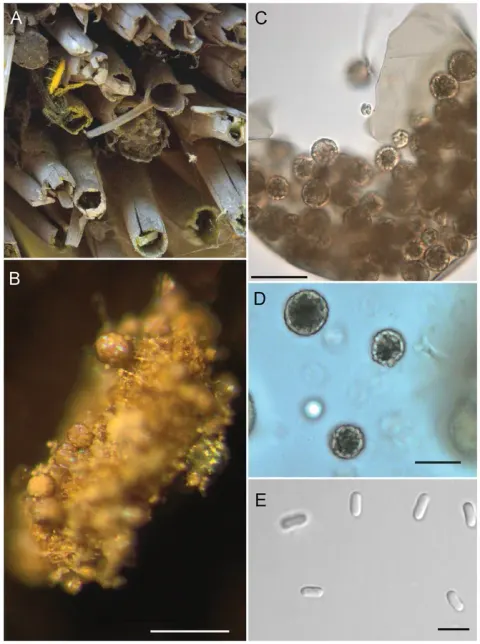
Ciri dan struktur
Ascosphaera aggregata is an obligate parasite that can cause chalkbrood by the fifth instar. The majority of the life cycle and growth of A. aggregata occurs in M. rotundata larvae. Infection of bee larvae occurs only via ingestion of resting spores, and is not possible via spore inhalation nor contact with the fungal vegetative form. Spores develop in the larva and cause it to swell, bursting the larval integument (giving the dead larvae a ragged appearance) and furthering the spread of the fungus. Buildup of larval cadavers traps the unaffected emerging bees, forcing them to chew through the cadavers and be covered in spores. Bees covered in spores then contaminate food provisions for other broods and spread the infection. Early vegetative growth utilizes gut lumen nutrients. A. aggregata grows through the midgut wall to the hemocoele (event trigger is unknown, not because of lack of space nor food) eventually replacing larval tissue. Resulting larvae are filled with a mycelial mat comprising two layers: a dense inner layer and a less dense outer layer. Although ascospore development is very unique, it is very hard to identify A. aggregata because the spore balls and conidia tend to resemble other species. Recent investigations by James and Skinner (2005) have discovered that PCR of the ITS domain of ribosomal DNA with species specific primer sets allows the detection of fungal DNA (working, even, in asymptomatic individuals). The PCR technique can also be used on hair and honey samples to avoid the difficulty of culturing spores, as spore were shown before to only germinate well in lipids.
Habitat dan peran ekologis
Ascosphaera aggregata is an obligate parasite that causes chalkbrood in bees, symptom manifestations differ depending on age of the larva. It primarily infects alfalfa leafcutting bees, Megachile rotundata. Megachile rotundata infected with A. aggregata have been detected in the United States, Canada, and South America. Other bee species that A. aggregata has been seen to infect include the red mason bee (Osmia rufa), the patchwork leafcutter bee (Megachile centuncularis), Megachile pugnata and Megachile relativa.
- Habitat atau konteks temuan
- Informasi belum tersedia pada sumber rilis ini.
- Substrat
- Informasi belum tersedia pada sumber rilis ini.
- Peran atau konteks
- Belum dikategorikan pada rilis ini.
Reproduksi
Ascosphaera aggregata is an obligate parasite that can cause chalkbrood by the fifth instar. The majority of the life cycle and growth of A. aggregata occurs in M. rotundata larvae. Infection of bee larvae occurs only via ingestion of resting spores, and is not possible via spore inhalation nor contact with the fungal vegetative form. Spores develop in the larva and cause it to swell, bursting the larval integument (giving the dead larvae a ragged appearance) and furthering the spread of the fungus. Buildup of larval cadavers traps the unaffected emerging bees, forcing them to chew through the cadavers and be covered in spores. Bees covered in spores then contaminate food provisions for other broods and spread the infection.
Catatan identitas dan cakupan
- Nama diterima mengikuti Catalogue of Life Base2026-09-11; uraian mempertahankan konsep dan nama sumber aslinya.
- Original geographic, specimen and life-cycle scope retained; source import awaits individual editorial review.
- Impor dan terjemahan otomatis belum diperiksa editorial per profil. Struktur reproduktif yang disebutkan tidak membuktikan seluruh siklus hidup diketahui.
- Pengukuran pada uraian mengikuti spesimen, kultur, dan metode sumber; angka tidak diperluas ke semua populasi.
Catatan distribusi dalam narasi mengikuti sumbernya. Dokumentasi spesimen atau foto mengikuti catatan sumber. Bukti wilayah Indonesia dan penilaian konservasi tidak disimpulkan dari gambar.
Melihat dengan konteks
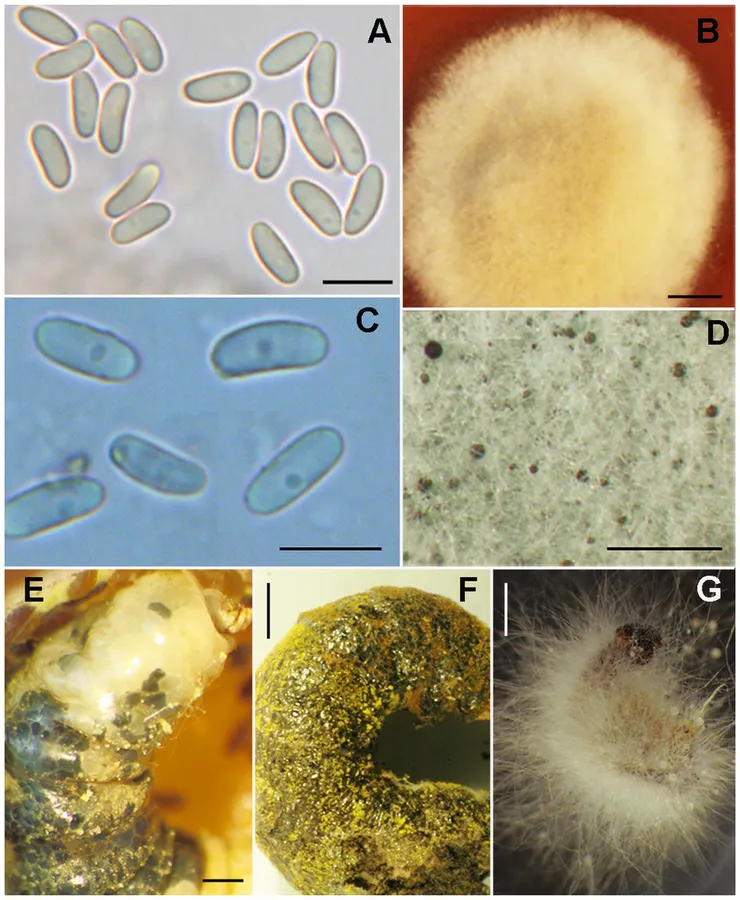
Dokumentasi Ascosphaera aggregata dari Wikimedia Commons. Figure 4. Ascosphaera aggregata and A. proliperda. Figure 4. Ascosphaera aggregata and A. proliperda. Ascosphaera aggregata and A. proliperda. Ascosphaera aggregata A) ascopores. B) culture on V8 agar medium showing pale buff mycelium.; A. proliperda C) ascospores. D) culture on SDA showing white mycelium and scattered black spore cysts. E–F) bee larvae with chalkbrood caused by A. aggregata. E) fresh Chelostoma florisomne cadaver showing mature (black) and immature (white) spore cysts below the cuticle. F) dry Osmia bicornis larva swollen from fungal growth and spore cyst production below the cuticle. G) aerial hyphae and spore cysts on bee larva with chalkbrood caused by A. proliperda. A, photographed from A.A. Wynns 5144; B from A.A. Wynns 5162; C from A.A. Wynns 5055. Scale bars: A = 10 µm, B = 2 cm, C = 5 µm, D = 825 µm, E = 2 mm, F = 1 mm, G = 2 mm. doi:10.1371/journal.pone.0073419.g001September 2013 Identifikasi mengikuti record berkas sumber.
- Jenis
- Fotografi
- Kredit
- Anja A. Wynns, Annette B. Jensen, Jørgen Eilenberg
- Lisensi
- CC BY-SA 3.0
- Sumber media
- Buka entri sumber
Sumber profil
- [1] Ascosphaera aggregata — Wikipedia (en)
- [2] Catalogue of Life Base2026-09-11 — Ascosphaera aggregata
- [3] Dokumentasi visual — Ascosphaera aggregata
Rujukan halaman ini
Fungi. Ascosphaera aggregata. Rilis data fungi-2026-10-12-expansion-2. https://fungi-atlas.mgadib.chatgpt.site/jamur/ascosphaera-aggregata/.
Status: impor sumber; pemeriksaan editorial per profil belum selesai. Untuk klaim biologis, gunakan rujukan pada bagian terkait dan periksa konteks sumber aslinya.