Ciri dan struktur
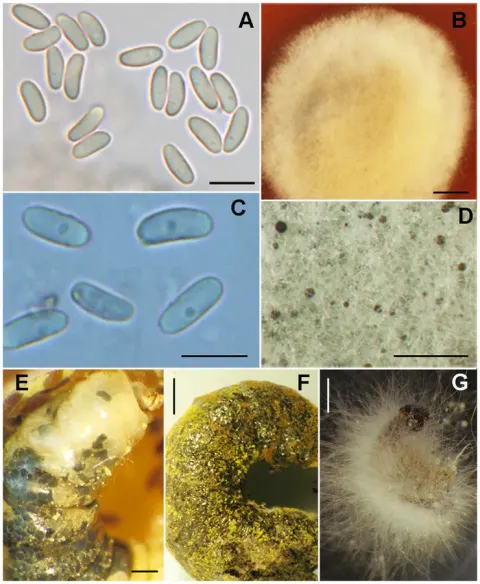
The mating system is heterothallic. Infected larvae appear shrunken, pale buff, covered by a weft of hyphae, with or without the production of ascomata. The ascomata are greenish (immature) to black (mature) spore cysts produced on aerial hyphae above the larval cuticle, measuring 40–119 μm in diameter. The spore wall is pale greenish to yellowish-brown, nearly smooth with minute punctae at high magnification. Spore balls are hyaline to pale yellowish, without granules, 7–20 μm in diameter, and mostly persistent. The ascospores are ellipsoid to somewhat sausage shaped, and measure 2.1–3.9 by 1.1–1.7 μm. Cultures grown on Sabouraud dextrose agar show rapid growth after 2–6 days; they are white with abundant production of spore cysts when both mating strains are present.
Habitat dan peran ekologis
Ascosphaera aggregate is an obligate pathogen with a preference for bees belonging to the family Megachilidae. This species has a broad distribution, with reports from both North America and Europe. This fast-growing saprotroph is associated primarily with solitary bees. This species is typically found growing on pollen provisions. Less common substrates from which A. agra has been isolated include the surface of a diseased M. rotundata larva with chalkbrood caused by A. aggregate, from pollen within the gut of an otherwise healthy M. rotundata larva and from the honey of A. mellifera. Ascosphaera agra is the only species of the genus that has been found growing on plant material (grass silage) outside of the bee habitat. Pathogenicity studies demonstrated that A. agra is not a pathogen of solitary bees; however it has been concluded that it is a weak pathogen of honeybees.
- Habitat atau konteks temuan
- Informasi belum tersedia pada sumber rilis ini.
- Substrat
- Informasi belum tersedia pada sumber rilis ini.
- Peran atau konteks
- Pengurai
Reproduksi
The mating system is heterothallic. Infected larvae appear shrunken, pale buff, covered by a weft of hyphae, with or without the production of ascomata. The ascomata are greenish (immature) to black (mature) spore cysts produced on aerial hyphae above the larval cuticle, measuring 40–119 μm in diameter. The spore wall is pale greenish to yellowish-brown, nearly smooth with minute punctae at high magnification. Spore balls are hyaline to pale yellowish, without granules, 7–20 μm in diameter, and mostly persistent. The ascospores are ellipsoid to somewhat sausage shaped, and measure 2.1–3.9 by 1.1–1.7 μm. Cultures grown on Sabouraud dextrose agar show rapid growth after 2–6 days; they are white with abundant production of spore cysts when both mating strains are present.
Catatan identitas dan cakupan
- Nama diterima mengikuti Catalogue of Life Base2026-09-11; uraian mempertahankan konsep dan nama sumber aslinya.
- Original geographic, specimen and life-cycle scope retained; source import awaits individual editorial review.
- Impor dan terjemahan otomatis belum diperiksa editorial per profil. Struktur reproduktif yang disebutkan tidak membuktikan seluruh siklus hidup diketahui.
- Pengukuran pada uraian mengikuti spesimen, kultur, dan metode sumber; angka tidak diperluas ke semua populasi.
Catatan distribusi dalam narasi mengikuti sumbernya. Dokumentasi spesimen atau foto mengikuti catatan sumber. Bukti wilayah Indonesia dan penilaian konservasi tidak disimpulkan dari gambar.
Melihat dengan konteks
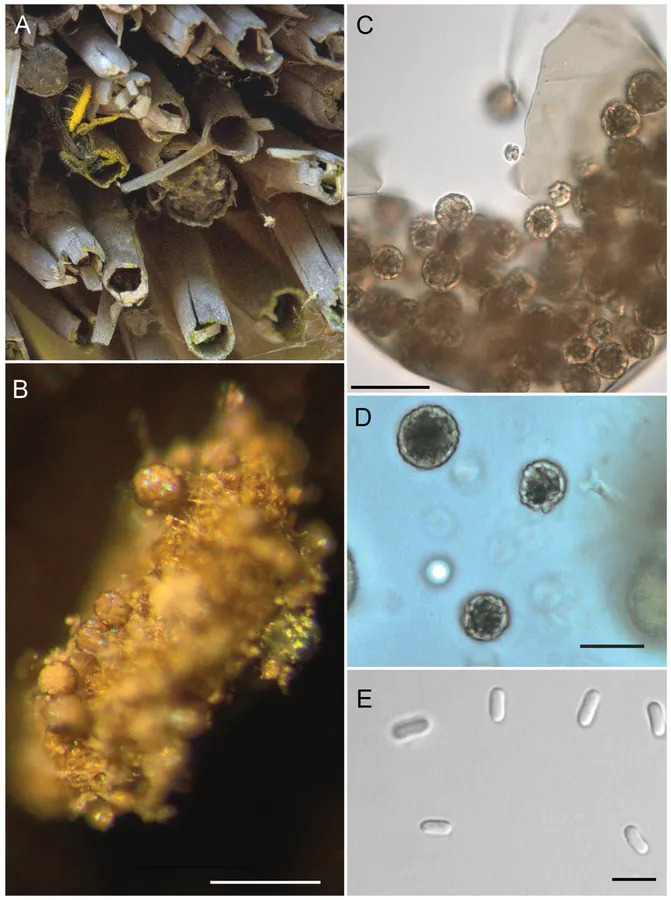
Dokumentasi Ascosphaera callicarpa dari Wikimedia Commons. Figure 1. Ascosphaera callicarpa. Figure 1. Ascosphaera callicarpa. A) habitat. Phragmites reeds and female Chelostoma florisomne returning with pollen for her brood. B) fecal pellet of C. florisomne larva covered with spore cysts; pale spore balls are visible through the transparent spore cyst wall. C) close-up of spore cyst showing spore balls and smooth, unornamented spore cyst wall. D) spore balls. E) bacilliform ascospores. B, photographed from A.A. Wynns 5168; C–E from A.A. Wynns 5166. Scale bars: B = 200 µm, C = 50 µm, C = 10 µm, D = 15 µm, E = 10 µm. doi:10.1371/journal.pone.0073419.g001September 2013 Identifikasi mengikuti record berkas sumber.
- Jenis
- Fotografi
- Kredit
- Anja A. Wynns, Annette B. Jensen, Jørgen Eilenberg
- Lisensi
- CC BY-SA 3.0
- Sumber media
- Buka entri sumber
Sumber profil
- [1] Ascosphaera callicarpa — Wikipedia (en)
- [2] Catalogue of Life Base2026-09-11 — Ascosphaera callicarpa
- [3] Dokumentasi visual — Ascosphaera callicarpa
Rujukan halaman ini
Fungi. Ascosphaera callicarpa. Rilis data fungi-2026-10-12-expansion-2. https://fungi-atlas.mgadib.chatgpt.site/jamur/ascosphaera-callicarpa/.
Status: impor sumber; pemeriksaan editorial per profil belum selesai. Untuk klaim biologis, gunakan rujukan pada bagian terkait dan periksa konteks sumber aslinya.