Ciri dan struktur
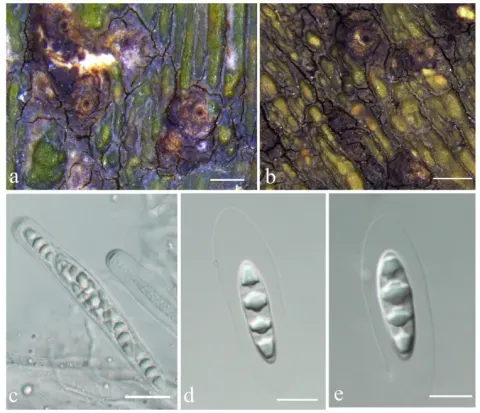
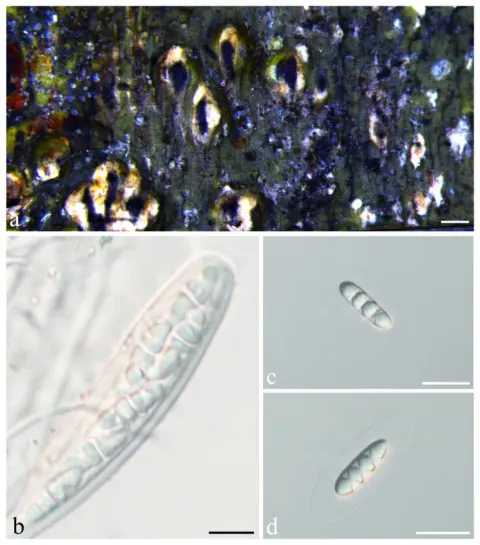
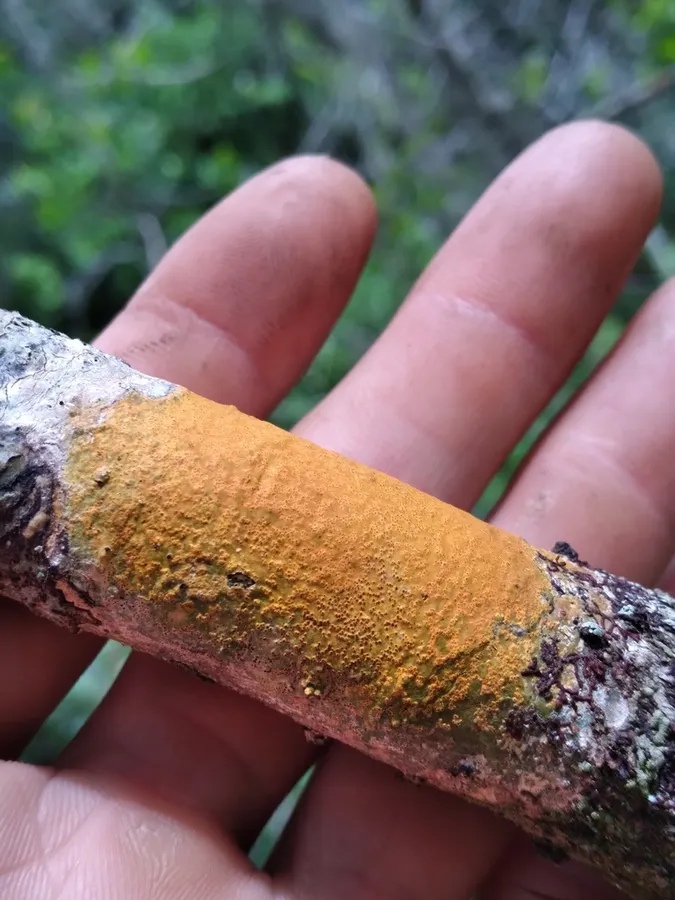
Astrothelium aeneum has a (having a cortex-like structure) thallus, which typically appears as a light olive-green to yellowish colouration. Much of its surface is often covered with a distinctive orange pigment. The texture of the thallus ranges from smooth to uneven. The ascomata, or spore-producing structures, are of the type, characterised by their apical ostioles (small openings). These ascomata are generally found either solitarily, irregularly merging with each other, or spreading diffusely in a pattern. Their size varies from 0.3 to 0.7 mm in diameter. They are , meaning they break through the thallus, and are covered by both the thallus and orange pigment, except for the darker area around the ostioles. The , the supportive tissue structure containing the asci, is clear. Each ascus typically contains eight ascospores. These spores are (spindle-shaped), with a size range of 20–27 μm in length and 7–10 μm in width. They are hyaline (translucent) and have three septa (internal partitions). They do not react to staining with iodine (IKI−). Chemically, both the thallus and ascomata of Astrothelium aeneum react to ultraviolet light by fluorescing red (UV+ red) and produce a purple reaction when treated with potassium hydroxide (K+ purple). This is indicative of the presence of an anthraquinone, a type of chemical compound.
Habitat dan peran ekologis
Astrothelium aeneum is found in a wide range of tropical regions globally. Its presence has been recorded in various countries including the United States, Costa Rica, El Salvador, the Revillagigedo Islands, the Bahamas, Cuba, Jamaica, Colombia, Venezuela, Guyana, Suriname, French Guiana, the Galápagos Islands, Bolivia, Brazil, Sri Lanka, Thailand, and Malaysia (specifically in Sarawak and Sabah). Additionally, it is found in Papua New Guinea and Australia.
- Habitat atau konteks temuan
- Informasi belum tersedia pada sumber rilis ini.
- Substrat
- Informasi belum tersedia pada sumber rilis ini.
- Peran atau konteks
- Pembentuk liken
Reproduksi
The ascomata, or spore-producing structures, are of the type, characterised by their apical ostioles (small openings). These ascomata are generally found either solitarily, irregularly merging with each other, or spreading diffusely in a pattern. Their size varies from 0.3 to 0.7 mm in diameter. They are , meaning they break through the thallus, and are covered by both the thallus and orange pigment, except for the darker area around the ostioles. The , the supportive tissue structure containing the asci, is clear. Each ascus typically contains eight ascospores. These spores are (spindle-shaped), with a size range of 20–27 μm in length and 7–10 μm in width. They are hyaline (translucent) and have three septa (internal partitions).
Catatan identitas dan cakupan
- Nama diterima mengikuti Catalogue of Life Base2026-09-11; uraian mempertahankan konsep dan nama sumber aslinya.
- Original geographic, specimen and life-cycle scope retained; source import awaits individual editorial review.
- Impor dan terjemahan otomatis belum diperiksa editorial per profil. Struktur reproduktif yang disebutkan tidak membuktikan seluruh siklus hidup diketahui.
- Pengukuran pada uraian mengikuti spesimen, kultur, dan metode sumber; angka tidak diperluas ke semua populasi.
Catatan distribusi dalam narasi mengikuti sumbernya. Dokumentasi spesimen atau foto mengikuti catatan sumber. Bukti wilayah Indonesia dan penilaian konservasi tidak disimpulkan dari gambar.
Melihat dengan konteks
Dokumentasi Astrothelium aeneum menurut asosiasi foto pada record takson iNaturalist. Kredit: Scott Ward. Identitas mengikuti sumber; bukan penentuan spesimen independen.
- Jenis
- Fotografi
- Kredit
- (c) Scott Ward, some rights reserved (CC BY), uploaded by Scott Ward
- Lisensi
- CC BY 4.0
- Sumber media
- Buka entri sumber
Sumber profil
- [1] Astrothelium aeneum — Wikipedia (en)
- [2] Catalogue of Life Base2026-09-11 — Astrothelium aeneum
- [3] Dokumentasi visual — Astrothelium aeneum
Rujukan halaman ini
Fungi. Astrothelium aeneum. Rilis data fungi-2026-10-12-expansion-2. https://fungi-atlas.mgadib.chatgpt.site/jamur/astrothelium-aeneum/.
Status: impor sumber; pemeriksaan editorial per profil belum selesai. Untuk klaim biologis, gunakan rujukan pada bagian terkait dan periksa konteks sumber aslinya.