01 / Morfologi

Ciri dan struktur

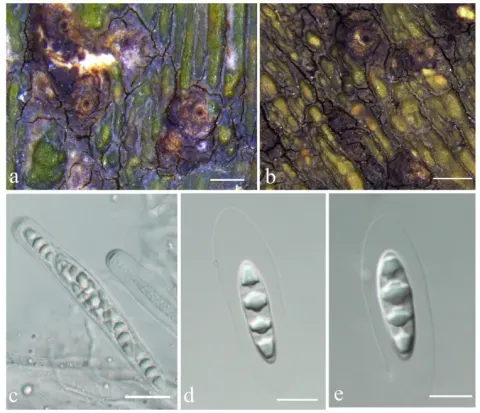
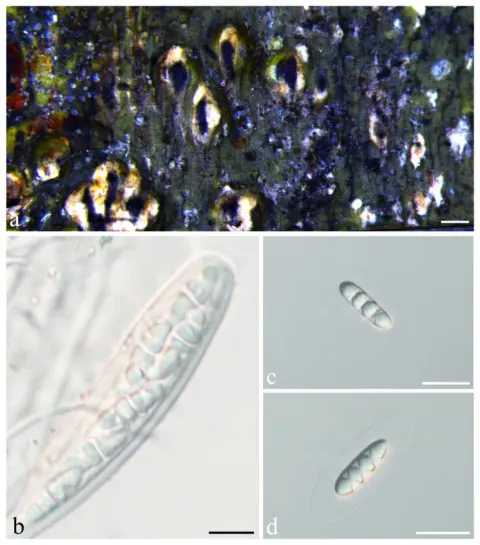
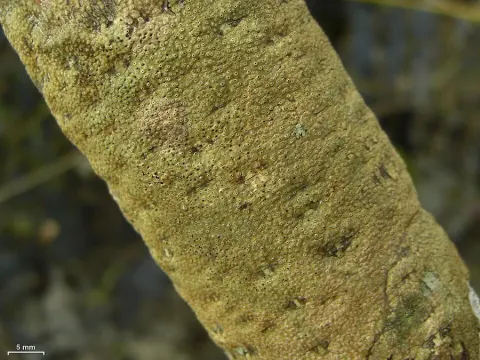
The thallus (lichen body) has an outer and is olive-green to brownish, with a distinctly uneven, (blistered) surface with gall-like swellings (pseudogalls). The fruiting bodies (ascomata) are and open through ostioles at the top. They are often packed together, sometimes forming diffuse ; each ascoma is about 0.4–0.5 mm in diameter and is embedded in, and overgrown by, the thallus. The (tissue between the asci) is (filled with many tiny droplets). Ascospores are eight per ascus, hyaline, 3-septate, and measure 15–32 × 9–12 μm; they are IKI−. In spot tests, the thallus and ascomata are UV+ (yellow under ultraviolet light) and K− (no reaction with potassium hydroxide). Thin-layer chromatography detected lichexanthone.

Sebagian uraian ditampilkan dalam bahasa sumber; terjemahannya belum tersedia atau belum lolos pemeriksaan.

Rujukan: [1]

Pengukuran mengikuti objek, spesimen atau kultur, dan metode yang disebutkan sumber. Baca uraian asli untuk konteks lengkap.

02 / Kehidupan

Habitat dan peran ekologis

Trypetheliaceae is an almost entirely tropical family. Most species are epiphytic (growing on plants, usually tree bark) and are often found in well-lit places such as the forest canopy. They also occur in more open tropical habitats, including savannas and dry forests. Astrothelium grossoides is reported from Papua New Guinea, where it is locally abundant, and from New Caledonia.

Sebagian uraian ditampilkan dalam bahasa sumber; terjemahannya belum tersedia atau belum lolos pemeriksaan.

Rujukan: [1]

Habitat atau konteks temuan
hutan
Substrat
Informasi belum tersedia pada sumber rilis ini.
Peran atau konteks
Pembentuk liken
Temukan hubungan serupa
03 / Siklus hidup

Reproduksi

The thallus (lichen body) has an outer and is olive-green to brownish, with a distinctly uneven, (blistered) surface with gall-like swellings (pseudogalls). The fruiting bodies (ascomata) are and open through ostioles at the top. They are often packed together, sometimes forming diffuse ; each ascoma is about 0.4–0.5 mm in diameter and is embedded in, and overgrown by, the thallus. The (tissue between the asci) is (filled with many tiny droplets). Ascospores are eight per ascus, hyaline, 3-septate, and measure 15–32 × 9–12 μm; they are IKI−. In spot tests, the thallus and ascomata are UV+ (yellow under ultraviolet light) and K− (no reaction with potassium hydroxide). Thin-layer chromatography detected lichexanthone.

Sebagian uraian ditampilkan dalam bahasa sumber; terjemahannya belum tersedia atau belum lolos pemeriksaan.

Rujukan: [1]

Sinonim menurut acuan taksonomi rilis: Trypethelium grossum
04 / Batas informasi

Catatan identitas dan cakupan

  • Nama diterima mengikuti Catalogue of Life Base2026-09-11; uraian mempertahankan konsep dan nama sumber aslinya.
  • Original geographic, specimen and life-cycle scope retained; source import awaits individual editorial review.
  • Impor dan terjemahan otomatis belum diperiksa editorial per profil. Struktur reproduktif yang disebutkan tidak membuktikan seluruh siklus hidup diketahui.
  • Pengukuran pada uraian mengikuti spesimen, kultur, dan metode sumber; angka tidak diperluas ke semua populasi.

Catatan distribusi dalam narasi mengikuti sumbernya. Dokumentasi spesimen atau foto mengikuti catatan sumber. Bukti wilayah Indonesia dan penilaian konservasi tidak disimpulkan dari gambar.

05 / Dokumentasi

Melihat dengan konteks

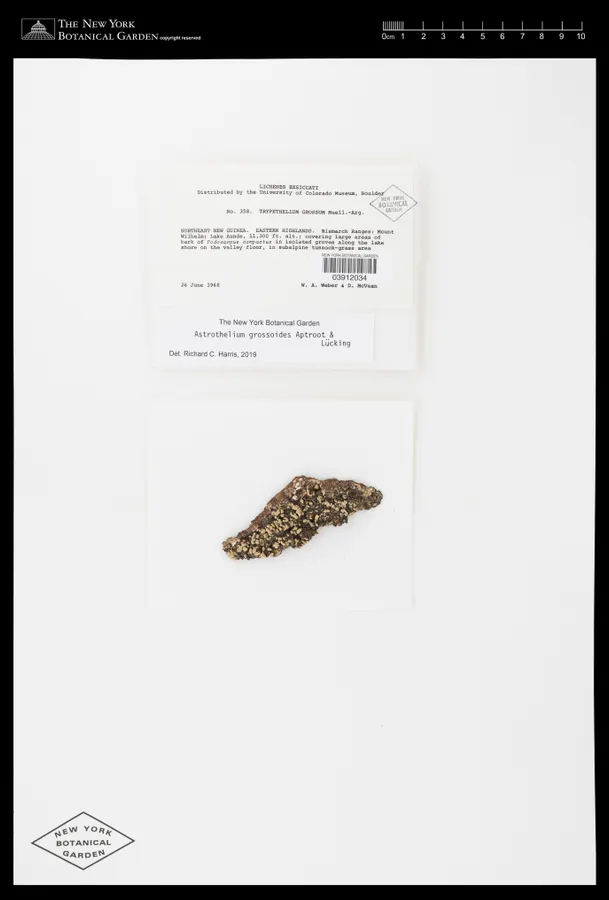
Voucher herbarium Astrothelium grossoides (03912034), The New York Botanical Garden. Identifikasi mengikuti record spesimen sumber. Foto bahan, kemasan, atau label herbarium sebagaimana tersedia pada record institusi; bukan foto lapangan atau penentuan spesimen independen.

Jenis
Voucher herbarium
Kredit
The New York Botanical Garden
Lisensi
CC BY 4.0
Sumber media
Buka entri sumber

Gambar menunjukkan objek menurut identifikasi sumber, bukan verifikasi independen spesimen oleh Fungi. Tidak ada skala baru yang ditambahkan.

06 / Rujukan

Sumber profil

  1. [1] Astrothelium grossoides — Wikipedia (en)Bagian sumber: Frozen revision 1329858210
    Tanggal penghimpunan sumber: 2026-10-12
    Teks sumber: CC BY-SA4.0 · Wikipedia contributors
  2. [2] Catalogue of Life Base2026-09-11 — Astrothelium grossoidesBagian sumber: ColDP NameUsage.tsv ID 5W85N; accepted species; source 2073
    Tanggal penghimpunan sumber: 2026-10-12
  3. [3] Dokumentasi visual — Astrothelium grossoidesBagian sumber: Individual media record; identification follows the source, not independent determination
    Tanggal penghimpunan sumber: 2026-10-12
    Media sumber: CC BY 4.0 · The New York Botanical Garden

Adaptasi teks: CC BY-SA 4.0. Wikipedia contributors — Astrothelium grossoides — Wikipedia (en)

Uraian asli dan riwayat sumber

Riwayat atau halaman sumber

Ringkasan sumber

Astrothelium grossoides is a species of lichen in the family Trypetheliaceae. It forms olive-green to brownish patches with a distinctly bumpy, blistered surface on tree bark in tropical forests, particularly in well-lit canopy environments and open woodland habitats. The species is recognized by its closely packed fruiting bodies that are largely embedded and overgrown by the thallus, each opening through a pore at the apex, and by relatively small ascospores with three cross-walls. It was formally established in 2016 under a replacement scientific name to avoid duplication with an earlier-named species, based on type material originally collected from Papua New Guinea where it occurs locally in abundance.

Revisi sumber

Morfologi sumber

The thallus (lichen body) has an outer and is olive-green to brownish, with a distinctly uneven, (blistered) surface with gall-like swellings (pseudogalls). The fruiting bodies (ascomata) are and open through ostioles at the top. They are often packed together, sometimes forming diffuse ; each ascoma is about 0.4–0.5 mm in diameter and is embedded in, and overgrown by, the thallus. The (tissue between the asci) is (filled with many tiny droplets). Ascospores are eight per ascus, hyaline, 3-septate, and measure 15–32 × 9–12 μm; they are IKI−. In spot tests, the thallus and ascomata are UV+ (yellow under ultraviolet light) and K− (no reaction with potassium hydroxide). Thin-layer chromatography detected lichexanthone.

Revisi sumber

Ekologi sumber

Trypetheliaceae is an almost entirely tropical family. Most species are epiphytic (growing on plants, usually tree bark) and are often found in well-lit places such as the forest canopy. They also occur in more open tropical habitats, including savannas and dry forests. Astrothelium grossoides is reported from Papua New Guinea, where it is locally abundant, and from New Caledonia.

Revisi sumber

Struktur reproduksi sumber

The thallus (lichen body) has an outer and is olive-green to brownish, with a distinctly uneven, (blistered) surface with gall-like swellings (pseudogalls). The fruiting bodies (ascomata) are and open through ostioles at the top. They are often packed together, sometimes forming diffuse ; each ascoma is about 0.4–0.5 mm in diameter and is embedded in, and overgrown by, the thallus. The (tissue between the asci) is (filled with many tiny droplets). Ascospores are eight per ascus, hyaline, 3-septate, and measure 15–32 × 9–12 μm; they are IKI−. In spot tests, the thallus and ascomata are UV+ (yellow under ultraviolet light) and K− (no reaction with potassium hydroxide). Thin-layer chromatography detected lichexanthone.

Revisi sumber

Rujukan halaman ini

Fungi. Astrothelium grossoides. Rilis data fungi-2026-10-12-expansion-2. https://fungi-atlas.mgadib.chatgpt.site/jamur/astrothelium-grossoides/.

Status: impor sumber; pemeriksaan editorial per profil belum selesai. Untuk klaim biologis, gunakan rujukan pada bagian terkait dan periksa konteks sumber aslinya.