01 / Morfologi

Ciri dan struktur

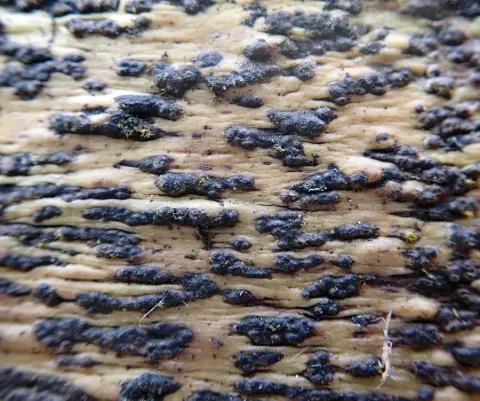
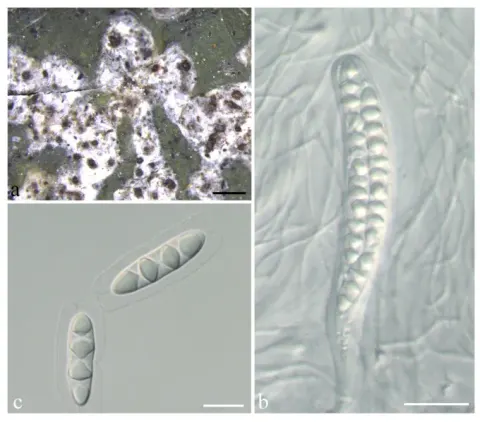
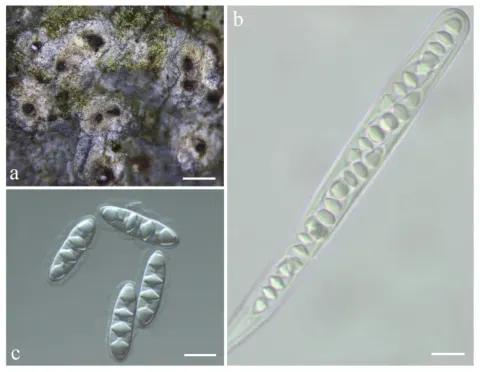
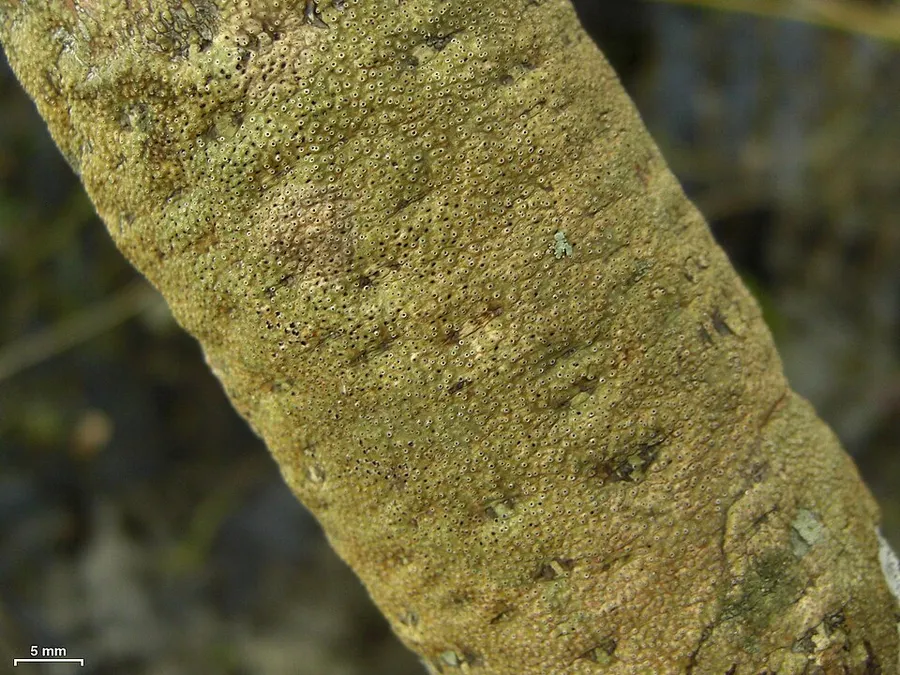
The thallus (the lichen body) is (bearing a ) olive-brown, and smooth to uneven. The spore-producing structures (ascomata) are astrothelioid: several chambers are joined together and share fused, slightly off-center pores (ostioles). These joined ascomata form small (a compact tissue mass that houses the chambers) that are about 0.7–1.0 mm across, immersed in the thallus and becoming (breaking through the surface). They are covered either by the surrounding thallus or by a thin yellowish-white layer. The internal hyphal matrix () is clear. Each ascus contains eight colorless (hyaline), 3-septate, to ellipsoid ascospores measuring roughly 35–45 × 14–16 μm; the spores do not stain with iodine (IKI−). Standard spot tests are negative on both thallus and ascomata (UV−, K−), and thin-layer chromatography detects no lichen products.

Sebagian uraian ditampilkan dalam bahasa sumber; terjemahannya belum tersedia atau belum lolos pemeriksaan.

Rujukan: [1]

Pengukuran mengikuti objek, spesimen atau kultur, dan metode yang disebutkan sumber. Baca uraian asli untuk konteks lengkap.

02 / Kehidupan

Habitat dan peran ekologis

Astrothelium marcidum is Neotropical. The type was collected from the bark of cinchona trees, and the species is corticolous (bark-dwelling).

Sebagian uraian ditampilkan dalam bahasa sumber; terjemahannya belum tersedia atau belum lolos pemeriksaan.

Rujukan: [1]

Habitat atau konteks temuan
Informasi belum tersedia pada sumber rilis ini.
Substrat
Informasi belum tersedia pada sumber rilis ini.
Peran atau konteks
Pembentuk liken
Temukan hubungan serupa
03 / Siklus hidup

Reproduksi

The thallus (the lichen body) is (bearing a ) olive-brown, and smooth to uneven. The spore-producing structures (ascomata) are astrothelioid: several chambers are joined together and share fused, slightly off-center pores (ostioles). These joined ascomata form small (a compact tissue mass that houses the chambers) that are about 0.7–1.0 mm across, immersed in the thallus and becoming (breaking through the surface). They are covered either by the surrounding thallus or by a thin yellowish-white layer. The internal hyphal matrix () is clear. Each ascus contains eight colorless (hyaline), 3-septate, to ellipsoid ascospores measuring roughly 35–45 × 14–16 μm; the spores do not stain with iodine (IKI−).

Sebagian uraian ditampilkan dalam bahasa sumber; terjemahannya belum tersedia atau belum lolos pemeriksaan.

Rujukan: [1]

Sinonim menurut acuan taksonomi rilis: Pyrenula marcida; Trypethelium marcidum; Verrucaria marcida
04 / Batas informasi

Catatan identitas dan cakupan

  • Nama diterima mengikuti Catalogue of Life Base2026-09-11; uraian mempertahankan konsep dan nama sumber aslinya.
  • Original geographic, specimen and life-cycle scope retained; source import awaits individual editorial review.
  • Impor dan terjemahan otomatis belum diperiksa editorial per profil. Struktur reproduktif yang disebutkan tidak membuktikan seluruh siklus hidup diketahui.
  • Pengukuran pada uraian mengikuti spesimen, kultur, dan metode sumber; angka tidak diperluas ke semua populasi.

Catatan distribusi dalam narasi mengikuti sumbernya. Dokumentasi spesimen atau foto mengikuti catatan sumber. Bukti wilayah Indonesia dan penilaian konservasi tidak disimpulkan dari gambar.

05 / Dokumentasi

Melihat dengan konteks

Dokumentasi Astrothelium marcidum dari Wikimedia Commons. Big Cypress Preserve, Florida, 20131217-8 Identifikasi mengikuti record berkas sumber.

Jenis
Fotografi
Kredit
Jason Hollinger
Lisensi
CC BY 2.0
Sumber media
Buka entri sumber

Gambar menunjukkan objek menurut identifikasi sumber, bukan verifikasi independen spesimen oleh Fungi. Tidak ada skala baru yang ditambahkan.

06 / Rujukan

Sumber profil

  1. [1] Astrothelium marcidum — Wikipedia (en)Bagian sumber: Frozen revision 1311340541
    Tanggal penghimpunan sumber: 2026-10-12
    Teks sumber: CC BY-SA4.0 · Wikipedia contributors
  2. [2] Catalogue of Life Base2026-09-11 — Astrothelium marcidumBagian sumber: ColDP NameUsage.tsv ID J5FZ; accepted species; source 2073
    Tanggal penghimpunan sumber: 2026-10-12
  3. [3] Dokumentasi visual — Astrothelium marcidumBagian sumber: Individual media record; identification follows the source, not independent determination
    Tanggal penghimpunan sumber: 2026-10-12
    Media sumber: CC BY 2.0 · Jason Hollinger

Adaptasi teks: CC BY-SA 4.0. Wikipedia contributors — Astrothelium marcidum — Wikipedia (en)

Uraian asli dan riwayat sumber

Riwayat atau halaman sumber

Ringkasan sumber

Astrothelium marcidum is a species of crustose lichen in the family Trypetheliaceae. Known from the Neotropics, it has an olive-brown crust and compound, multi-chambered fruiting bodies, and it lacks detectable lichen substances. The species was originally described in 1824 from the bark of cinchona trees in South America.

Revisi sumber

Morfologi sumber

The thallus (the lichen body) is (bearing a ) olive-brown, and smooth to uneven. The spore-producing structures (ascomata) are astrothelioid: several chambers are joined together and share fused, slightly off-center pores (ostioles). These joined ascomata form small (a compact tissue mass that houses the chambers) that are about 0.7–1.0 mm across, immersed in the thallus and becoming (breaking through the surface). They are covered either by the surrounding thallus or by a thin yellowish-white layer. The internal hyphal matrix () is clear. Each ascus contains eight colorless (hyaline), 3-septate, to ellipsoid ascospores measuring roughly 35–45 × 14–16 μm; the spores do not stain with iodine (IKI−). Standard spot tests are negative on both thallus and ascomata (UV−, K−), and thin-layer chromatography detects no lichen products.

Revisi sumber

Ekologi sumber

Astrothelium marcidum is Neotropical. The type was collected from the bark of cinchona trees, and the species is corticolous (bark-dwelling).

Revisi sumber

Struktur reproduksi sumber

The thallus (the lichen body) is (bearing a ) olive-brown, and smooth to uneven. The spore-producing structures (ascomata) are astrothelioid: several chambers are joined together and share fused, slightly off-center pores (ostioles). These joined ascomata form small (a compact tissue mass that houses the chambers) that are about 0.7–1.0 mm across, immersed in the thallus and becoming (breaking through the surface). They are covered either by the surrounding thallus or by a thin yellowish-white layer. The internal hyphal matrix () is clear. Each ascus contains eight colorless (hyaline), 3-septate, to ellipsoid ascospores measuring roughly 35–45 × 14–16 μm; the spores do not stain with iodine (IKI−).

Revisi sumber

Rujukan halaman ini

Fungi. Astrothelium marcidum. Rilis data fungi-2026-10-12-expansion-2. https://fungi-atlas.mgadib.chatgpt.site/jamur/astrothelium-marcidum/.

Status: impor sumber; pemeriksaan editorial per profil belum selesai. Untuk klaim biologis, gunakan rujukan pada bagian terkait dan periksa konteks sumber aslinya.