01 / Morfologi

Ciri dan struktur

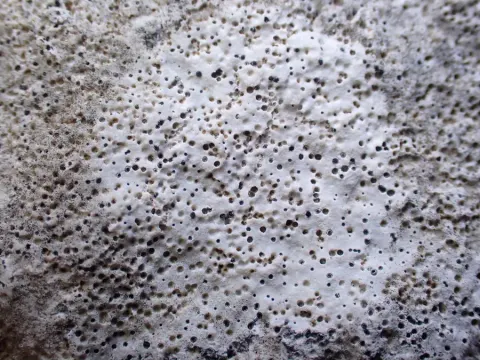
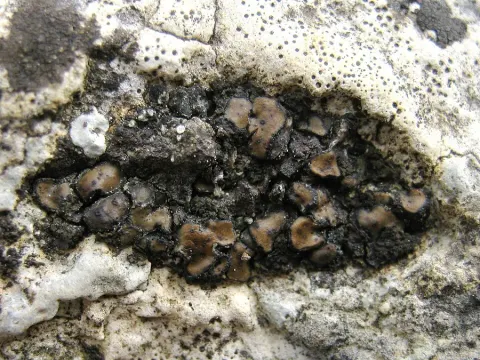
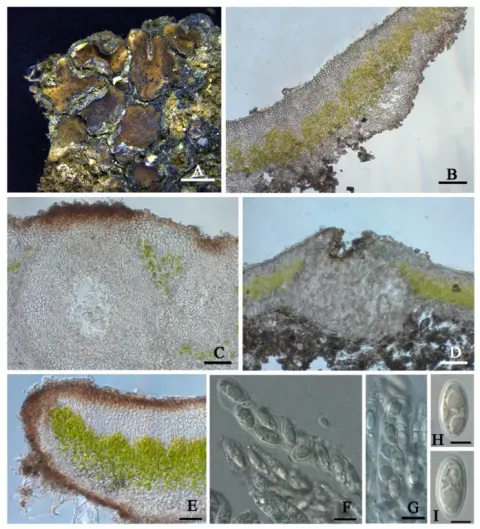
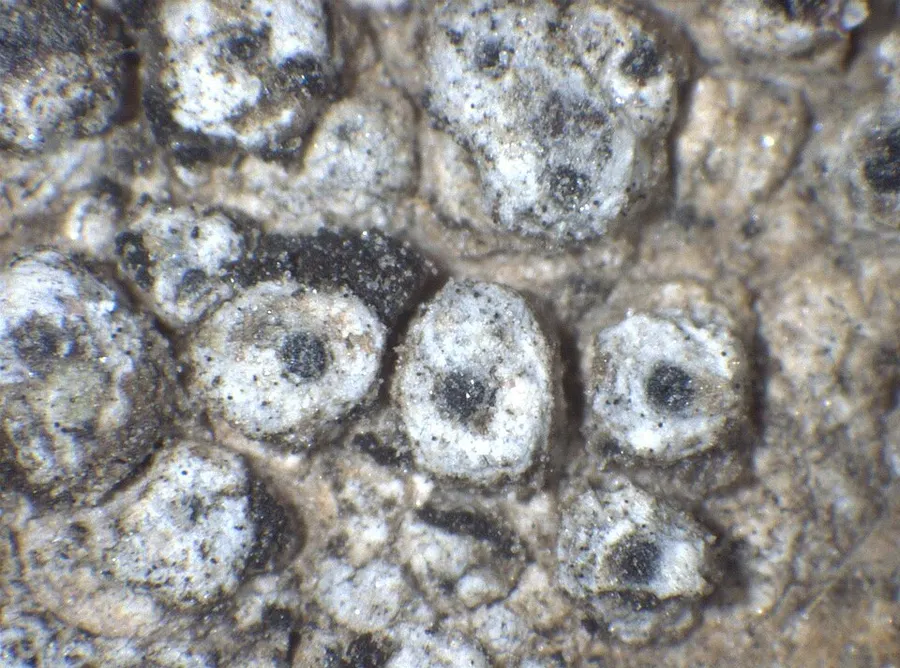
Atla alpina is a crustose lichen characterized by a thin thallus (the main body of the lichen) that forms minute measuring 0.4–0.6 mm wide. These areoles have irregular, slightly uneven surfaces, ranging in colour from grey to dark greenish grey. The thallus sometimes appears minutely , thin, and matt, or it may be partly immersed in its substrate, emerging only as blackish green patches. The primary is an unidentified green alga, while small, almost black colonies of the cyanobacterium Nostoc are frequently found associated with the thallus, suggesting they may also participate in the symbiotic relationship. The reproductive structures, , are relatively large (0.71–0.87 mm in diameter), shiny black, and almost spherical. They are and broadly connected at the base without a thalline covering. The (outer protective layer) is thick, measuring approximately 80–120 μm, with a strongly black outer layer. The (inner wall) is 15–25 μm thick, brown, and composed of narrow, concentrically arranged cells that become paler in the lowermost part. Mature asci lack apical thickening and measure 153–178 μm by 70–112 μm, containing eight spores each. The ascospores are large (70.1–83.0 μm by 39.1–49.0 μm), broadly ellipsoidal, and very dark brown when mature. They have a muriform structure with 7–8 transverse walls and 3–4 longitudinal walls in the central part. When treated with iodine, the gel stains red, and with potassium iodide, it turns blue.

Sebagian uraian ditampilkan dalam bahasa sumber; terjemahannya belum tersedia atau belum lolos pemeriksaan.

Rujukan: [1]

Pengukuran mengikuti objek, spesimen atau kultur, dan metode yang disebutkan sumber. Baca uraian asli untuk konteks lengkap.

02 / Kehidupan

Habitat dan peran ekologis

Atla alpina is a species of saxicolous (rock-dwelling), crustose lichen in the family Verrucariaceae, and the type species of the genus Atla. Found in Europe, it was formally described as a new species in 2008 by Sanja Savić and Leif Tibell. The type specimen was collected near Djupdalsvallen (Mittåkläppen, Härjedalen, Sweden) at an altitude of 1170 m, where it was found growing on northwest-facing, vertical slate rocks. In addition to Sweden, the lichen has been recorded from Scandinavia, Spitsbergen, Novaya Zemlya, Austria, and Germany, at elevations ranging from 345 to 2700 m.

Sebagian uraian ditampilkan dalam bahasa sumber; terjemahannya belum tersedia atau belum lolos pemeriksaan.

Rujukan: [1]

Habitat atau konteks temuan
Informasi belum tersedia pada sumber rilis ini.
Substrat
Informasi belum tersedia pada sumber rilis ini.
Peran atau konteks
Pembentuk liken
Temukan hubungan serupa
03 / Siklus hidup

Reproduksi

The reproductive structures, , are relatively large (0.71–0.87 mm in diameter), shiny black, and almost spherical. They are and broadly connected at the base without a thalline covering. The (outer protective layer) is thick, measuring approximately 80–120 μm, with a strongly black outer layer. The (inner wall) is 15–25 μm thick, brown, and composed of narrow, concentrically arranged cells that become paler in the lowermost part. Mature asci lack apical thickening and measure 153–178 μm by 70–112 μm, containing eight spores each. The ascospores are large (70.1–83.0 μm by 39.1–49.0 μm), broadly ellipsoidal, and very dark brown when mature. They have a muriform structure with 7–8 transverse walls and 3–4 longitudinal walls in the central part.

Sebagian uraian ditampilkan dalam bahasa sumber; terjemahannya belum tersedia atau belum lolos pemeriksaan.

Rujukan: [1]

04 / Batas informasi

Catatan identitas dan cakupan

  • Nama diterima mengikuti Catalogue of Life Base2026-09-11; uraian mempertahankan konsep dan nama sumber aslinya.
  • Original geographic, specimen and life-cycle scope retained; source import awaits individual editorial review.
  • Impor dan terjemahan otomatis belum diperiksa editorial per profil. Struktur reproduktif yang disebutkan tidak membuktikan seluruh siklus hidup diketahui.
  • Pengukuran pada uraian mengikuti spesimen, kultur, dan metode sumber; angka tidak diperluas ke semua populasi.

Catatan distribusi dalam narasi mengikuti sumbernya. Dokumentasi spesimen atau foto mengikuti catatan sumber. Bukti wilayah Indonesia dan penilaian konservasi tidak disimpulkan dari gambar.

05 / Dokumentasi

Melihat dengan konteks

Dokumentasi Atla alpina dari Wikimedia Commons. The crustose, rock-dwelling lichen Atla alpina . Identifikasi mengikuti record berkas sumber.

Jenis
Fotografi
Kredit
Pier Luigi Nimis
Sumber media
Buka entri sumber

Gambar menunjukkan objek menurut identifikasi sumber, bukan verifikasi independen spesimen oleh Fungi. Tidak ada skala baru yang ditambahkan.

06 / Rujukan

Sumber profil

  1. [1] Atla alpina — Wikipedia (en)Bagian sumber: Frozen revision 1284910989
    Tanggal penghimpunan sumber: 2026-10-12
    Teks sumber: CC BY-SA4.0 · Wikipedia contributors
  2. [2] Catalogue of Life Base2026-09-11 — Atla alpinaBagian sumber: ColDP NameUsage.tsv ID JGTB; accepted species; source 2073
    Tanggal penghimpunan sumber: 2026-10-12
  3. [3] Dokumentasi visual — Atla alpinaBagian sumber: Individual media record; identification follows the source, not independent determination
    Tanggal penghimpunan sumber: 2026-10-12
    Media sumber: CC BY-SA 4.0 · Pier Luigi Nimis

Adaptasi teks: CC BY-SA 4.0. Wikipedia contributors — Atla alpina — Wikipedia (en)

Uraian asli dan riwayat sumber

Riwayat atau halaman sumber

Ringkasan sumber

Atla alpina is a species of saxicolous (rock-dwelling), crustose lichen in the family Verrucariaceae, and the type species of the genus Atla. Found in Europe, it was formally described as a new species in 2008 by Sanja Savić and Leif Tibell. The type specimen was collected near Djupdalsvallen (Mittåkläppen, Härjedalen, Sweden) at an altitude of 1170 m, where it was found growing on northwest-facing, vertical slate rocks. In addition to Sweden, the lichen has been recorded from Scandinavia, Spitsbergen, Novaya Zemlya, Austria, and Germany, at elevations ranging from 345 to 2700 m.

Revisi sumber

Morfologi sumber

Atla alpina is a crustose lichen characterized by a thin thallus (the main body of the lichen) that forms minute measuring 0.4–0.6 mm wide. These areoles have irregular, slightly uneven surfaces, ranging in colour from grey to dark greenish grey. The thallus sometimes appears minutely , thin, and matt, or it may be partly immersed in its substrate, emerging only as blackish green patches. The primary is an unidentified green alga, while small, almost black colonies of the cyanobacterium Nostoc are frequently found associated with the thallus, suggesting they may also participate in the symbiotic relationship. The reproductive structures, , are relatively large (0.71–0.87 mm in diameter), shiny black, and almost spherical. They are and broadly connected at the base without a thalline covering. The (outer protective layer) is thick, measuring approximately 80–120 μm, with a strongly black outer layer. The (inner wall) is 15–25 μm thick, brown, and composed of narrow, concentrically arranged cells that become paler in the lowermost part. Mature asci lack apical thickening and measure 153–178 μm by 70–112 μm, containing eight spores each. The ascospores are large (70.1–83.0 μm by 39.1–49.0 μm), broadly ellipsoidal, and very dark brown when mature. They have a muriform structure with 7–8 transverse walls and 3–4 longitudinal walls in the central part. When treated with iodine, the gel stains red, and with potassium iodide, it turns blue.

Revisi sumber

Ekologi sumber

Atla alpina is a species of saxicolous (rock-dwelling), crustose lichen in the family Verrucariaceae, and the type species of the genus Atla. Found in Europe, it was formally described as a new species in 2008 by Sanja Savić and Leif Tibell. The type specimen was collected near Djupdalsvallen (Mittåkläppen, Härjedalen, Sweden) at an altitude of 1170 m, where it was found growing on northwest-facing, vertical slate rocks. In addition to Sweden, the lichen has been recorded from Scandinavia, Spitsbergen, Novaya Zemlya, Austria, and Germany, at elevations ranging from 345 to 2700 m.

Revisi sumber

Struktur reproduksi sumber

The reproductive structures, , are relatively large (0.71–0.87 mm in diameter), shiny black, and almost spherical. They are and broadly connected at the base without a thalline covering. The (outer protective layer) is thick, measuring approximately 80–120 μm, with a strongly black outer layer. The (inner wall) is 15–25 μm thick, brown, and composed of narrow, concentrically arranged cells that become paler in the lowermost part. Mature asci lack apical thickening and measure 153–178 μm by 70–112 μm, containing eight spores each. The ascospores are large (70.1–83.0 μm by 39.1–49.0 μm), broadly ellipsoidal, and very dark brown when mature. They have a muriform structure with 7–8 transverse walls and 3–4 longitudinal walls in the central part.

Revisi sumber

Rujukan halaman ini

Fungi. Atla alpina. Rilis data fungi-2026-10-12-expansion-2. https://fungi-atlas.mgadib.chatgpt.site/jamur/atla-alpina/.

Status: impor sumber; pemeriksaan editorial per profil belum selesai. Untuk klaim biologis, gunakan rujukan pada bagian terkait dan periksa konteks sumber aslinya.