Ciri dan struktur
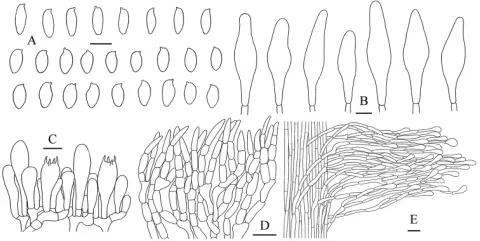
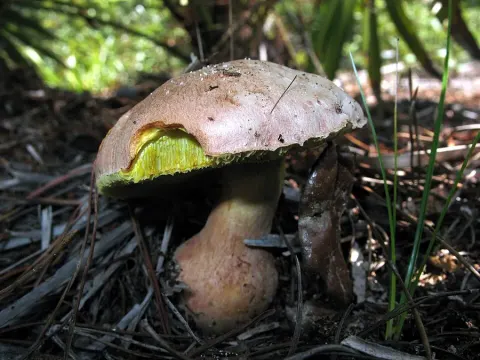
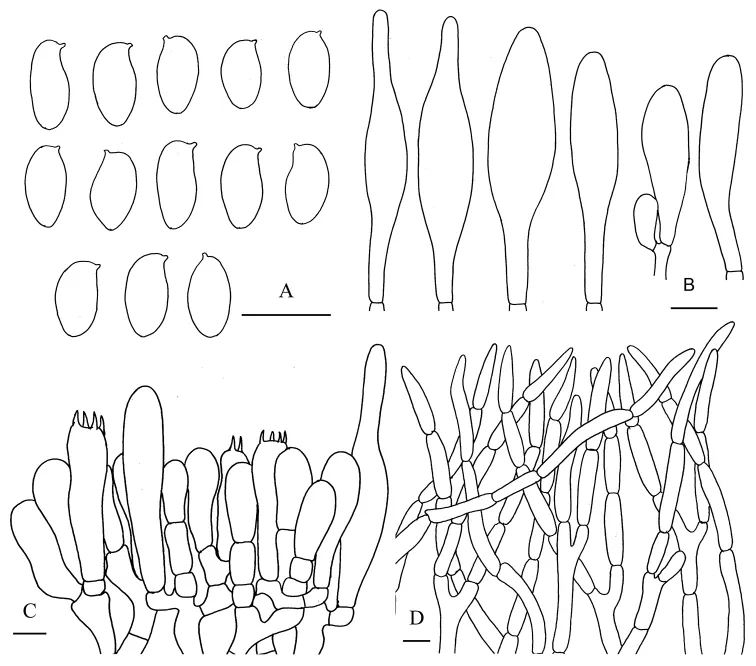
This species can be easily distinguished from other Aureoboletus taxa by its dry and small basidiomata, brownish-yellow to greyish-red pileus, glabrous stipe and smaller basidiospores (7–)8–10.5(–11) × (4–)4.5–5 μm. Basidiomata small-sized. Pileus 1.5–2.5 cm wide, hemispheric when young, becoming convex to nearly plane in age, fleshy, dry or slightly viscid when wet, minutely velvet subtomentose, slightly wrinkled, brownish-yellow, brownish-orange, brownish-red to greyish-red (5C7–8C7, 5C5–9C5); margin thin, slightly incurved at first, becoming nearly straight, often appendiculate with small membranous remains of the veil. Context 2–6 mm thick at centre, firm and tough in youth, becoming soft, white, more or less greyish-red (9C5–11C5) to brownish-red (9C7–11C7) beneath the pileipellis, unchanging when exposed. Tubes 2–3 mm deep, gr-yish-yellow (1B5–3B5), light yellow (1A5–3A5) to vivid yellow (1A8–3A8), gradually changing to greenish-yellow when mature, unchanging when bruised, shallowly depressed around the stipe at maturity. Pores small, 1–2 per mm, somewhat larger around the stipe, circular to angular; pore-surface concolorous with tubes. Stipe 20–45 × 2–6 mm, central, cylindrical or clavate, equal to slightly enlarged downwards, glabrous, dry or slightly viscid when wet, pale orange to pale red (5A3–7A3), pastel red (8A5–10A5), with very pale flush of pastel red (8A5–10A5) fibrous stripes. Stipe context white to pastel red (8A4–10A4), slightly darker when bruised, especially in the lower part. Basal mycelium white. Odour none. Taste mild. Basidiospores [80/3/3] (7–)8–10.5(–11) ×(4–)4.5–5 μm, Q = (1.5–)1.8–2.2(–2.6), Q m = 2.0 ± 0.21, subfusiform and inequilateral in side view, oblong to ovoid in ventral view, smooth, yellowish to yellowish-brown in 5% KOH and yellow brown to dark brown in Melzer’s reagent, thin-walled.
Habitat dan peran ekologis
Solitary or gregarious on soil under broadleaf forests dominated by Castanopsis spp. and Cyclobalanopsis spp. and mixed with other broadleaf trees, alt. 300–1200 m; May to July, currently only known from Guangdong Province.
- Habitat atau konteks temuan
- hutan
- Substrat
- tanah
- Peran atau konteks
- Belum dikategorikan pada rilis ini.
Reproduksi
This species can be easily distinguished from other Aureoboletus taxa by its dry and small basidiomata, brownish-yellow to greyish-red pileus, glabrous stipe and smaller basidiospores (7–)8–10.5(–11) × (4–)4.5–5 μm. Basidiomata small-sized. Pileus 1.5–2.5 cm wide, hemispheric when young, becoming convex to nearly plane in age, fleshy, dry or slightly viscid when wet, minutely velvet subtomentose, slightly wrinkled, brownish-yellow, brownish-orange, brownish-red to greyish-red (5C7–8C7, 5C5–9C5); margin thin, slightly incurved at first, becoming nearly straight, often appendiculate with small membranous remains of the veil. Context 2–6 mm thick at centre, firm and tough in youth, becoming soft, white, more or less greyish-red (9C5–11C5) to brownish-red (9C7–11C7) beneath the pileipellis, unchanging when exposed.
Catatan identitas dan cakupan
- Nama diterima mengikuti Catalogue of Life Base2026-09-11; uraian mempertahankan konsep dan nama sumber aslinya.
- Preserve original treatment localities, hosts and substrate scope. Materials examined describe documented specimens, not the full global range.
- Impor dan terjemahan otomatis belum diperiksa editorial per profil. Struktur reproduktif yang disebutkan tidak membuktikan seluruh siklus hidup diketahui.
- Pengukuran pada uraian mengikuti spesimen, kultur, dan metode sumber; angka tidak diperluas ke semua populasi.
Catatan distribusi dalam narasi mengikuti sumbernya. Dokumentasi spesimen atau foto mengikuti catatan sumber. Bukti wilayah Indonesia dan penilaian konservasi tidak disimpulkan dari gambar.
Melihat dengan konteks
Aureoboletus solus. A Basidiospores B Cheilocystidia and pleurocystidia C Basidia and pleurocystidia D Pileipellis. Scale bars: 10 µm (A–D).
- Jenis
- Pelat ilmiah
- Kredit
- Ming Zhang, Tai-Hui Li, Chao-Qun Wang, Nian-Kai Zeng, Wang-Qiu Deng
- Lisensi
- CC BY 4.0
- Sumber media
- Buka entri sumber
Dokumentasi tambahan
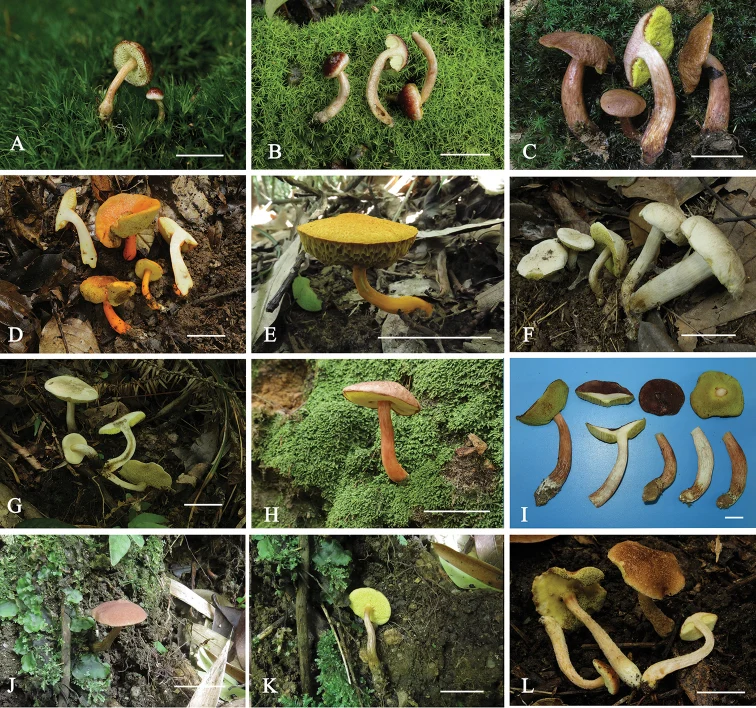
Basidiomata of six new species and one new combination of Aureoboletus from China. A, B A. glutinosus (A GDGM44476 B GDGM44477, holotype) C A. griseorufescens (GDGM28490, holotype) D, E A. miniatoaurantiacus (D GDGM43439 E GDGM43282) F, G A. raphanaceus (F GDGM45911, holotype G GDGM52890) H, I A. sinobadius (H GDGM44732 I GDGM 71932, holotype) J, K A. solus (GDGM44759, holotype) L A. velutipes (L GDGM44713, holotype). Scale bars: 2 cm.
Kredit dan penggunaan
Ming Zhang, Tai-Hui Li, Chao-Qun Wang, Nian-Kai Zeng, Wang-Qiu Deng
Ukuran dan format gambar disesuaikan tanpa pemotongan, retus, atau penambahan skala. Lisensi sumber dipertahankan.
Sumber profil
- [1] Phylogenetic overview of Aureoboletus (Boletaceae, Boletales), with descriptions of six new species from China — Aureoboletus solus
- [2] Catalogue of Life Base2026-09-11 — Aureoboletus solus
- [3] Dokumentasi visual — Aureoboletus solus
- [4] Dokumentasi visual — Aureoboletus solus
Rujukan halaman ini
Fungi. Aureoboletus solus. Rilis data fungi-2026-10-12-expansion-2. https://fungi-atlas.mgadib.chatgpt.site/jamur/aureoboletus-solus/.
Status: impor sumber; pemeriksaan editorial per profil belum selesai. Untuk klaim biologis, gunakan rujukan pada bagian terkait dan periksa konteks sumber aslinya.