01 / Morfologi

Ciri dan struktur

The species is characterised by a grey-white hypothallus or very thin thallus covered by groups of white, farinose to granular soredia or by being completely sorediate. Ascomata and pycnidia are unknown. Atranorin is the only secondary metabolite. The species occurs in old-growth forests on bark of broad-leaved trees with high bark pH (> 5). The thallus consists of a hypothallus (i.e. without photobiont cells) or, in some parts, a lichenised and thinly episubstratal thallus (up to 100 μm high), which is smooth or partially areolate, pustulate or granular, grey-white to grey, sorediate. A prothallus is absent or very thin and white. Soredia are not produced in clearly delimited soralia, but dispersed in groups or forming a more or less continuous layer, white or, when fresh, yellowish-white, farinose to granular, simple, (25–)35–65 μm in diam., or in consoredia up to 125 μm in diam. Soredia are enclosed by a colourless, more or less compact “wall” without projecting hyphae. The photobiont is trebouxioid, and 5–16 μm in diameter. Ascomata and pycnidia are unknown.

Sebagian uraian ditampilkan dalam bahasa sumber; terjemahannya belum tersedia atau belum lolos pemeriksaan.

Rujukan: [1]

Pengukuran mengikuti objek, spesimen atau kultur, dan metode yang disebutkan sumber. Baca uraian asli untuk konteks lengkap.

02 / Kehidupan

Habitat dan peran ekologis

The new species is reported from the Czech Republic, Poland, Russia (European part of the Caucasus) and Ukraine. It has already been published under a provisional name, Bacidia albogranulosa ined. from the Czech Republic (Vondrák et al. 2016) and the Ukrainian Carpathians (Malíček et al. 2018, Vondrák et al. 2018). Bacidia albogranulosa grows abundantly in old-growth floodplain and scree forests in the Czech Republic and old-growth ash or hornbeam dominated broad-leaved forests in Poland. It rarely occurs in old-growth beech (Ukraine) and mixed forests (Russia). It has usually been found on a dry and coarse bark of broad-leaved trees with a relatively high bark pH (approximately > 5). The most frequent phorophytes are Acer campestre (n=5), A. platanoides (11) and Fagus orientalis / sylvatica (4; overmature or dying trees due to a fungal infection). A few specimens were recorded also on Fraxinus angustifolia (2), F. excelsior (2), Carpinus orientalis (1), Euonymus europaeus (1) and Quercus sp. (2). The species prefers rather shaded trunks and places not directly exposed to rain, similar to many Lepraria species (Saag et al. 2009). Alyxoria varia (Pers.) Ertz & Tehler, Bacidia rubella and the non-lichenised fungus Dendrothele acerina (Pers.) P.A.

Sebagian uraian ditampilkan dalam bahasa sumber; terjemahannya belum tersedia atau belum lolos pemeriksaan.

Rujukan: [1]

Habitat atau konteks temuan
hutan
Substrat
Informasi belum tersedia pada sumber rilis ini.
Peran atau konteks
Pembentuk liken
Temukan hubungan serupa
03 / Siklus hidup

Reproduksi

The species is characterised by a grey-white hypothallus or very thin thallus covered by groups of white, farinose to granular soredia or by being completely sorediate. Ascomata and pycnidia are unknown. Atranorin is the only secondary metabolite. The species occurs in old-growth forests on bark of broad-leaved trees with high bark pH (> 5). The thallus consists of a hypothallus (i.e. without photobiont cells) or, in some parts, a lichenised and thinly episubstratal thallus (up to 100 μm high), which is smooth or partially areolate, pustulate or granular, grey-white to grey, sorediate. A prothallus is absent or very thin and white. Soredia are not produced in clearly delimited soralia, but dispersed in groups or forming a more or less continuous layer, white or, when fresh, yellowish-white, farinose to granular, simple, (25–)35–65 μm in diam., or in consoredia up to 125 μm in diam.

Sebagian uraian ditampilkan dalam bahasa sumber; terjemahannya belum tersedia atau belum lolos pemeriksaan.

Rujukan: [1]

04 / Batas informasi

Catatan identitas dan cakupan

  • Nama diterima mengikuti Catalogue of Life Base2026-09-11; uraian mempertahankan konsep dan nama sumber aslinya.
  • Preserve original treatment localities, hosts and substrate scope. Materials examined describe documented specimens, not the full global range.
  • Impor dan terjemahan otomatis belum diperiksa editorial per profil. Struktur reproduktif yang disebutkan tidak membuktikan seluruh siklus hidup diketahui.
  • Pengukuran pada uraian mengikuti spesimen, kultur, dan metode sumber; angka tidak diperluas ke semua populasi.

Catatan distribusi dalam narasi mengikuti sumbernya. Dokumentasi spesimen atau foto mengikuti catatan sumber. Bukti wilayah Indonesia dan penilaian konservasi tidak disimpulkan dari gambar.

05 / Dokumentasi

Melihat dengan konteks

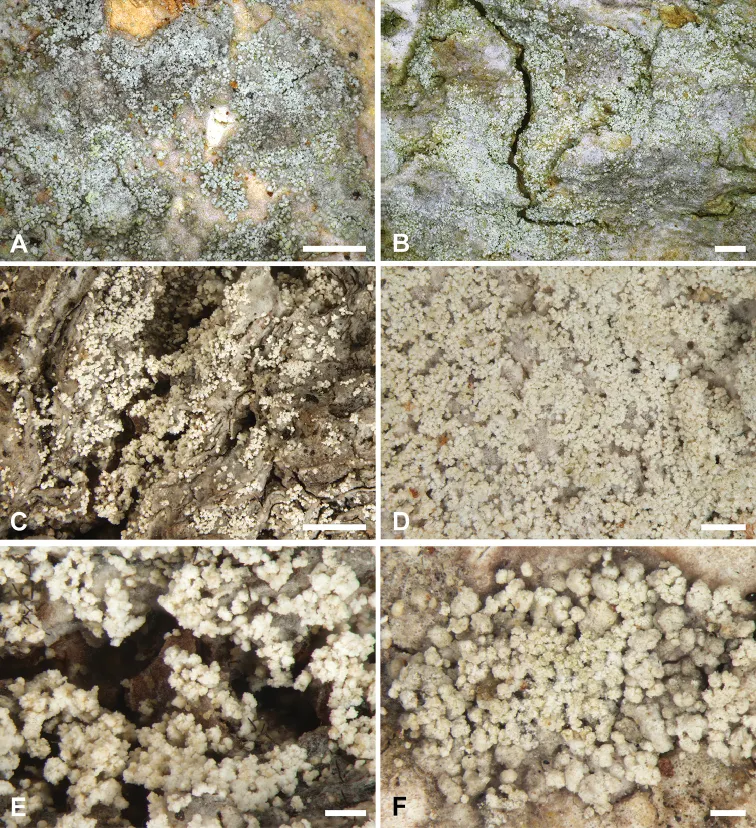
Morphology of Bacidia albogranulosa. A Holotype (PRA/Vondrák 11888) B Common phenotype (Malíček 10802) C Typical growth form on old beech trees (Malíček 8166) D Phenotype with abundant soredia forming a seemingly leprose thallus (Malíček 8013) E Detail of soredia (Malíček 8166) F Soredia arising from granules (PRA/Vondrák 11888). Scale bars: 1 mm (A−C), 0.5 mm (D), 0.2 mm (E, F). Photos by J. Malíček (A, B) and J. Machač (C−F).

Jenis
Pelat ilmiah
Kredit
Jiří M líček, Zdeněk alice, Jan Vondrák, Anna Łubek, Martin Kukwa
Lisensi
CC BY 4.0
Sumber media
Buka entri sumber

Gambar menunjukkan objek menurut identifikasi sumber, bukan verifikasi independen spesimen oleh Fungi. Tidak ada skala baru yang ditambahkan.

06 / Rujukan

Sumber profil

  1. [1] Bacidia albogranulosa (Ramalinaceae, lichenized Ascomycota), a new sorediate lichen from European old-growth forests — Bacidia albogranulosaBagian sumber: PMC6303282_section_7
    Tanggal penghimpunan sumber: 2026-10-12
    Teks sumber: CC BY 4.0 · Líček JM, Alice Z, Vondrák J, Łubek A, Kukwa M.
  2. [2] Catalogue of Life Base2026-09-11 — Bacidia albogranulosaBagian sumber: ColDP NameUsage.tsv ID 67YC4; accepted species; source 2073
    Tanggal penghimpunan sumber: 2026-10-12
  3. [3] Dokumentasi visual — Bacidia albogranulosaBagian sumber: Individual media record; identification follows the source, not independent determination
    Tanggal penghimpunan sumber: 2026-10-12
    Media sumber: CC BY 4.0 · Jiří M líček, Zdeněk alice, Jan Vondrák, Anna Łubek, Martin Kukwa

Adaptasi teks: CC BY 4.0. Líček JM, Alice Z, Vondrák J, Łubek A, Kukwa M. — Bacidia albogranulosa (Ramalinaceae, lichenized Ascomycota), a new sorediate lichen from European old-growth forests — Bacidia albogranulosa

Uraian asli dan riwayat sumber

Riwayat atau halaman sumber

Ringkasan sumber

The species is characterised by a grey-white hypothallus or very thin thallus covered by groups of white, farinose to granular soredia or by being completely sorediate. Ascomata and pycnidia are unknown. Atranorin is the only secondary metabolite. The species occurs in old-growth forests on bark of broad-leaved trees with high bark pH (> 5). The thallus consists of a hypothallus (i.e. without photobiont cells) or, in some parts, a lichenised and thinly episubstratal thallus (up to 100 μm high), which is smooth or partially areolate, pustulate or granular, grey-white to grey, sorediate.

Revisi sumber

Morfologi sumber

The species is characterised by a grey-white hypothallus or very thin thallus covered by groups of white, farinose to granular soredia or by being completely sorediate. Ascomata and pycnidia are unknown. Atranorin is the only secondary metabolite. The species occurs in old-growth forests on bark of broad-leaved trees with high bark pH (> 5). The thallus consists of a hypothallus (i.e. without photobiont cells) or, in some parts, a lichenised and thinly episubstratal thallus (up to 100 μm high), which is smooth or partially areolate, pustulate or granular, grey-white to grey, sorediate. A prothallus is absent or very thin and white. Soredia are not produced in clearly delimited soralia, but dispersed in groups or forming a more or less continuous layer, white or, when fresh, yellowish-white, farinose to granular, simple, (25–)35–65 μm in diam., or in consoredia up to 125 μm in diam. Soredia are enclosed by a colourless, more or less compact “wall” without projecting hyphae. The photobiont is trebouxioid, and 5–16 μm in diameter. Ascomata and pycnidia are unknown.

Revisi sumber

Ekologi sumber

The new species is reported from the Czech Republic, Poland, Russia (European part of the Caucasus) and Ukraine. It has already been published under a provisional name, Bacidia albogranulosa ined. from the Czech Republic (Vondrák et al. 2016) and the Ukrainian Carpathians (Malíček et al. 2018, Vondrák et al. 2018). Bacidia albogranulosa grows abundantly in old-growth floodplain and scree forests in the Czech Republic and old-growth ash or hornbeam dominated broad-leaved forests in Poland. It rarely occurs in old-growth beech (Ukraine) and mixed forests (Russia). It has usually been found on a dry and coarse bark of broad-leaved trees with a relatively high bark pH (approximately > 5). The most frequent phorophytes are Acer campestre (n=5), A. platanoides (11) and Fagus orientalis / sylvatica (4; overmature or dying trees due to a fungal infection). A few specimens were recorded also on Fraxinus angustifolia (2), F. excelsior (2), Carpinus orientalis (1), Euonymus europaeus (1) and Quercus sp. (2). The species prefers rather shaded trunks and places not directly exposed to rain, similar to many Lepraria species (Saag et al. 2009). Alyxoria varia (Pers.) Ertz & Tehler, Bacidia rubella and the non-lichenised fungus Dendrothele acerina (Pers.) P.A.

Revisi sumber

Struktur reproduksi sumber

The species is characterised by a grey-white hypothallus or very thin thallus covered by groups of white, farinose to granular soredia or by being completely sorediate. Ascomata and pycnidia are unknown. Atranorin is the only secondary metabolite. The species occurs in old-growth forests on bark of broad-leaved trees with high bark pH (> 5). The thallus consists of a hypothallus (i.e. without photobiont cells) or, in some parts, a lichenised and thinly episubstratal thallus (up to 100 μm high), which is smooth or partially areolate, pustulate or granular, grey-white to grey, sorediate. A prothallus is absent or very thin and white. Soredia are not produced in clearly delimited soralia, but dispersed in groups or forming a more or less continuous layer, white or, when fresh, yellowish-white, farinose to granular, simple, (25–)35–65 μm in diam., or in consoredia up to 125 μm in diam.

Revisi sumber

Rujukan halaman ini

Fungi. Bacidia albogranulosa. Rilis data fungi-2026-10-12-expansion-2. https://fungi-atlas.mgadib.chatgpt.site/jamur/bacidia-albogranulosa/.

Status: impor sumber; pemeriksaan editorial per profil belum selesai. Untuk klaim biologis, gunakan rujukan pada bagian terkait dan periksa konteks sumber aslinya.