Ciri dan struktur
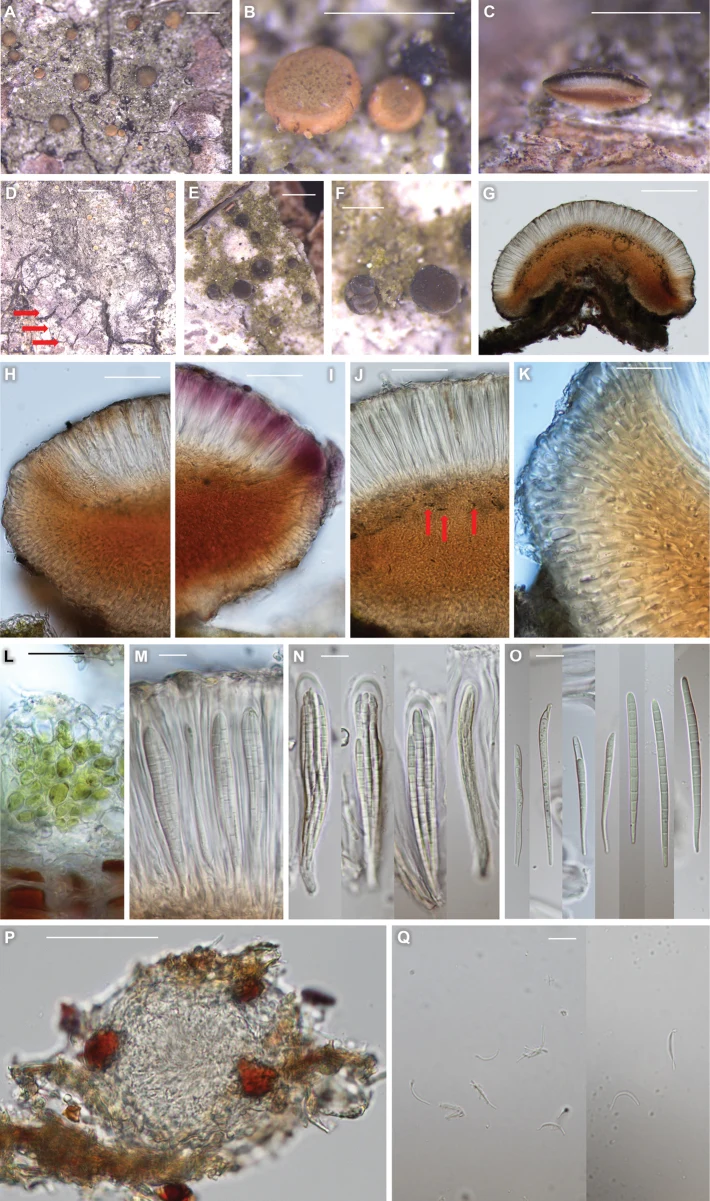
Bacidia fuscopallida differs from B. diffracta by generally non-granular, olive-green thallus, pale yellow-orange apothecia without pruina, the absence of crystals in proper exciple, slightly narrower ascospores with up to 15-septation and smaller pycnidia and pycnoconidia.
Habitat dan peran ekologis
The species occurs on barks of Acer pictum var. mono, A. triflorum and Quercus mongolica. The species is currently known from the type collections.
- Habitat atau konteks temuan
- Informasi belum tersedia pada sumber rilis ini.
- Substrat
- Informasi belum tersedia pada sumber rilis ini.
- Peran atau konteks
- Pembentuk liken
Reproduksi
Bacidia fuscopallida differs from B. diffracta by generally non-granular, olive-green thallus, pale yellow-orange apothecia without pruina, the absence of crystals in proper exciple, slightly narrower ascospores with up to 15-septation and smaller pycnidia and pycnoconidia.
Catatan identitas dan cakupan
- Nama diterima mengikuti Catalogue of Life Base2026-09-11; uraian mempertahankan konsep dan nama sumber aslinya.
- Preserve original treatment localities, hosts and substrate scope. Materials examined describe documented specimens, not the full global range.
- Impor dan terjemahan otomatis belum diperiksa editorial per profil. Struktur reproduktif yang disebutkan tidak membuktikan seluruh siklus hidup diketahui.
- Pengukuran pada uraian mengikuti spesimen, kultur, dan metode sumber; angka tidak diperluas ke semua populasi.
Catatan distribusi dalam narasi mengikuti sumbernya. Dokumentasi spesimen atau foto mengikuti catatan sumber. Bukti wilayah Indonesia dan penilaian konservasi tidak disimpulkan dari gambar.
Melihat dengan konteks
Bacidia fuscopallida (KBA -L-0001011, holotype for A–D, G–O KBA -L-0001049 for E, F KBA -L-0001010 for P, Q) in morphology A, B habitus and apothecia on bark of Acer pictum var. mono. Olive-green thallus and pale yellow-orange apothecia C vertical section of apothecia D prothallus present around margin of habitus (red arrows) E, F habitus and apothecia growing on bark of Acer triflorum G apothecial section H epihymenium colourless or a little pigmented I epihymenium K+ purple J small crystals (red arrows) present in upper hypothecium K proper exciple pigmented with pale or colourless margin. Radiating hyphae wider to margin L photobiont composing most part of thallus M, N asci cylindrical to narrowly clavate. Ascospores not twisted in ascus O ascospores acicular to filiform up to 15-septate P pycnidia globose with brown wall Q pycnoconidia curved or almost straight. Scale bars: 1 mm (A, E); 500 μm (B, C, F); 2 mm (D); 200 μm (G); 50 μm (H–J, P); 20 μm (K, L); 10 μm (M–O, Q).
- Jenis
- Pelat ilmiah
- Kredit
- Beeyoung Gun Lee, Jae-Seoun Hur
- Lisensi
- CC BY 4.0
- Sumber media
- Buka entri sumber
Sumber profil
- [1] A new species and four new records of Bacidia (Lecanorales, Ramalinaceae) from South Korea, with a key to Korean species — Bacidia fuscopallida
- [2] Catalogue of Life Base2026-09-11 — Bacidia fuscopallida
- [3] Dokumentasi visual — Bacidia fuscopallida
Rujukan halaman ini
Fungi. Bacidia fuscopallida. Rilis data fungi-2026-10-12-expansion-2. https://fungi-atlas.mgadib.chatgpt.site/jamur/bacidia-fuscopallida/.
Status: impor sumber; pemeriksaan editorial per profil belum selesai. Untuk klaim biologis, gunakan rujukan pada bagian terkait dan periksa konteks sumber aslinya.