Ciri dan struktur
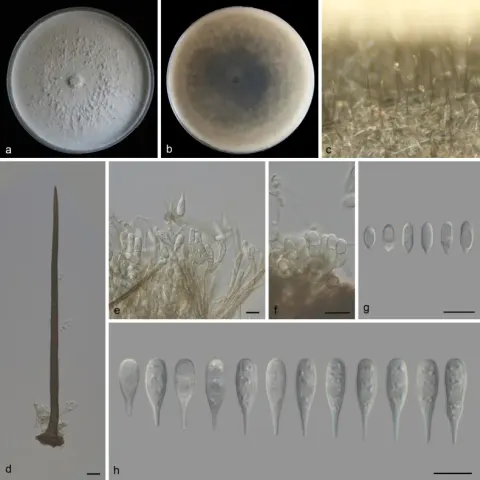
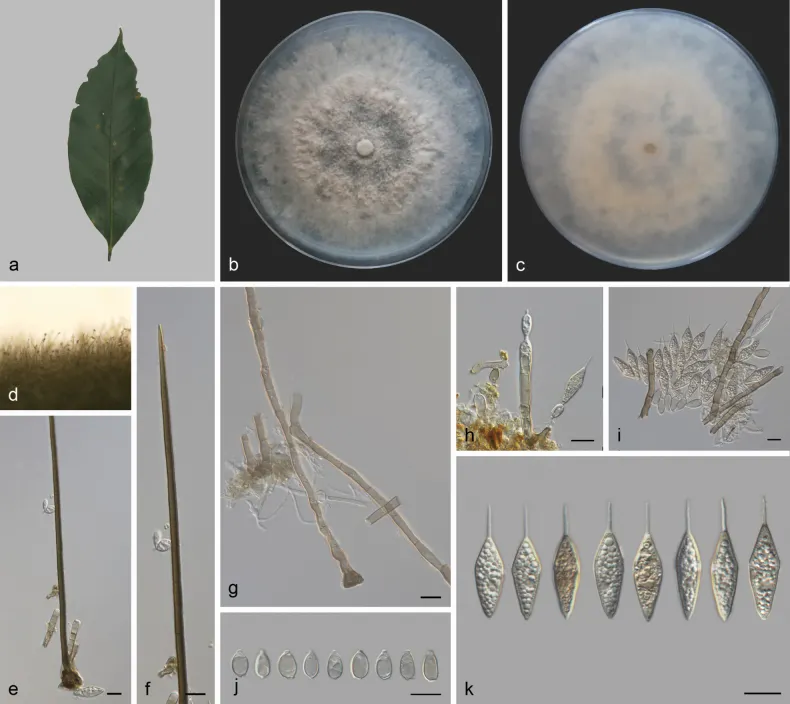
Sexual morph: Undetermined. Asexual morph: Setae numerous, erect, arising from radially lobed basal cells, straight or slightly flexuous, unbranched, thick-walled, verrucose, medium to dark brown, paler at apex, 135–242 µm long, 4.2–5.7 µm wide, tapering to a pointed apex, or arising from a dark brown, swollen, radially lobed basal cell, 11.9–17.6 μm in diameter. Imperfect setae single, flexuous, septate, verrucose, pale brown, swollen at the base. Conidiophores macronematous, mononematous, erect, subcylindrical or clavate, unbranched, pale brown, smooth, straight to flexuous, 64–134 × 4.4–6.7 µm. Conidiogenous cells polyblastic, integrated, terminal, sympodial, with flat-tipped denticles, subhyaline to pale brown, smooth, 9.0–14.3 µm (av. = 12.3 μm, n = 10) long, 4.0–5.2 µm (av. = 4.7 μm, n = 10) wide. Separating cells subhyaline to pale brown, finely roughened, aseptate, oval or obovoid, 9.2–13.2 µm (av. = 11.1 µm, n = 22) long, 4.4–7.0 µm (av. = 5.7 µm, n = 22) wide in the broadest part, 1-denticulate at each end. Conidia arise directly from conidiogenous cells or from separating cells, acrogenous, biconic, aseptate, smooth, pale brown with a hyaline to subhyaline equatorial transverse band, with distinct granules, rounded or 1-denticulate at base, 29.3–34.4 µm (av. = 32.1 µm, n = 21) long including appendage, 7.2–10.3 µm (av. = 8.3 µm, n = 21) wide in the broadest part, apical appendages 7.2–10.1 µm (av. = 9.1 µm, n = 21) long, tapering to an acutely rounded tip. Colonies on PDA at 25 °C in darkness, occupying an entire 90 mm Petri dish in 14 d. Surface pale brown and white, prominent in the middle and flat at the edges.
Habitat dan peran ekologis
Colonies on PDA at 25 °C in darkness, occupying an entire 90 mm Petri dish in 14 d. Surface pale brown and white, prominent in the middle and flat at the edges. Reverse pale yellow in the middle, with the edges being medium white. Beltrania sinensis was originally described from the root of Quercus cocciferoides and Fraxinus malacophylla in Jianshui County, Yunnan Province, China (Zheng et al. 2020). In the present study, two strains (SAUCC 3860 and SAUCC 5483-1) are clustered with the B. sinensis (YMF 1.05739, JS101, JS260, and JS43) clade in the combined phylogenetic tree (Fig. 1). Our strains (SAUCC 3860 and SAUCC 5483-1) were similar to B. sinensis (YMF 1.05739) in ITS (with 100% and 99.81% sequence identity, respectively) and LSU (with 100% and 99.87% sequence identity, respectively). Morphologically, our two strains were similar to B. sinensis (YMF 1.05739) by setae and separating cells (135–242 × 4.2–5.7 vs. 155–269 × 4–5 μm; 9.2–13.2 × 4.4–7.0 vs. 8.5–13.0 × 5.2–6.0 μm). Thus, we consider the isolated strains as B. sinensis. Additionally, B. sinensis (YMF 1.05739, JS101, JS260, and JS43) were found in the roots in Yunnan Province, China. Our two strains represent new records: SAUCC 3860 was first discovered on Litchi chinensis in Hainan Province (new host and locality record), while SAUCC 5483-1 was first recorded in Guizhou Province (new locality record) (Zheng et al. 2020).
- Habitat atau konteks temuan
- kultur yang didokumentasikan
- Substrat
- Informasi belum tersedia pada sumber rilis ini.
- Peran atau konteks
- Belum dikategorikan pada rilis ini.
Reproduksi
Sexual morph: Undetermined. Asexual morph: Setae numerous, erect, arising from radially lobed basal cells, straight or slightly flexuous, unbranched, thick-walled, verrucose, medium to dark brown, paler at apex, 135–242 µm long, 4.2–5.7 µm wide, tapering to a pointed apex, or arising from a dark brown, swollen, radially lobed basal cell, 11.9–17.6 μm in diameter. Imperfect setae single, flexuous, septate, verrucose, pale brown, swollen at the base. Conidiophores macronematous, mononematous, erect, subcylindrical or clavate, unbranched, pale brown, smooth, straight to flexuous, 64–134 × 4.4–6.7 µm. Conidiogenous cells polyblastic, integrated, terminal, sympodial, with flat-tipped denticles, subhyaline to pale brown, smooth, 9.0–14.3 µm (av. = 12.3 μm, n = 10) long, 4.0–5.2 µm (av. = 4.7 μm, n = 10) wide.
Catatan identitas dan cakupan
- Nama diterima mengikuti Catalogue of Life Base2026-09-11; uraian mempertahankan konsep dan nama sumber aslinya.
- Preserve original treatment localities, hosts and substrate scope. Materials examined describe documented specimens, not the full global range.
- Impor dan terjemahan otomatis belum diperiksa editorial per profil. Struktur reproduktif yang disebutkan tidak membuktikan seluruh siklus hidup diketahui.
- Pengukuran pada uraian mengikuti spesimen, kultur, dan metode sumber; angka tidak diperluas ke semua populasi.
Catatan distribusi dalam narasi mengikuti sumbernya. Dokumentasi spesimen atau foto mengikuti catatan sumber. Bukti wilayah Indonesia dan penilaian konservasi tidak disimpulkan dari gambar.
Melihat dengan konteks
Beltrania sinensis (SAUCC 3860). a. Leaf of host plant; b, c. Upper and reverse views of cultures on PDA after 14 days of inoculation at 25 °C; d. Conidiophores and setae on a pine needle on WA; e. Basal part of seta; f. Apex of seta; g. Imperfect setae; h. Conidiophores, conidiogenous cells, separating cell and conidia; i. Separating cells and conidia; j. Separating cells; k. Conidia. Scale bars: 10 μm (e–k).
- Jenis
- Pelat ilmiah
- Kredit
- Qiyun Liu, Duhua Li, Zhaoxue Zhang, Yuefeng Geng, Zhuang Li, Xiuguo Zhang, Jiwen Xia
- Lisensi
- CC BY 4.0
- Sumber media
- Buka entri sumber
Sumber profil
- [1] Morpho-phylogenetic evidence reveals new species and records of Beltraniaceae (Amphisphaeriales, Sordariomycetes) from southern China — Beltrania sinensis
- [2] Catalogue of Life Base2026-09-11 — Beltrania sinensis
- [3] Dokumentasi visual — Beltrania sinensis
Rujukan halaman ini
Fungi. Beltrania sinensis. Rilis data fungi-2026-10-12-expansion-2. https://fungi-atlas.mgadib.chatgpt.site/jamur/beltrania-sinensis/.
Status: impor sumber; pemeriksaan editorial per profil belum selesai. Untuk klaim biologis, gunakan rujukan pada bagian terkait dan periksa konteks sumber aslinya.