Isolated from Cryconite of gletser. Morph seksual tidak ditentukan. Transformasi aseksual Hyphomycetous. Vegetative hyphae ramping halus sampai kasar, bersepta subyaline hingga ringan zaitun, tertekan dekat septa, hingga 6.2 μm lebar. Conidiophores arising dari permukaan hifa, kecil hingga menengah besar, mikronematus, mononematus, sederhana, jarang bercabang, lurus, berwarna zaitun terang hingga berwarna cokelat zaitun, ber dinding halus, 1–3-bersepta, 5.9–44.1 × 4.2–19.4 μm. Conidiogenous cells monoblastik, terintegrasi, terminal, determinat, silinder.
Profil ini diimpor dari uraian spesies pada sumber berlisensi dan sebagian teks diterjemahkan otomatis. Pemeriksaan editorial per profil belum selesai. Bagian yang belum diterjemahkan atau belum lolos pemeriksaan terjemahan tetap ditampilkan dalam bahasa sumber. Angka dan nama ilmiah dipertahankan.
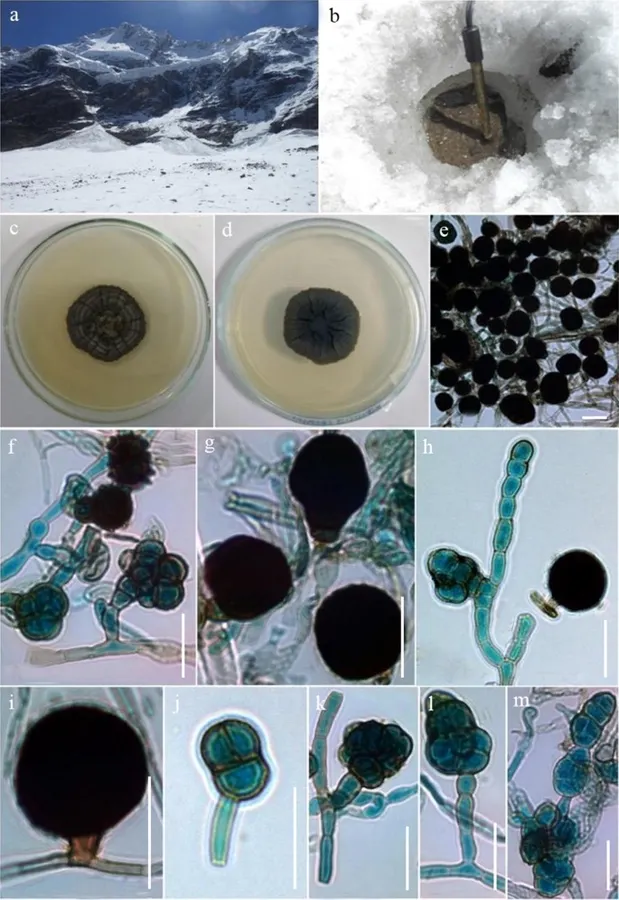
Bhagirathimyces himalayensis (AMH 10127, holotype). a Landscape of the sampling location at Hamtah glacier. b Cryoconites with pH probe. c Colony morphology on PDA (front view). d Reverse view of colony. e Numerous conidia. f Lobbed conidia (muriform) attached with conidiophores. g Globose to subglobose and obclavate conidia. h Branched conidiophore with attached conidia. i Attached conidia and conidiophores. j Conidia with a pale basal stalk cell. k Branched conidiophore with muriform conidium. l Macronematous conidiophore with conidium. m Conidia in chain. Scale bars: e – m = 20 μm Penulis dan sumber artikel: Hyde, Kevin D.; Dong, Yang; Phookamsak, Rungtiwa; Jeewon, Rajesh; Bhat, D. Jayarama; Jones, E. B. Gareth; Liu, Ning-Guo; A… (kredit lengkap di bawah) · CC BY 4.0 · Ukuran dan format gambar disesuaikan; lisensi asli dipertahankan.
01 / Morfologi
Ciri dan struktur
Isolated from Cryconite of glacier. Sexual morph Undetermined. Asexual morph Hyphomycetous. Vegetative hyphae smooth to rough walled, septate subhyaline to light olivaceous, constricted near septa, up to 6.2 μm wide. Conidiophores arising from superficial hyphae, small to median large, micronematous, mononematous, simple, rarely branched, straight, light olivaceous to olivaceous brown, smooth-walled, 1–3-septate, 5.9–44.1 × 4.2–19.4 μm. Conidiogenous cells monoblastic, integrated, terminal, determinate, cylindrical. Conidia solitary or catenate, very variable in shape and size, lobed, globose to subglobose, clavate, muriform, often with a pale protuberant basal stalk cell, persistent to sessile, smooth-walled, sometimes spinulose, dark brown to blackish brown, sometimes olivaceous brown, 15.4–50.4 × 12.8–46.2 μm (\(\bar{x} \) = 26.8 × 22.4 μm, n = 30). Culture characteristics: On PDA greyish black (10F-1), reaching 2.2 cm diam. in 15 days at 25 °C, velvety, sulcate with successive growth rings, regular margin, reverse greyish black (10F-1). Interestingly, Bhagirathimyces himalayensis was isolated from an entirely different habitat/ecological niche, i.e. from cryoconites of glacier of Indian Himalayan region as against its allied taxa such as Nodulosphaeria multiseptata Tibpromma, Camporesi & K.D. Hyde, (MFLUCC 15-0078/IT1889, type) isolated from forest soil of Sambucus ebulus (from Italy), N. guttulatum Tibpromma, Camporesi & K.D. Hyde (MFLUCC 14-1111) and N. scabiosae Mapook, Camporesi & K.D. Hyde (MFLUCC 15-0069/IT1826) from forest soil of Scabiosa sp. (from Italy), Dematiopleospora cirsii Wanas. et al. isolated from Cirsium sp. (from Italy), and D. mariae Wanas. et al. (MFLUCC 13-0612/IT1293) isolated from dead and hanging branches of Ononis spinosa (from Forli-Cesena, Italy).
Sebagian uraian ditampilkan dalam bahasa sumber; terjemahannya belum tersedia atau belum lolos pemeriksaan.
Pengukuran mengikuti objek, spesimen atau kultur, dan metode yang disebutkan sumber. Baca uraian asli untuk konteks lengkap.
02 / Kehidupan
Habitat dan peran ekologis
Isolated from Cryconite of glacier. Sexual morph Undetermined. Asexual morph Hyphomycetous. Vegetative hyphae smooth to rough walled, septate subhyaline to light olivaceous, constricted near septa, up to 6.2 μm wide. Conidiophores arising from superficial hyphae, small to median large, micronematous, mononematous, simple, rarely branched, straight, light olivaceous to olivaceous brown, smooth-walled, 1–3-septate, 5.9–44.1 × 4.2–19.4 μm. Conidiogenous cells monoblastic, integrated, terminal, determinate, cylindrical. Conidia solitary or catenate, very variable in shape and size, lobed, globose to subglobose, clavate, muriform, often with a pale protuberant basal stalk cell, persistent to sessile, smooth-walled, sometimes spinulose, dark brown to blackish brown, sometimes olivaceous brown, 15.4–50.4 × 12.8–46.2 μm (\(\bar{x} \) = 26.8 × 22.4 μm, n = 30). Culture characteristics: On PDA greyish black (10F-1), reaching 2.2 cm diam. in 15 days at 25 °C, velvety, sulcate with successive growth rings, regular margin, reverse greyish black (10F-1). Interestingly, Bhagirathimyces himalayensis was isolated from an entirely different habitat/ecological niche, i.e. from cryoconites of glacier of Indian Himalayan region as against its allied taxa such as Nodulosphaeria multiseptata Tibpromma, Camporesi & K.D.
Sebagian uraian ditampilkan dalam bahasa sumber; terjemahannya belum tersedia atau belum lolos pemeriksaan.
Isolated from Cryconite of glacier. Sexual morph Undetermined. Asexual morph Hyphomycetous. Vegetative hyphae smooth to rough walled, septate subhyaline to light olivaceous, constricted near septa, up to 6.2 μm wide. Conidiophores arising from superficial hyphae, small to median large, micronematous, mononematous, simple, rarely branched, straight, light olivaceous to olivaceous brown, smooth-walled, 1–3-septate, 5.9–44.1 × 4.2–19.4 μm. Conidiogenous cells monoblastic, integrated, terminal, determinate, cylindrical. Conidia solitary or catenate, very variable in shape and size, lobed, globose to subglobose, clavate, muriform, often with a pale protuberant basal stalk cell, persistent to sessile, smooth-walled, sometimes spinulose, dark brown to blackish brown, sometimes olivaceous brown, 15.4–50.4 × 12.8–46.2 μm (\(\bar{x} \) = 26.8 × 22.4 μm, n = 30).
Sebagian uraian ditampilkan dalam bahasa sumber; terjemahannya belum tersedia atau belum lolos pemeriksaan.
Nama diterima mengikuti Catalogue of Life Base2026-09-11; uraian mempertahankan konsep dan nama sumber aslinya.
Preserve original monograph treatment localities, hosts and specimen/substrate scope. Materials examined document specimens, not the full global range.
Impor dan terjemahan otomatis belum diperiksa editorial per profil. Struktur reproduktif yang disebutkan tidak membuktikan seluruh siklus hidup diketahui.
Pengukuran pada uraian mengikuti spesimen, kultur, dan metode sumber; angka tidak diperluas ke semua populasi.
Catatan distribusi dalam narasi mengikuti sumbernya. Dokumentasi spesimen atau foto mengikuti catatan sumber. Bukti wilayah Indonesia dan penilaian konservasi tidak disimpulkan dari gambar.
05 / Dokumentasi
Melihat dengan konteks
Bhagirathimyces himalayensis (AMH 10127, holotype). a Landscape of the sampling location at Hamtah glacier. b Cryoconites with pH probe. c Colony morphology on PDA (front view). d Reverse view of colony. e Numerous conidia. f Lobbed conidia (muriform) attached with conidiophores. g Globose to subglobose and obclavate conidia. h Branched conidiophore with attached conidia. i Attached conidia and conidiophores. j Conidia with a pale basal stalk cell. k Branched conidiophore with muriform conidium. l Macronematous conidiophore with conidium. m Conidia in chain. Scale bars: e – m = 20 μm
Jenis
Pelat ilmiah
Kredit
Penulis dan sumber artikel: Hyde, Kevin D.; Dong, Yang; Phookamsak, Rungtiwa; Jeewon, Rajesh; Bhat, D. Jayarama; Jones, E. B. Gareth; Liu, Ning-Guo; Abeywickrama, Pranami D.; Mapook, Ausana; Wei, Deping; Perera, Rekhani H.; Manawasinghe, Ishara S.; Pem, Dhandevi; Bundhun, Digvijayini; Karunarathna, Anuruddha; Ekanayaka, Anusha H.; Bao, Dan-Feng; Li, Junfu; Samarakoon, Milan C.; Chaiwan, Napalai; Lin, Chuan-Gen; Phutthacharoen, Kunthida; Zhang, Sheng-Nan; Senanayake, Indunil C.; Goonasekara, Ishani D.; Thambugala, Kasun M.; Phukhamsakda, Chayanard; Tennakoon, Danushka S.; Jiang, Hong-Bo; Yang, Jing; Zeng, Ming; Huanraluek, Naruemon; Liu, Jian-Kui (Jack); Wijesinghe, Subodini N.; Tian, Qing; Tibpromma, Saowaluck; Brahmanage, Rashika S.; Boonmee, Saranyaphat; Huang, Shi-Ke; Thiyagaraja, Vinodhini; Lu, Yong-Zhong; Jayawardena, Ruvishika S.; Dong, Wei; Yang, Er-Fu; Singh, Sanjay K.; Singh, Shiv Mohan; Rana, Shiwali; Lad, Sneha S.; Anand, Garima; Devadatha, Bandarupalli; Niranjan, M.; Sarma, V. Venkateswara; Liimatainen, Kare; Aguirre-Hudson, Begoña; Niskanen, Tuula; Overall, Andy; Alvarenga, Renato Lúcio Mendes; Gibertoni, Tatiana Baptista; Pfliegler, Walter P.; Horváth, Enikő; Imre, Alexandra; Alves, Amanda Lucia; da Silva Santos, Ana Carla; Tiago, Patricia Vieira; Bulgakov, Timur S.; Wanasinghe, Dhanushaka N.; Bahkali, Ali H.; Doilom, Mingkwan; Elgorban, Abdallah M.; Maharachchikumbura, Sajeewa S. N.; Rajeshkumar, Kunhiraman C.; Haelewaters, Danny; Mortimer, Peter E.; Zhao, Qi; Lumyong, Saisamorn; Xu, Jianchu; Sheng, Jun
Isolated from Cryconite of glacier.
Sexual morph Undetermined.
Asexual morph Hyphomycetous.
Vegetative hyphae smooth to rough walled, septate subhyaline to light olivaceous, constricted near septa, up to 6.2 μm wide.
Conidiophores arising from superficial hyphae, small to median large, micronematous, mononematous, simple, rarely branched, straight, light olivaceous to olivaceous brown, smooth-walled, 1–3-septate, 5.9–44.1 × 4.2–19.4 μm.
Conidiogenous cells monoblastic, integrated, terminal, determinate, cylindrical.
Isolated from Cryconite of glacier.
Sexual morph Undetermined.
Asexual morph Hyphomycetous.
Vegetative hyphae smooth to rough walled, septate subhyaline to light olivaceous, constricted near septa, up to 6.2 μm wide.
Conidiophores arising from superficial hyphae, small to median large, micronematous, mononematous, simple, rarely branched, straight, light olivaceous to olivaceous brown, smooth-walled, 1–3-septate, 5.9–44.1 × 4.2–19.4 μm.
Conidiogenous cells monoblastic, integrated, terminal, determinate, cylindrical.
Conidia solitary or catenate, very variable in shape and size, lobed, globose to subglobose, clavate, muriform, often with a pale protuberant basal stalk cell, persistent to sessile, smooth-walled, sometimes spinulose, dark brown to blackish brown, sometimes olivaceous brown, 15.4–50.4 × 12.8–46.2 μm (\(\bar{x} \) = 26.8 × 22.4 μm, n = 30).
Culture characteristics: On PDA greyish black (10F-1), reaching 2.2 cm diam. in 15 days at 25 °C, velvety, sulcate with successive growth rings, regular margin, reverse greyish black (10F-1).
Interestingly, Bhagirathimyces himalayensis was isolated from an entirely different habitat/ecological niche, i.e. from cryoconites of glacier of Indian Himalayan region as against its allied taxa such as Nodulosphaeria multiseptata Tibpromma, Camporesi & K.D.
Hyde, (MFLUCC 15-0078/IT1889, type) isolated from forest soil of Sambucus ebulus (from Italy), N. guttulatum Tibpromma, Camporesi & K.D.
Hyde (MFLUCC 14-1111) and N. scabiosae Mapook, Camporesi & K.D.
Hyde (MFLUCC 15-0069/IT1826) from forest soil of Scabiosa sp. (from Italy), Dematiopleospora cirsii Wanas. et al. isolated from Cirsium sp. (from Italy), and D. mariae Wanas. et al. (MFLUCC 13-0612/IT1293) isolated from dead and hanging branches of Ononis spinosa (from Forli-Cesena, Italy).
Isolated from Cryconite of glacier.
Sexual morph Undetermined.
Asexual morph Hyphomycetous.
Vegetative hyphae smooth to rough walled, septate subhyaline to light olivaceous, constricted near septa, up to 6.2 μm wide.
Conidiophores arising from superficial hyphae, small to median large, micronematous, mononematous, simple, rarely branched, straight, light olivaceous to olivaceous brown, smooth-walled, 1–3-septate, 5.9–44.1 × 4.2–19.4 μm.
Conidiogenous cells monoblastic, integrated, terminal, determinate, cylindrical.
Conidia solitary or catenate, very variable in shape and size, lobed, globose to subglobose, clavate, muriform, often with a pale protuberant basal stalk cell, persistent to sessile, smooth-walled, sometimes spinulose, dark brown to blackish brown, sometimes olivaceous brown, 15.4–50.4 × 12.8–46.2 μm (\(\bar{x} \) = 26.8 × 22.4 μm, n = 30).
Culture characteristics: On PDA greyish black (10F-1), reaching 2.2 cm diam. in 15 days at 25 °C, velvety, sulcate with successive growth rings, regular margin, reverse greyish black (10F-1).
Interestingly, Bhagirathimyces himalayensis was isolated from an entirely different habitat/ecological niche, i.e. from cryoconites of glacier of Indian Himalayan region as against its allied taxa such as Nodulosphaeria multiseptata Tibpromma, Camporesi & K.D.
Isolated from Cryconite of glacier.
Sexual morph Undetermined.
Asexual morph Hyphomycetous.
Vegetative hyphae smooth to rough walled, septate subhyaline to light olivaceous, constricted near septa, up to 6.2 μm wide.
Conidiophores arising from superficial hyphae, small to median large, micronematous, mononematous, simple, rarely branched, straight, light olivaceous to olivaceous brown, smooth-walled, 1–3-septate, 5.9–44.1 × 4.2–19.4 μm.
Conidiogenous cells monoblastic, integrated, terminal, determinate, cylindrical.
Conidia solitary or catenate, very variable in shape and size, lobed, globose to subglobose, clavate, muriform, often with a pale protuberant basal stalk cell, persistent to sessile, smooth-walled, sometimes spinulose, dark brown to blackish brown, sometimes olivaceous brown, 15.4–50.4 × 12.8–46.2 μm (\(\bar{x} \) = 26.8 × 22.4 μm, n = 30).
Status: impor sumber; pemeriksaan editorial per profil belum selesai. Untuk klaim biologis, gunakan rujukan pada bagian terkait dan periksa konteks sumber aslinya.
Saprobic on cabang mati tergantung dari Lonicera maackii. Morph seksual Ascomata 170–280 μm tinggi, 230–330 µm berdiameter, bercacah, bersendirian, atau dalam kelompok, semi-merendam ke erumpent, terlihat sebagai naik, titik hitam di…
Saprobic on daun mati dari Hedychium coronarium J. Koenig. Morph seksual: tidak ditentukan. Morph asexual: Coelomycetous. konidiomata 120–140 µm tinggi, 60–70 µm berlian, piknidia, sepi, tersebar, dangkal, terlihat sebagai bintik hitam…