Ciri dan struktur
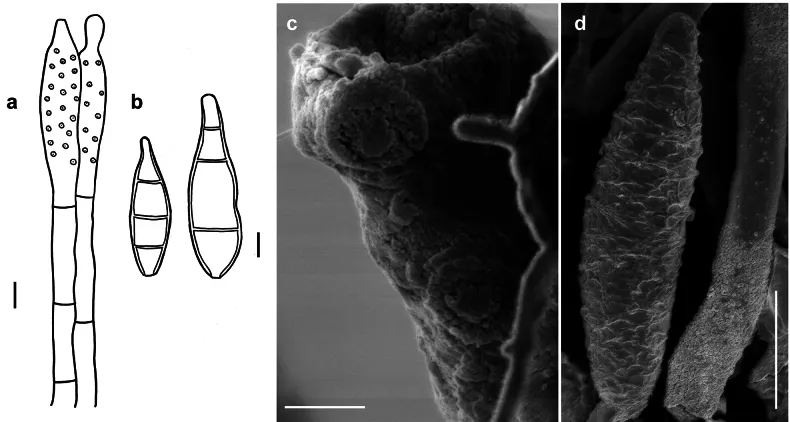
Colonies effuse, brown to dark brown or black. Hyphae superficial, branched, anastomosing, septate, 1–3 µm wide, pale olivaceous-brown. Conidiophores tightly packed to form dark brown to blackish synnemata up to 700 µm long, 20–40 µm thick, often splaying out to a width of up to 110 µm at the apex. Individual hyphae straight or flexous, cylindrical, 1–3 µm thick near the base, 4–7 µm thick near the apex, dark brown, paler towards the apex, verrucose, with numerous conidial scars. Conidia solitary, fusiform to obclavate, mostly 3–, rarely 1–, 2– or 4–septate, (13–)18–25(–33) × (4–)5–7(–8) µm, tapering to about 1–1.5 µm at the apex and at the base, pale brown to brown, the cells at each end paler, wrinkled. As seen by SEM, the ornamentation of the spores is distinctly reticulated, with thin to thick networks and no ridges.
Habitat dan peran ekologis
On colonies of Meliolales on living leaves of various plants in Argentina, Brazil, Ghana, Malaysia, Puerto Rico, Sierra Leone, Trinidad and Uganda (Ellis 1968).
- Habitat atau konteks temuan
- Informasi belum tersedia pada sumber rilis ini.
- Substrat
- Informasi belum tersedia pada sumber rilis ini.
- Peran atau konteks
- Belum dikategorikan pada rilis ini.
Reproduksi
Colonies effuse, brown to dark brown or black. Hyphae superficial, branched, anastomosing, septate, 1–3 µm wide, pale olivaceous-brown. Conidiophores tightly packed to form dark brown to blackish synnemata up to 700 µm long, 20–40 µm thick, often splaying out to a width of up to 110 µm at the apex. Individual hyphae straight or flexous, cylindrical, 1–3 µm thick near the base, 4–7 µm thick near the apex, dark brown, paler towards the apex, verrucose, with numerous conidial scars. Conidia solitary, fusiform to obclavate, mostly 3–, rarely 1–, 2– or 4–septate, (13–)18–25(–33) × (4–)5–7(–8) µm, tapering to about 1–1.5 µm at the apex and at the base, pale brown to brown, the cells at each end paler, wrinkled.
Catatan identitas dan cakupan
- Nama diterima mengikuti Catalogue of Life Base2026-09-11; uraian mempertahankan konsep dan nama sumber aslinya.
- Preserve original treatment localities, hosts and substrate scope. Materials examined describe documented specimens, not the full global range.
- Impor dan terjemahan otomatis belum diperiksa editorial per profil. Struktur reproduktif yang disebutkan tidak membuktikan seluruh siklus hidup diketahui.
- Pengukuran pada uraian mengikuti spesimen, kultur, dan metode sumber; angka tidak diperluas ke semua populasi.
Catatan distribusi dalam narasi mengikuti sumbernya. Dokumentasi spesimen atau foto mengikuti catatan sumber. Bukti wilayah Indonesia dan penilaian konservasi tidak disimpulkan dari gambar.
Melihat dengan konteks
Spiropes clavatus (IMI 102772) a conidiophores with scars b conidia shown in optical section c, d as seen by SEM c conidiophore with scars d conidium. Scale bars: 5 μm (a); 2.5 μm (b); 1 μm (c); 5 μm (d).
- Jenis
- Pelat ilmiah
- Kredit
- Miguel A. Bermúdez-Cova, Tina A. Hofmann, Nourou S. Yorou, Meike Piepenbring
- Lisensi
- CC BY 4.0
- Sumber media
- Buka entri sumber
Sumber profil
- [1] Systematic revision of species of Atractilina and Spiropes hyperparasitic on Meliolales (Ascomycota) in the tropics — Spiropes clavatus
- [2] Catalogue of Life Base2026-09-11 — Bitunicostilbe clavata
- [3] Dokumentasi visual — Spiropes clavatus
Rujukan halaman ini
Fungi. Bitunicostilbe clavata. Rilis data fungi-2026-10-12-expansion-2. https://fungi-atlas.mgadib.chatgpt.site/jamur/bitunicostilbe-clavata/.
Status: impor sumber; pemeriksaan editorial per profil belum selesai. Untuk klaim biologis, gunakan rujukan pada bagian terkait dan periksa konteks sumber aslinya.