01 / Morfologi

Ciri dan struktur

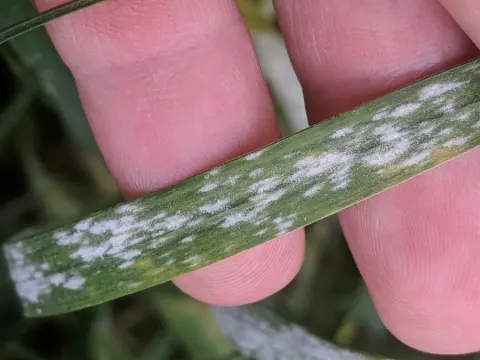
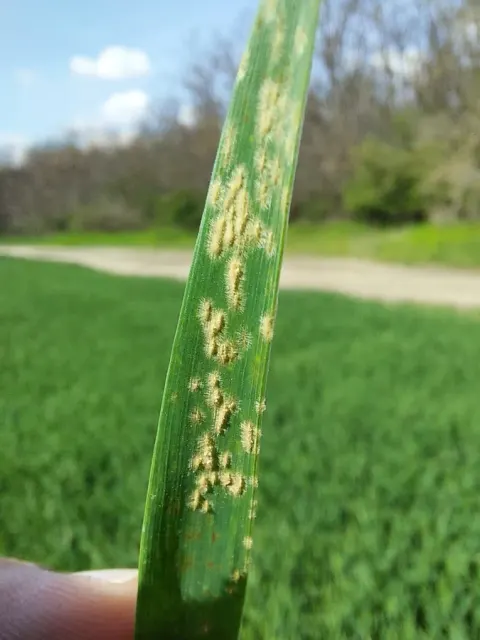
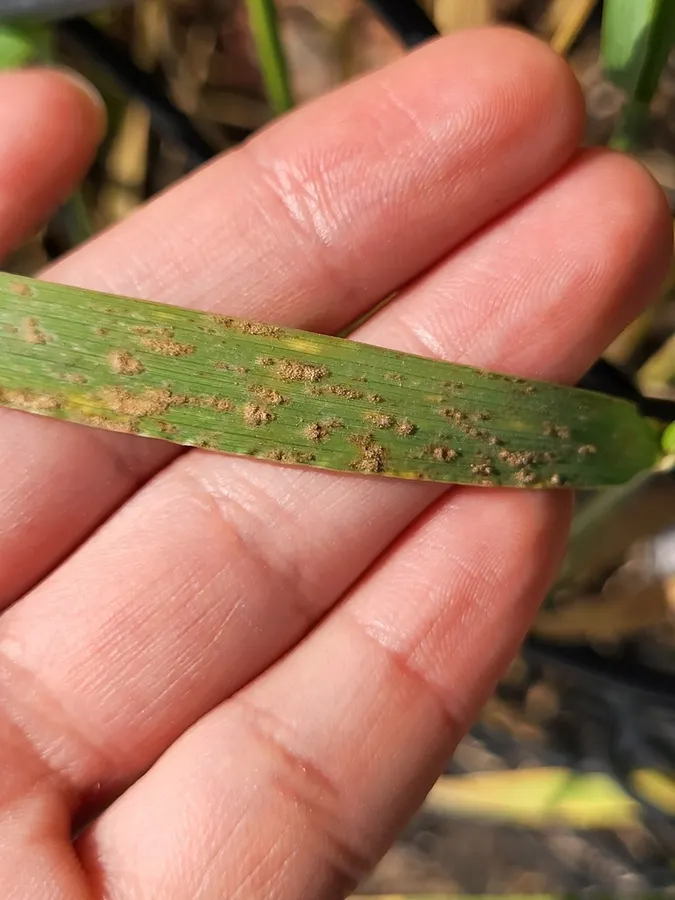
The fungus forms thick mycelial growth on the leaves of its hosts, which soon becomes pigmented, greyish-orange or brownish-orange to rusty brown. The mycelium is formed from late spring or early summer to August. Secondary mycelium is said to be dingy greyish-white to grey. When present, the chasmothecia are often densely packed. As with most Erysiphaceae, Blumeria americana is fairly host-specific, having been most frequently recorded from Elymus, along with Leymus, Hordeum, Pascopyrum, Psathyrostachys, and Apera. However, many of these genera more commonly host other species of Blumeria (such as Hordeum with Blumeria hordei). The type host of Blumeria americana is Elymus repens – this species hosts Blumeria graminis in Eurasia (and potentially also in North America). Blumeria americana can be found only in North America, in any habitats where its host species can be found. The primary mycelium occurs in parallel with the secondary mycelium. It is effuse or typically in patches, at first white, becoming pigmented, greyish-orange or brownish-orange to rusty brown. The secondary mycelium is dense, appearing woolly to felt-like. It occurs on the leaf in patches, often around chasmothecia. It is coloured dingy greyish white to grey. The hyphal appressoria are described as nipple-, lobe-, or fork-shaped, occurring either singly or opposite in pairs. Conidia are broad and ellipsoid-ovoid. Secondary conidia can be lemon-shaped. Conidiophores are single or in pairs, with a swollen foot-cell characteristic of the genus. They can be branched or unbranched, with a basal septum at the junction with the mother cell or elevated up to 10 μm high.

Sebagian uraian ditampilkan dalam bahasa sumber; terjemahannya belum tersedia atau belum lolos pemeriksaan.

Rujukan: [1]

Pengukuran mengikuti objek, spesimen atau kultur, dan metode yang disebutkan sumber. Baca uraian asli untuk konteks lengkap.

02 / Kehidupan

Habitat dan peran ekologis

Blumeria americana is a species of powdery mildew in the family Erysiphaceae. It is found in North America where it infects multiple genera of plants in the family Poaceae (grasses), mainly in the tribe Triticeae, with one host in the Poeae.

Sebagian uraian ditampilkan dalam bahasa sumber; terjemahannya belum tersedia atau belum lolos pemeriksaan.

Rujukan: [1]

Habitat atau konteks temuan
Informasi belum tersedia pada sumber rilis ini.
Substrat
Informasi belum tersedia pada sumber rilis ini.
Peran atau konteks
Belum dikategorikan pada rilis ini.
Temukan hubungan serupa
03 / Siklus hidup

Reproduksi

The primary mycelium occurs in parallel with the secondary mycelium. It is effuse or typically in patches, at first white, becoming pigmented, greyish-orange or brownish-orange to rusty brown. The secondary mycelium is dense, appearing woolly to felt-like. It occurs on the leaf in patches, often around chasmothecia. It is coloured dingy greyish white to grey. The hyphal appressoria are described as nipple-, lobe-, or fork-shaped, occurring either singly or opposite in pairs. Conidia are broad and ellipsoid-ovoid. Secondary conidia can be lemon-shaped. Conidiophores are single or in pairs, with a swollen foot-cell characteristic of the genus. They can be branched or unbranched, with a basal septum at the junction with the mother cell or elevated up to 10 μm high.

Sebagian uraian ditampilkan dalam bahasa sumber; terjemahannya belum tersedia atau belum lolos pemeriksaan.

Rujukan: [1]

04 / Batas informasi

Catatan identitas dan cakupan

  • Nama diterima mengikuti Catalogue of Life Base2026-09-11; uraian mempertahankan konsep dan nama sumber aslinya.
  • Original geographic, specimen and life-cycle scope retained; source import awaits individual editorial review.
  • Impor dan terjemahan otomatis belum diperiksa editorial per profil. Struktur reproduktif yang disebutkan tidak membuktikan seluruh siklus hidup diketahui.
  • Pengukuran pada uraian mengikuti spesimen, kultur, dan metode sumber; angka tidak diperluas ke semua populasi.

Catatan distribusi dalam narasi mengikuti sumbernya. Dokumentasi spesimen atau foto mengikuti catatan sumber. Bukti wilayah Indonesia dan penilaian konservasi tidak disimpulkan dari gambar.

05 / Dokumentasi

Melihat dengan konteks

Dokumentasi Blumeria americana menurut asosiasi foto pada record takson iNaturalist. Kredit: Zihao Wang. Identitas mengikuti sumber; bukan penentuan spesimen independen.

Jenis
Fotografi
Kredit
(c) Zihao Wang, some rights reserved (CC BY), uploaded by Zihao Wang
Lisensi
CC BY 4.0
Sumber media
Buka entri sumber

Gambar menunjukkan objek menurut identifikasi sumber, bukan verifikasi independen spesimen oleh Fungi. Tidak ada skala baru yang ditambahkan.

06 / Rujukan

Sumber profil

  1. [1] Blumeria americana — Wikipedia (en)Bagian sumber: Frozen revision 1371241955
    Tanggal penghimpunan sumber: 2026-10-12
    Teks sumber: CC BY-SA4.0 · Wikipedia contributors
  2. [2] Catalogue of Life Base2026-09-11 — Blumeria americanaBagian sumber: ColDP NameUsage.tsv ID 9YZJ8; accepted species; source 2073
    Tanggal penghimpunan sumber: 2026-10-12
  3. [3] Dokumentasi visual — Blumeria americanaBagian sumber: Individual media record; identification follows the source, not independent determination
    Tanggal penghimpunan sumber: 2026-10-12
    Media sumber: CC BY 4.0 · (c) Zihao Wang, some rights reserved (CC BY), uploaded by Zihao Wang

Adaptasi teks: CC BY-SA 4.0. Wikipedia contributors — Blumeria americana — Wikipedia (en)

Uraian asli dan riwayat sumber

Riwayat atau halaman sumber

Ringkasan sumber

The fungus forms thick mycelial growth on the leaves of its hosts, which soon becomes pigmented, greyish-orange or brownish-orange to rusty brown. The mycelium is formed from late spring or early summer to August. Secondary mycelium is said to be dingy greyish-white to grey. When present, the chasmothecia are often densely packed. As with most Erysiphaceae, Blumeria americana is fairly host-specific, having been most frequently recorded from Elymus, along with Leymus, Hordeum, Pascopyrum, Psathyrostachys, and Apera.

Revisi sumber

Morfologi sumber

The fungus forms thick mycelial growth on the leaves of its hosts, which soon becomes pigmented, greyish-orange or brownish-orange to rusty brown. The mycelium is formed from late spring or early summer to August. Secondary mycelium is said to be dingy greyish-white to grey. When present, the chasmothecia are often densely packed. As with most Erysiphaceae, Blumeria americana is fairly host-specific, having been most frequently recorded from Elymus, along with Leymus, Hordeum, Pascopyrum, Psathyrostachys, and Apera. However, many of these genera more commonly host other species of Blumeria (such as Hordeum with Blumeria hordei). The type host of Blumeria americana is Elymus repens – this species hosts Blumeria graminis in Eurasia (and potentially also in North America). Blumeria americana can be found only in North America, in any habitats where its host species can be found. The primary mycelium occurs in parallel with the secondary mycelium. It is effuse or typically in patches, at first white, becoming pigmented, greyish-orange or brownish-orange to rusty brown. The secondary mycelium is dense, appearing woolly to felt-like. It occurs on the leaf in patches, often around chasmothecia. It is coloured dingy greyish white to grey. The hyphal appressoria are described as nipple-, lobe-, or fork-shaped, occurring either singly or opposite in pairs. Conidia are broad and ellipsoid-ovoid. Secondary conidia can be lemon-shaped. Conidiophores are single or in pairs, with a swollen foot-cell characteristic of the genus. They can be branched or unbranched, with a basal septum at the junction with the mother cell or elevated up to 10 μm high.

Revisi sumber

Ekologi sumber

Blumeria americana is a species of powdery mildew in the family Erysiphaceae. It is found in North America where it infects multiple genera of plants in the family Poaceae (grasses), mainly in the tribe Triticeae, with one host in the Poeae.

Revisi sumber

Struktur reproduksi sumber

The primary mycelium occurs in parallel with the secondary mycelium. It is effuse or typically in patches, at first white, becoming pigmented, greyish-orange or brownish-orange to rusty brown. The secondary mycelium is dense, appearing woolly to felt-like. It occurs on the leaf in patches, often around chasmothecia. It is coloured dingy greyish white to grey. The hyphal appressoria are described as nipple-, lobe-, or fork-shaped, occurring either singly or opposite in pairs. Conidia are broad and ellipsoid-ovoid. Secondary conidia can be lemon-shaped. Conidiophores are single or in pairs, with a swollen foot-cell characteristic of the genus. They can be branched or unbranched, with a basal septum at the junction with the mother cell or elevated up to 10 μm high.

Revisi sumber

Rujukan halaman ini

Fungi. Blumeria americana. Rilis data fungi-2026-10-12-expansion-2. https://fungi-atlas.mgadib.chatgpt.site/jamur/blumeria-americana/.

Status: impor sumber; pemeriksaan editorial per profil belum selesai. Untuk klaim biologis, gunakan rujukan pada bagian terkait dan periksa konteks sumber aslinya.