Ciri dan struktur
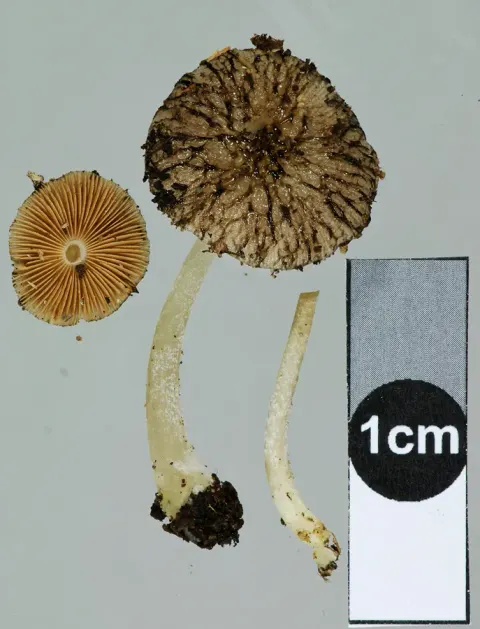
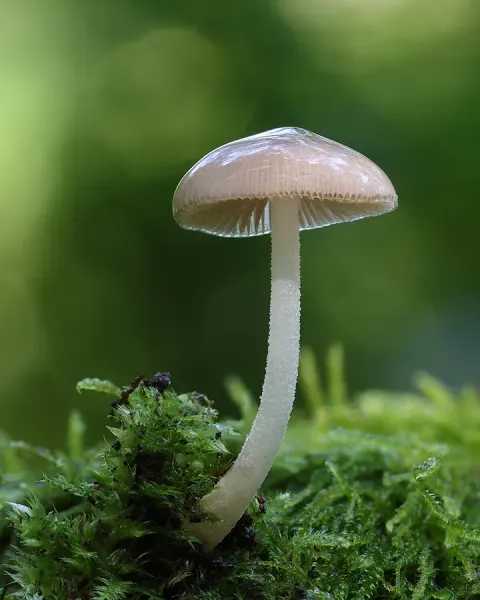
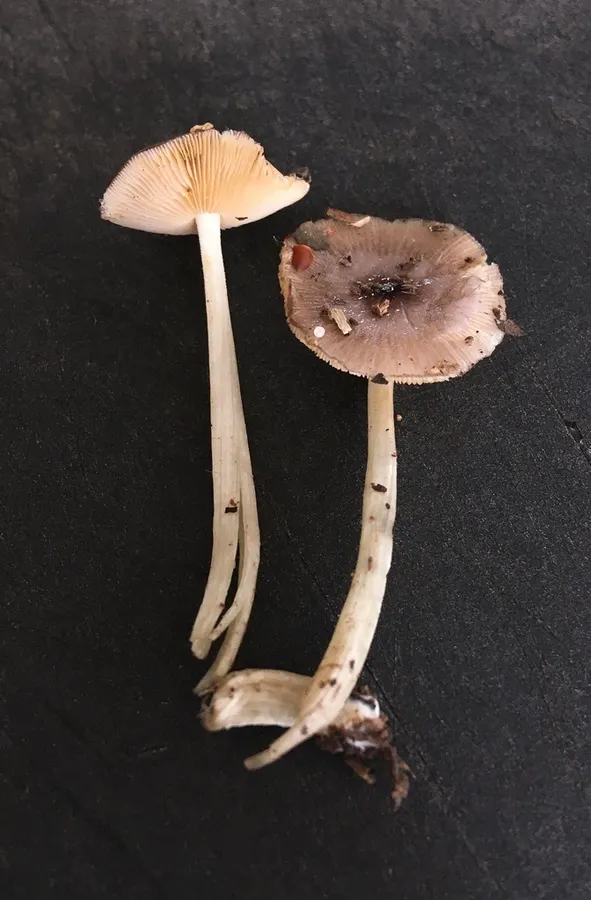
Basidiomata small-sized, pileus 0.8–1.8 cm in diameter, convex to applanate when mature; greyish-violet (18D4) at the centre, transitioning to reddish-brown (9D4), with the margin grey (18B1) to white (18A1). Pileus surface viscid, with radiating sulcate-striae; margin with faint whitish (1A1) veil remnants, evanescent. Context thin, with no specific odour. Lamellae free, moderately crowded, unequal in length, ventricose, white when young, gradually becoming pale yellow (4A3), with the edges nearly white in dried specimens. Stipe 2–4 cm long, 2–3 mm thick, cylindrical, fistulose, fragile, white (1A1), longitudinally striate and covered with white powdery to flocculose pubescence. Stipe base slightly enlarged, with surface sometimes pale yellow (2A3). Basidiospores (60/2/2) 9.8–12.7 μm × 5.1–6.8 μm, Q = 1.63–1.97, Qm = 1.79 (± 0.09), ellipsoid to oblong in frontal view, similar in side view, but slightly flattened or with a slight suprahilar depression, thick-walled, smooth, with distinct germ pore, greyish-yellow (4B5) to greyish-orange (5B5) in KOH solution. Basidia 16–2 μm 4 × 6.5–8 μm, broadly clavate, predominantly 2-spored, occasionally 1-spored, sterigmata 3–5 μm long, with vacuolar contents. Cheilocystidia 11–32 μm × 6.0–7.8 μm, clavate to narrowly utriform, with a rounded apex, hyaline, thin-walled. Pleurocystidia absent. Stipitipellis a cutis. Caulocystidia (26–)33–51 μm × 9–13 μm, cylindrical to narrowly clavate or narrowly utriform, neck flexuous, apex rounded, hyaline, thin-walled. Pileocystidia absent. Pileipellis a hymeniderm, composed of a mixture of thin-walled elements containing greyish-magenta (13D3) to purplish-grey (13D2) or light brown (7D4) pigment: mostly subglobose to pyriform elements (17–41 μm × 10–20 μm), together with fewer clavate to narrowly cylindrical elements (18–32 μm × 4.2–6.2 μm).
Habitat dan peran ekologis
Solitary, on rotten wood in broad-leaved forests dominated by Quercus species, with Betula as associated trees; usually in humid and shaded microhabitats; fruiting in autumn. Russia (type locality, Malysheva et al. (2015)); China: Jilin Province (this study, new record).
- Habitat atau konteks temuan
- hutan
- Substrat
- Informasi belum tersedia pada sumber rilis ini.
- Peran atau konteks
- Belum dikategorikan pada rilis ini.
Reproduksi
Basidiomata small-sized, pileus 0.8–1.8 cm in diameter, convex to applanate when mature; greyish-violet (18D4) at the centre, transitioning to reddish-brown (9D4), with the margin grey (18B1) to white (18A1). Pileus surface viscid, with radiating sulcate-striae; margin with faint whitish (1A1) veil remnants, evanescent. Context thin, with no specific odour. Lamellae free, moderately crowded, unequal in length, ventricose, white when young, gradually becoming pale yellow (4A3), with the edges nearly white in dried specimens. Stipe 2–4 cm long, 2–3 mm thick, cylindrical, fistulose, fragile, white (1A1), longitudinally striate and covered with white powdery to flocculose pubescence. Stipe base slightly enlarged, with surface sometimes pale yellow (2A3).
Catatan identitas dan cakupan
- Nama diterima mengikuti Catalogue of Life Base2026-09-11; uraian mempertahankan konsep dan nama sumber aslinya.
- Preserve original treatment localities, hosts and substrate scope. Materials examined describe documented specimens, not the full global range.
- Impor dan terjemahan otomatis belum diperiksa editorial per profil. Struktur reproduktif yang disebutkan tidak membuktikan seluruh siklus hidup diketahui.
- Pengukuran pada uraian mengikuti spesimen, kultur, dan metode sumber; angka tidak diperluas ke semua populasi.
Catatan distribusi dalam narasi mengikuti sumbernya. Dokumentasi spesimen atau foto mengikuti catatan sumber. Bukti wilayah Indonesia dan penilaian konservasi tidak disimpulkan dari gambar.
Melihat dengan konteks
Dokumentasi Bolbitius bisporus menurut asosiasi foto pada record takson iNaturalist. Kredit: Sigrid Jakob. Identitas mengikuti sumber; bukan penentuan spesimen independen.
- Jenis
- Fotografi
- Kredit
- no rights reserved, uploaded by Sigrid Jakob
- Lisensi
- CC0 1.0
- Sumber media
- Buka entri sumber
Dokumentasi tambahan
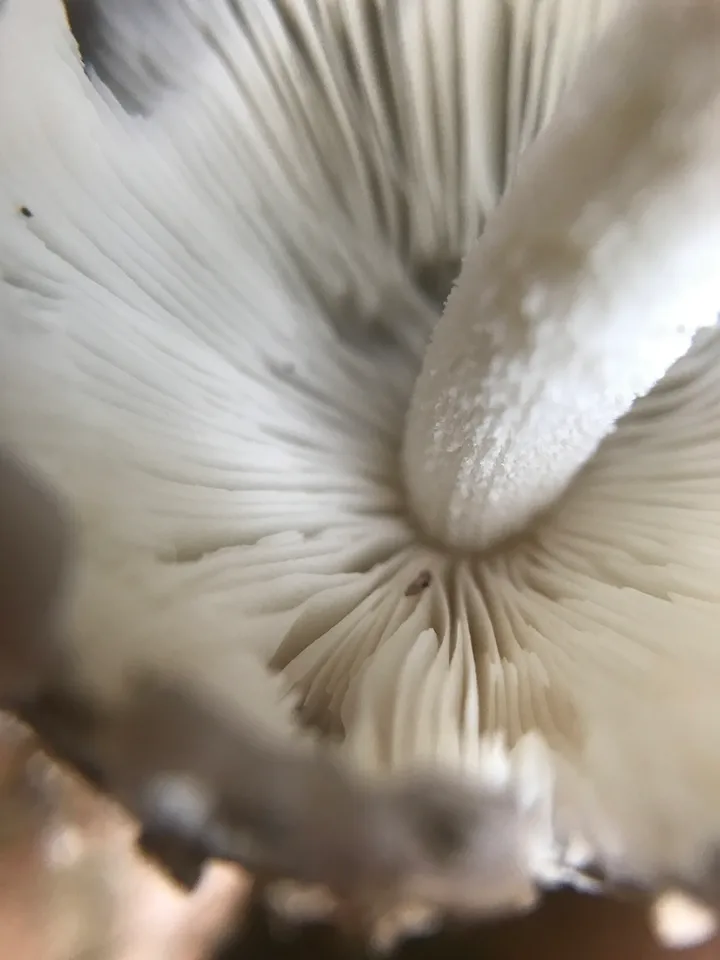
Foto yang diasosiasikan dengan Bolbitius bisporus pada iNaturalist. Identifikasi mengikuti sumber; bukan penentuan spesimen independen.
Kredit dan penggunaan
(c) Matthew Rozanoff, some rights reserved (CC BY), uploaded by Matthew Rozanoff
Ukuran dan format gambar disesuaikan tanpa pemotongan, retus, atau penambahan skala. Lisensi sumber dipertahankan.
Sumber profil
- [1] Two new species and one new record of Bolbitius (Bolbitiaceae, Agaricales) from northeast China — Bolbitius bisporus
- [2] Catalogue of Life Base2026-09-11 — Bolbitius bisporus
- [3] Dokumentasi visual — Bolbitius bisporus
- [4] Dokumentasi visual — Bolbitius bisporus
Rujukan halaman ini
Fungi. Bolbitius bisporus. Rilis data fungi-2026-10-12-expansion-2. https://fungi-atlas.mgadib.chatgpt.site/jamur/bolbitius-bisporus/.
Status: impor sumber; pemeriksaan editorial per profil belum selesai. Untuk klaim biologis, gunakan rujukan pada bagian terkait dan periksa konteks sumber aslinya.