01 / Morfologi

Ciri dan struktur

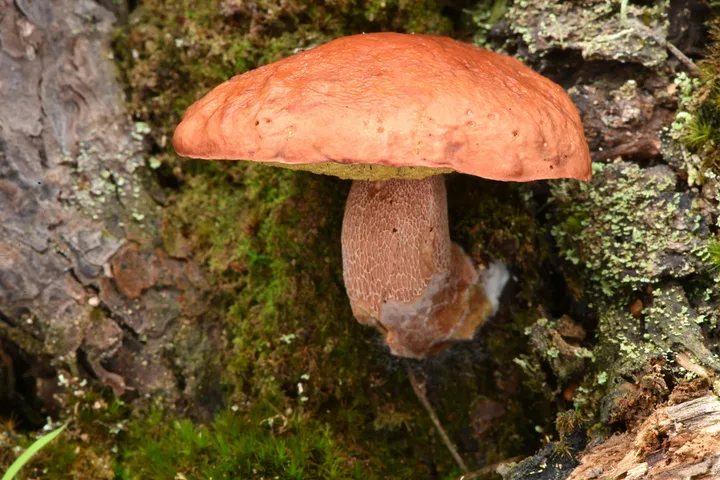
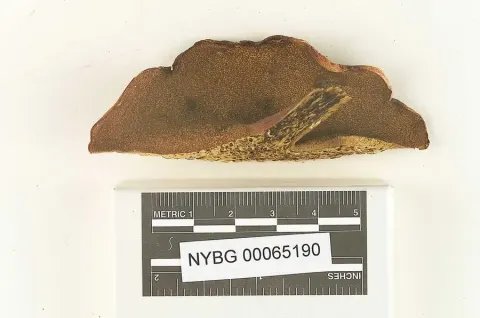
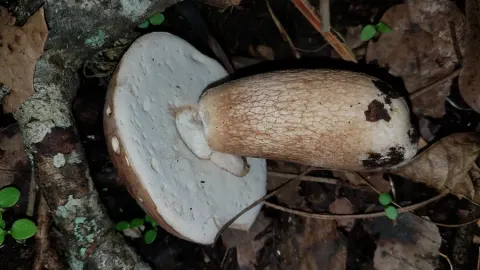
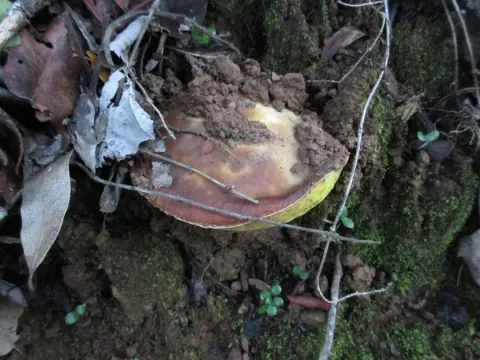
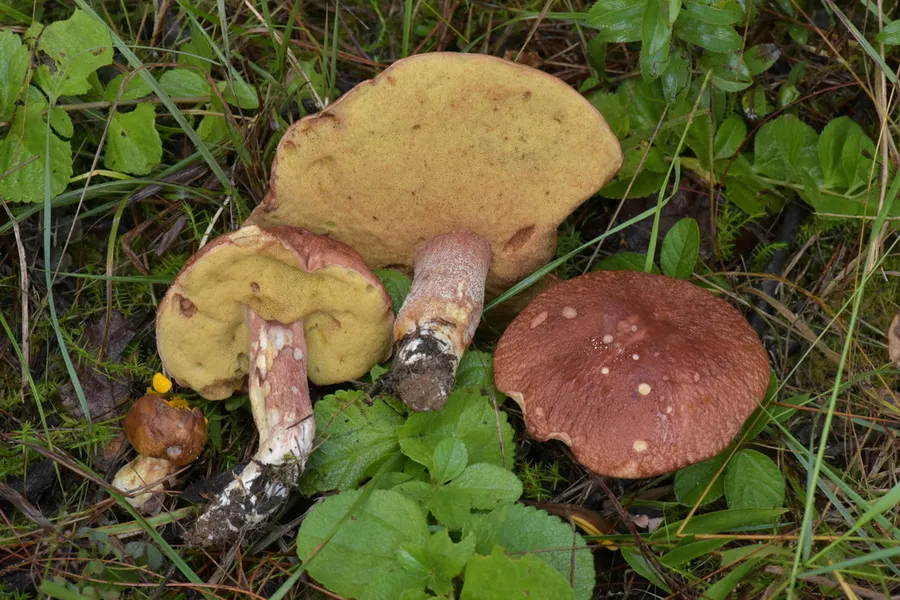
The fruiting body has a convex-shaped cap, at first small in relation to its stipe, expanding in volume as it matures. The skin of the cap is dry, matte and can be coloured from maroon to chocolate brown with a reddish tint. It is thicker than other porcini-like boletes and is gelatinous. These characteristics distinguish it visually from relatives such as Boletus edulis, B. reticulatus and B. aereus. The young, immature cap may have a pale pink colour and a white, powdery flush. As with all boletes, the size of the fruiting body can vary greatly. The cap diameter can be as much as 40 cm, the stem height 25 cm and stem diameter 16 cm. The bulbous stipe is often swollen and has a network pattern, which is much coarser in this species than other porcinis. The overall colour may have an orange-red tinge which is more obvious in the lowest parts, although this is also common in other species. Like other boletes, B. pinophilus has small pores on the underside of its cap rather than gills. These are coloured white at first, becoming yellow with age and olive-brown at full maturity. The spores are cylindric-ellipsoid, smooth, with oil drops and dimensions 15.5–20 by 4.5–5.5 μm. They produce an olive-brown spore print.

Sebagian uraian ditampilkan dalam bahasa sumber; terjemahannya belum tersedia atau belum lolos pemeriksaan.

Rujukan: [1]

Pengukuran mengikuti objek, spesimen atau kultur, dan metode yang disebutkan sumber. Baca uraian asli untuk konteks lengkap.

02 / Kehidupan

Habitat dan peran ekologis

Boletus pinophilus adalah jamur yang paling langka di Eropa, meskipun ditemukan di wilayah berangin. Leningrad Oblast and Vologda Oblast in Rusia, dan Ukraina. Bolete dianggap rentan di Republik Ceko dan Irkutsk Oblast in Siberia. Hal ini juga ditemukan di perkebunan pinus eksotis (seperti Pinus sylvestris) di Amerika Utara timur, Meksiko, Chili, Selatan Africa and Selandia Baru. Native populations dari China and Utara America have sebagian besar dikonfirmasi sebagai spesies yang berbeda lainnya. B. pinophilus forms ectomycorrhizal relationships in symbiosis with pine (Pinus) species such as stone pine (P. cembra), black pine (P. nigra), Corsican pine (P. nigra subsp. laricio), cluster pine (P. pinaster), Monterey pine (P. radiata), Scots pine (P. sylvestris) and P. uncinata, as well as European silver fir (Abies alba) and European spruce (Picea abies). preferring the poor, acidic, and sandy soils associated with coniferous forests. Tampaknya lebih menyukai Pinus, sementara bentuk jamur yang terjadi dalam kombinasi dengan Abies and Picea has telah diberi label B. pinophilus var. fuscoruber. However, it is not confined to coniferous trees and may also be found fruiting in deciduous forests, such as under chestnut trees (Castanea sativa), oak (Quercus spp.), beech (Fagus sylvatica), and possibly birch (Betula spp.) and hornbeam (Carpinus spp.).

Sebagian uraian ditampilkan dalam bahasa sumber; terjemahannya belum tersedia atau belum lolos pemeriksaan.

Rujukan: [1]

Habitat atau konteks temuan
hutan
Substrat
Informasi belum tersedia pada sumber rilis ini.
Peran atau konteks
Mitra tumbuhan
Temukan hubungan serupa
03 / Siklus hidup

Reproduksi

As with all boletes, the size of the fruiting body can vary greatly. The cap diameter can be as much as 40 cm, the stem height 25 cm and stem diameter 16 cm. The bulbous stipe is often swollen and has a network pattern, which is much coarser in this species than other porcinis. The overall colour may have an orange-red tinge which is more obvious in the lowest parts, although this is also common in other species. Like other boletes, B. pinophilus has small pores on the underside of its cap rather than gills. These are coloured white at first, becoming yellow with age and olive-brown at full maturity. The spores are cylindric-ellipsoid, smooth, with oil drops and dimensions 15.5–20 by 4.5–5.5 μm.

Sebagian uraian ditampilkan dalam bahasa sumber; terjemahannya belum tersedia atau belum lolos pemeriksaan.

Rujukan: [1]

Sinonim menurut acuan taksonomi rilis: Boletus aestivalis var. pinicola; Boletus edulis f. pinicola; Boletus edulis var. pinicola; Boletus pinicola; Boletus pinophilus f. frondosophilus; Boletus pinophilus f. fuscoruber; Boletus pinophilus var. viridicaerulescens; Dictyopus edulis var. fuscoruber
04 / Batas informasi

Catatan identitas dan cakupan

  • Nama diterima mengikuti Catalogue of Life Base2026-09-11; uraian mempertahankan konsep dan nama sumber aslinya.
  • Original geographic, specimen and life-cycle scope retained; source import awaits individual editorial review.
  • Impor dan terjemahan otomatis belum diperiksa editorial per profil. Struktur reproduktif yang disebutkan tidak membuktikan seluruh siklus hidup diketahui.
  • Pengukuran pada uraian mengikuti spesimen, kultur, dan metode sumber; angka tidak diperluas ke semua populasi.

Catatan distribusi dalam narasi mengikuti sumbernya. Dokumentasi spesimen atau foto mengikuti catatan sumber. Bukti wilayah Indonesia dan penilaian konservasi tidak disimpulkan dari gambar.

05 / Dokumentasi

Melihat dengan konteks

Dokumentasi Boletus pinophilus menurut asosiasi foto pada record takson iNaturalist. Kredit: Alan Rockefeller. Identitas mengikuti sumber; bukan penentuan spesimen independen.

Jenis
Fotografi
Kredit
(c) Alan Rockefeller, some rights reserved (CC BY), uploaded by Alan Rockefeller
Lisensi
CC BY 4.0
Sumber media
Buka entri sumber

Gambar menunjukkan objek menurut identifikasi sumber, bukan verifikasi independen spesimen oleh Fungi. Tidak ada skala baru yang ditambahkan.

Dokumentasi tambahan

06 / Rujukan

Sumber profil

  1. [1] Boletus pinophilus — Wikipedia (en)Bagian sumber: Frozen revision 1364420807
    Tanggal penghimpunan sumber: 2026-10-12
    Teks sumber: CC BY-SA4.0 · Wikipedia contributors
  2. [2] Catalogue of Life Base2026-09-11 — Boletus pinophilusBagian sumber: ColDP NameUsage.tsv ID MCWC; accepted species; source 2073
    Tanggal penghimpunan sumber: 2026-10-12
  3. [3] Dokumentasi visual — Boletus pinophilusBagian sumber: Identitas mengikuti sumber dokumentasi; bukan penentuan spesimen independen.
    Tanggal penghimpunan sumber: 2026-10-17
    Media sumber: CC BY 4.0 · (c) Alan Rockefeller, some rights reserved (CC BY), uploaded by Alan Rockefeller
  4. [4] Dokumentasi visual — Boletus pinophilusBagian sumber: Identitas mengikuti sumber dokumentasi; bukan penentuan spesimen independen.
    Tanggal penghimpunan sumber: 2026-10-17
    Teks sumber: CC BY 4.0 · (c) Alan Rockefeller, some rights reserved (CC BY), uploaded by Alan Rockefeller

Adaptasi teks: CC BY-SA 4.0. Wikipedia contributors — Boletus pinophilus — Wikipedia (en)

Uraian asli dan riwayat sumber

Riwayat atau halaman sumber

Ringkasan sumber

Boletus pinophilus, commonly known as the pine bolete or pinewood king bolete, is a basidiomycete fungus of the genus Boletus. Described by Italian naturalist Carlo Vittadini in 1835, B. pinophilus was for many years considered a subspecies or form of the porcini mushroom B. edulis before genetic studies confirmed its distinct status. In 2008, B. pinophilus in western North America were reclassified as a new species, B. rex-veris. The fungus produces spore-bearing fruit bodies (i.e. mushrooms) above ground under pine trees in summer and autumn.

Revisi sumber

Morfologi sumber

The fruiting body has a convex-shaped cap, at first small in relation to its stipe, expanding in volume as it matures. The skin of the cap is dry, matte and can be coloured from maroon to chocolate brown with a reddish tint. It is thicker than other porcini-like boletes and is gelatinous. These characteristics distinguish it visually from relatives such as Boletus edulis, B. reticulatus and B. aereus. The young, immature cap may have a pale pink colour and a white, powdery flush. As with all boletes, the size of the fruiting body can vary greatly. The cap diameter can be as much as 40 cm, the stem height 25 cm and stem diameter 16 cm. The bulbous stipe is often swollen and has a network pattern, which is much coarser in this species than other porcinis. The overall colour may have an orange-red tinge which is more obvious in the lowest parts, although this is also common in other species. Like other boletes, B. pinophilus has small pores on the underside of its cap rather than gills. These are coloured white at first, becoming yellow with age and olive-brown at full maturity. The spores are cylindric-ellipsoid, smooth, with oil drops and dimensions 15.5–20 by 4.5–5.5 μm. They produce an olive-brown spore print.

Revisi sumber

Ekologi sumber

Boletus pinophilus is the rarest of the porcini-like mushrooms in Europe, though is found across temperate regions. Leningrad Oblast and Vologda Oblast in Russia, and Ukraine. The bolete is considered vulnerable in the Czech Republic. and Irkutsk Oblast in Siberia. It is also found in exotic pine plantations (such as Pinus sylvestris) in eastern North America, Mexico, Chile, South Africa and New Zealand. Native populations from China and North America have been mostly confirmed as other distinct species. B. pinophilus forms ectomycorrhizal relationships in symbiosis with pine (Pinus) species such as stone pine (P. cembra), black pine (P. nigra), Corsican pine (P. nigra subsp. laricio), cluster pine (P. pinaster), Monterey pine (P. radiata), Scots pine (P. sylvestris) and P. uncinata, as well as European silver fir (Abies alba) and European spruce (Picea abies). preferring the poor, acidic, and sandy soils associated with coniferous forests. It appears to favour Pinus, while the form of the mushroom occurring in association with Abies and Picea has been labeled B. pinophilus var. fuscoruber. However, it is not confined to coniferous trees and may also be found fruiting in deciduous forests, such as under chestnut trees (Castanea sativa), oak (Quercus spp.), beech (Fagus sylvatica), and possibly birch (Betula spp.) and hornbeam (Carpinus spp.).

Revisi sumber

Struktur reproduksi sumber

As with all boletes, the size of the fruiting body can vary greatly. The cap diameter can be as much as 40 cm, the stem height 25 cm and stem diameter 16 cm. The bulbous stipe is often swollen and has a network pattern, which is much coarser in this species than other porcinis. The overall colour may have an orange-red tinge which is more obvious in the lowest parts, although this is also common in other species. Like other boletes, B. pinophilus has small pores on the underside of its cap rather than gills. These are coloured white at first, becoming yellow with age and olive-brown at full maturity. The spores are cylindric-ellipsoid, smooth, with oil drops and dimensions 15.5–20 by 4.5–5.5 μm.

Revisi sumber

Rujukan halaman ini

Fungi. Boletus pinophilus. Rilis data fungi-2026-10-12-expansion-2. https://fungi-atlas.mgadib.chatgpt.site/jamur/boletus-pinophilus/.

Status: impor sumber; pemeriksaan editorial per profil belum selesai. Untuk klaim biologis, gunakan rujukan pada bagian terkait dan periksa konteks sumber aslinya.