01 / Morfologi

Ciri dan struktur

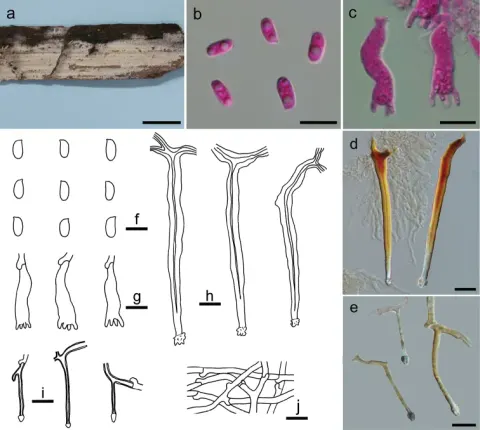
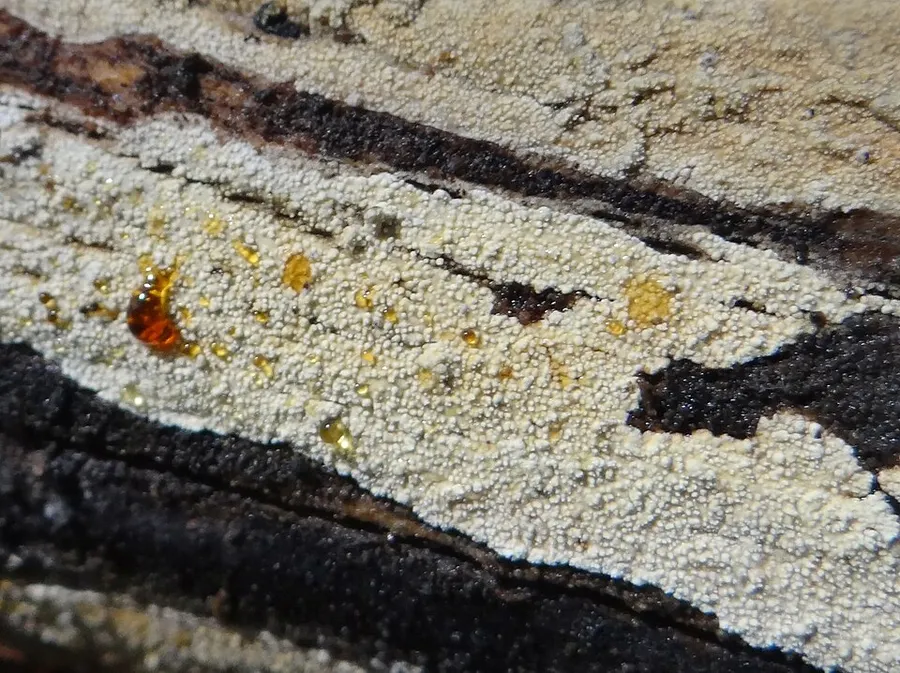
Brevicellicium olivascens forms thin, patchy resupinate fruit bodies that adhere to the substrate (wood). The fruiting body is a crust or film that can cover several square centimetres, with a thickness of only 0.1–0.3 mm. It often appears as an irregular, web-like patch on the underside of decaying wood. Fresh areas of the crust are pale greyish-olive to olive-brown in colour (hence olivascens, "becoming olive"). The texture is cottony to membranous when active, drying to a thin papery film. Under a hand lens, the surface may show a very fine, porulose or granulose texture (tiny bumps or pores), though Brevicellicium typically has a smooth hymenial surface with no distinct pores or teeth. The edges of the crust are indistinct, thinning out to whitish mycelium. B. olivascens does not have stems, caps, or any differentiated structures – it is entirely crustose. Microscopically, it is characterized by short cylindrical basidia and ellipsoid spores about 4–6 μm long. The basidia bear only two spores each (biannulate basidia), a distinctive feature of Hydnodontaceae. The spores are smooth, thin-walled, and typically non-amyloid. Cystidia (sterile cells) are absent or inconspicuous. The hyphae have clamp connections. When a small piece of the crust is placed in potassium hydroxide (KOH) solution, it may exude a yellowish or olive tint. B. olivascens is not conspicuous in the field – one usually notices a faint olive discolouration on wood, which under a microscope reveals the fertile basidia. It can be confused with other corticioid fungi; the combination of olive colouration and microscopic traits is needed to identify it.

Sebagian uraian ditampilkan dalam bahasa sumber; terjemahannya belum tersedia atau belum lolos pemeriksaan.

Rujukan: [1]

Pengukuran mengikuti objek, spesimen atau kultur, dan metode yang disebutkan sumber. Baca uraian asli untuk konteks lengkap.

02 / Kehidupan

Habitat dan peran ekologis

Brevicellicium olivascens adalah saprotrof, tumbuh di atas kayu berdaun lebar dan anggur kayu yang membusuk. The species has a European distribution – it is recorded widely across Europe from Italy (the type locality) and France up to Scandinavia. Bresadola berasal dari Trento, Italia, dari kayu yang sudah rusak. Hal ini mungkin terjadi sepanjang habitat kayu berkarat yang cocok Europe anywhere ada. Di luar Eropa, B. olivascens dianggap kosmopolitan: telah diidentifikasi di Amerika Utara, Asia, dan Oceania in survei hutan.

Sebagian uraian ditampilkan dalam bahasa sumber; terjemahannya belum tersedia atau belum lolos pemeriksaan.

Rujukan: [1]

Habitat atau konteks temuan
hutan
Substrat
kayu
Peran atau konteks
Pengurai
Temukan hubungan serupa
03 / Siklus hidup

Reproduksi

Brevicellicium olivascens forms thin, patchy resupinate fruit bodies that adhere to the substrate (wood). The fruiting body is a crust or film that can cover several square centimetres, with a thickness of only 0.1–0.3 mm. It often appears as an irregular, web-like patch on the underside of decaying wood. Fresh areas of the crust are pale greyish-olive to olive-brown in colour (hence olivascens, "becoming olive"). The texture is cottony to membranous when active, drying to a thin papery film. Under a hand lens, the surface may show a very fine, porulose or granulose texture (tiny bumps or pores), though Brevicellicium typically has a smooth hymenial surface with no distinct pores or teeth. The edges of the crust are indistinct, thinning out to whitish mycelium.

Sebagian uraian ditampilkan dalam bahasa sumber; terjemahannya belum tersedia atau belum lolos pemeriksaan.

Rujukan: [1]

Sinonim menurut acuan taksonomi rilis: Athelopsis viridula; Brevicellicium viridulum; Corticium sulphurellum; Cristella mutabilis; Cristella mutabilis f. cirsii; Cristella mutabilis f. sulphurella; Cristella mutabilis var. corticina; Cristella mutabilis var. microspora; Grandinia abrotani; Grandinia mutabilis; Grandinia mutabilis var. cyrtospora; Grandinia mutabilis var. multipartita; Hydnum granulosum var. mutabile; Odontia chromoflava; Odontia mutabilis; Odontia olivascens; Trechispora mutabilis; Trechispora sphaerocystis
04 / Batas informasi

Catatan identitas dan cakupan

  • Nama diterima mengikuti Catalogue of Life Base2026-09-11; uraian mempertahankan konsep dan nama sumber aslinya.
  • Original geographic, specimen and life-cycle scope retained; source import awaits individual editorial review.
  • Impor dan terjemahan otomatis belum diperiksa editorial per profil. Struktur reproduktif yang disebutkan tidak membuktikan seluruh siklus hidup diketahui.
  • Pengukuran pada uraian mengikuti spesimen, kultur, dan metode sumber; angka tidak diperluas ke semua populasi.

Catatan distribusi dalam narasi mengikuti sumbernya. Dokumentasi spesimen atau foto mengikuti catatan sumber. Bukti wilayah Indonesia dan penilaian konservasi tidak disimpulkan dari gambar.

05 / Dokumentasi

Melihat dengan konteks

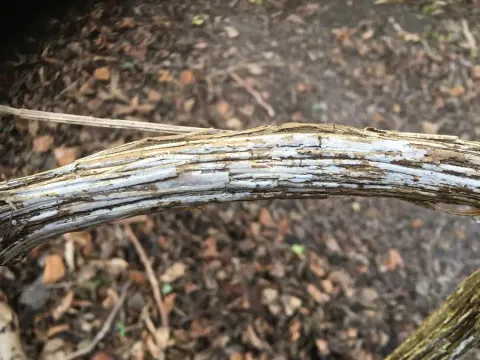
Dokumentasi Brevicellicium olivascens dari Wikimedia Commons. Brevicellicium olivascens]]. Location: Poland, Rajbrot Identifikasi mengikuti record berkas sumber.

Jenis
Fotografi
Kredit
Jerzy Opioła
Sumber media
Buka entri sumber

Gambar menunjukkan objek menurut identifikasi sumber, bukan verifikasi independen spesimen oleh Fungi. Tidak ada skala baru yang ditambahkan.

06 / Rujukan

Sumber profil

  1. [1] Brevicellicium olivascens — Wikipedia (en)Bagian sumber: Frozen revision 1341957809
    Tanggal penghimpunan sumber: 2026-10-12
    Teks sumber: CC BY-SA4.0 · Wikipedia contributors
  2. [2] Catalogue of Life Base2026-09-11 — Brevicellicium olivascensBagian sumber: ColDP NameUsage.tsv ID N9NQ; accepted species; source 2073
    Tanggal penghimpunan sumber: 2026-10-12
  3. [3] Dokumentasi visual — Brevicellicium olivascensBagian sumber: Individual media record; identification follows the source, not independent determination
    Tanggal penghimpunan sumber: 2026-10-12
    Media sumber: CC BY-SA 4.0 · Jerzy Opioła

Adaptasi teks: CC BY-SA 4.0. Wikipedia contributors — Brevicellicium olivascens — Wikipedia (en)

Uraian asli dan riwayat sumber

Riwayat atau halaman sumber

Ringkasan sumber

Brevicellicium olivascens is a species of crust-forming fungus in the family Hydnodontaceae that grows as thin, olive-tinted patches on decaying wood. First described by the Italian mycologist Giacomo Bresadola in 1892 as Odontia olivascens, it was later reclassified in 1978 by the Swedish mycologists Karl-Henrik Larsson and Erik Hjortstam, who created the new genus Brevicellicium (meaning "short cells") to accommodate it. This inconspicuous fungus forms delicate, web-like films only 0.1–0.3 millimetres thick that appear greyish-olive to olive-brown when fresh, becoming papery when dry, and can be identified microscopically by its distinctive two-spored reproductive cells.

Revisi sumber

Morfologi sumber

Brevicellicium olivascens forms thin, patchy resupinate fruit bodies that adhere to the substrate (wood). The fruiting body is a crust or film that can cover several square centimetres, with a thickness of only 0.1–0.3 mm. It often appears as an irregular, web-like patch on the underside of decaying wood. Fresh areas of the crust are pale greyish-olive to olive-brown in colour (hence olivascens, "becoming olive"). The texture is cottony to membranous when active, drying to a thin papery film. Under a hand lens, the surface may show a very fine, porulose or granulose texture (tiny bumps or pores), though Brevicellicium typically has a smooth hymenial surface with no distinct pores or teeth. The edges of the crust are indistinct, thinning out to whitish mycelium. B. olivascens does not have stems, caps, or any differentiated structures – it is entirely crustose. Microscopically, it is characterized by short cylindrical basidia and ellipsoid spores about 4–6 μm long. The basidia bear only two spores each (biannulate basidia), a distinctive feature of Hydnodontaceae. The spores are smooth, thin-walled, and typically non-amyloid. Cystidia (sterile cells) are absent or inconspicuous. The hyphae have clamp connections. When a small piece of the crust is placed in potassium hydroxide (KOH) solution, it may exude a yellowish or olive tint. B. olivascens is not conspicuous in the field – one usually notices a faint olive discolouration on wood, which under a microscope reveals the fertile basidia. It can be confused with other corticioid fungi; the combination of olive colouration and microscopic traits is needed to identify it.

Revisi sumber

Ekologi sumber

Brevicellicium olivascens is saprotrophic, growing on decaying wood of broadleaf trees and woody vines. The species has a European distribution – it is recorded widely across Europe from Italy (the type locality) and France up to Scandinavia. Bresadola's original specimens came from Trento, Italy, on decayed wood. It likely occurs throughout temperate Europe anywhere suitable decaying wood habitat exists. Outside Europe, B. olivascens is considered cosmopolitan: it has been identified in North America, Asia, and Oceania in forest surveys.

Revisi sumber

Struktur reproduksi sumber

Brevicellicium olivascens forms thin, patchy resupinate fruit bodies that adhere to the substrate (wood). The fruiting body is a crust or film that can cover several square centimetres, with a thickness of only 0.1–0.3 mm. It often appears as an irregular, web-like patch on the underside of decaying wood. Fresh areas of the crust are pale greyish-olive to olive-brown in colour (hence olivascens, "becoming olive"). The texture is cottony to membranous when active, drying to a thin papery film. Under a hand lens, the surface may show a very fine, porulose or granulose texture (tiny bumps or pores), though Brevicellicium typically has a smooth hymenial surface with no distinct pores or teeth. The edges of the crust are indistinct, thinning out to whitish mycelium.

Revisi sumber

Rujukan halaman ini

Fungi. Brevicellicium olivascens. Rilis data fungi-2026-10-12-expansion-2. https://fungi-atlas.mgadib.chatgpt.site/jamur/brevicellicium-olivascens/.

Status: impor sumber; pemeriksaan editorial per profil belum selesai. Untuk klaim biologis, gunakan rujukan pada bagian terkait dan periksa konteks sumber aslinya.