01 / Morfologi

Ciri dan struktur

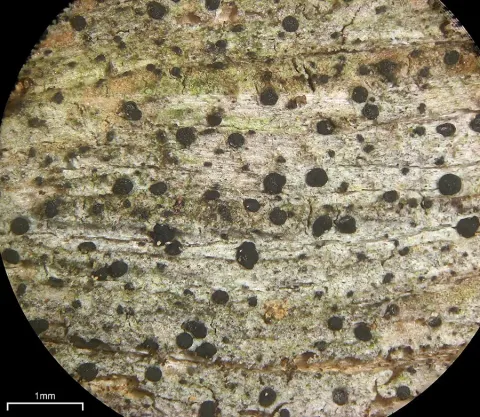
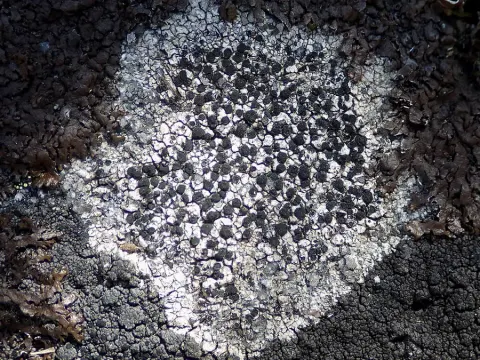
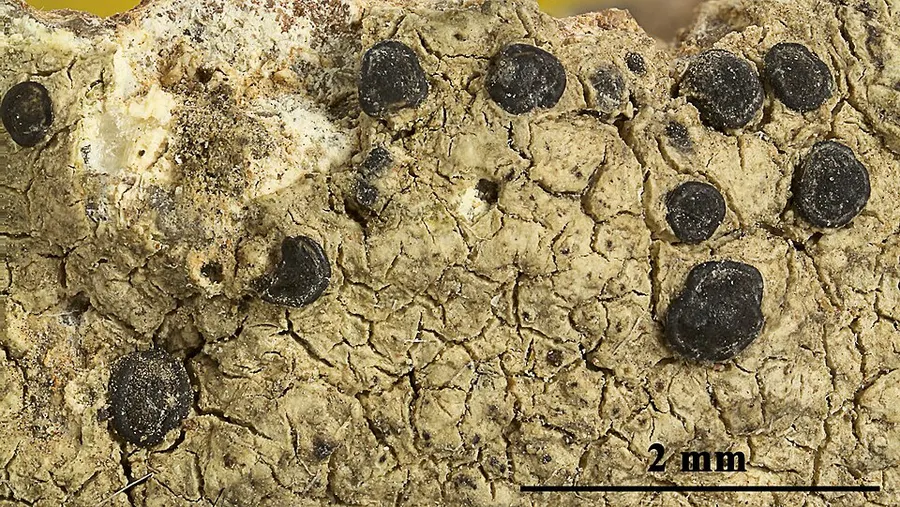
Buellia saxorum forms a moderately thick crust-like growth (thallus) on its substrate. The thallus has a distinctive appearance with a network of fine cracks (described as "-cracked" in technical terminology) and displays a white to pale yellow-grey colouration. One of its distinctive features is the black border () that clearly defines its edges, often creating a mosaic pattern where multiple thalli meet. When stained with iodine, the inner layer (medulla) turns blue. The reproductive structures (apothecia) measure between 0.3 and 1 mm in diameter and sit on the surface of the thallus rather than being embedded within it. These apothecia have a flat to slightly convex dark disc surrounded by a prominent true rim (). Under microscopic examination, the upper layer of the apothecia () appears brown and does not react with nitric acid. The spore-producing layer (hymenium) lacks oil droplets. The spores (ascospores) are divided by a single septum (internal partition) and measure 10–18 by 5–9 micrometres (μm). They have walls that are uniformly thickened and smooth. They are of the Physconia-type The asexual reproductive structures (pycnidia) are abundant, producing spindle to cylinder-shaped spores (conidia) that measure 4–7 (–9) by about 1 μm. When subjected to chemical spot tests, the thallus is C+ (red), K+ (yellow), Pd (± yellow), and UV−. These reactions indicate the presence of two secondary metabolites: atranorin and gyrophoric acid. Lecanoric acid is present in trace amounts.

Sebagian uraian ditampilkan dalam bahasa sumber; terjemahannya belum tersedia atau belum lolos pemeriksaan.

Rujukan: [1]

Pengukuran mengikuti objek, spesimen atau kultur, dan metode yang disebutkan sumber. Baca uraian asli untuk konteks lengkap.

02 / Kehidupan

Habitat dan peran ekologis

Buellia saxorum grows on more or less vertical faces of siliceous rocks. In Europe, it occurs in Britain, France, Italy, and Spain.

Sebagian uraian ditampilkan dalam bahasa sumber; terjemahannya belum tersedia atau belum lolos pemeriksaan.

Rujukan: [1]

Habitat atau konteks temuan
Informasi belum tersedia pada sumber rilis ini.
Substrat
Informasi belum tersedia pada sumber rilis ini.
Peran atau konteks
Pembentuk liken
Temukan hubungan serupa
03 / Siklus hidup

Reproduksi

The reproductive structures (apothecia) measure between 0.3 and 1 mm in diameter and sit on the surface of the thallus rather than being embedded within it. These apothecia have a flat to slightly convex dark disc surrounded by a prominent true rim (). Under microscopic examination, the upper layer of the apothecia () appears brown and does not react with nitric acid. The spore-producing layer (hymenium) lacks oil droplets. The spores (ascospores) are divided by a single septum (internal partition) and measure 10–18 by 5–9 micrometres (μm). They have walls that are uniformly thickened and smooth. They are of the Physconia-type The asexual reproductive structures (pycnidia) are abundant, producing spindle to cylinder-shaped spores (conidia) that measure 4–7 (–9) by about 1 μm.

Sebagian uraian ditampilkan dalam bahasa sumber; terjemahannya belum tersedia atau belum lolos pemeriksaan.

Rujukan: [1]

Sinonim menurut acuan taksonomi rilis: Lecidea disciformis var. saxorum
04 / Batas informasi

Catatan identitas dan cakupan

  • Nama diterima mengikuti Catalogue of Life Base2026-09-11; uraian mempertahankan konsep dan nama sumber aslinya.
  • Original geographic, specimen and life-cycle scope retained; source import awaits individual editorial review.
  • Impor dan terjemahan otomatis belum diperiksa editorial per profil. Struktur reproduktif yang disebutkan tidak membuktikan seluruh siklus hidup diketahui.
  • Pengukuran pada uraian mengikuti spesimen, kultur, dan metode sumber; angka tidak diperluas ke semua populasi.

Catatan distribusi dalam narasi mengikuti sumbernya. Dokumentasi spesimen atau foto mengikuti catatan sumber. Bukti wilayah Indonesia dan penilaian konservasi tidak disimpulkan dari gambar.

05 / Dokumentasi

Melihat dengan konteks

Dokumentasi Buellia saxorum dari Wikimedia Commons. The rock-dwelling crustose lichen Buellia saxorum; photographed in Italy Identifikasi mengikuti record berkas sumber.

Jenis
Fotografi
Kredit
Felis Schumm
Sumber media
Buka entri sumber

Gambar menunjukkan objek menurut identifikasi sumber, bukan verifikasi independen spesimen oleh Fungi. Tidak ada skala baru yang ditambahkan.

06 / Rujukan

Sumber profil

  1. [1] Buellia saxorum — Wikipedia (en)Bagian sumber: Frozen revision 1353398795
    Tanggal penghimpunan sumber: 2026-10-12
    Teks sumber: CC BY-SA4.0 · Wikipedia contributors
  2. [2] Catalogue of Life Base2026-09-11 — Buellia saxorumBagian sumber: ColDP NameUsage.tsv ID NNM4; accepted species; source 2073
    Tanggal penghimpunan sumber: 2026-10-12
  3. [3] Dokumentasi visual — Buellia saxorumBagian sumber: Individual media record; identification follows the source, not independent determination
    Tanggal penghimpunan sumber: 2026-10-12
    Media sumber: CC BY-SA 4.0 · Felis Schumm

Adaptasi teks: CC BY-SA 4.0. Wikipedia contributors — Buellia saxorum — Wikipedia (en)

Uraian asli dan riwayat sumber

Riwayat atau halaman sumber

Ringkasan sumber

Buellia saxorum is a species of saxicolous (rock-dwelling) crustose lichen in the family Caliciaceae. It forms a moderately thick, white to pale yellow-grey crust with a network of fine cracks and a distinctive black border where it meets other lichen thalli, creating a mosaic pattern. The lichen's reproductive structures appear as small dark discs up to 1 mm in diameter on the surface of the thallus. First described by the Italian botanist Abramo Bartolommeo Massalongo in 1852, B. saxorum can be identified by its chemical spot test reactions due to the presence of atranorin and gyrophoric acid.

Revisi sumber

Morfologi sumber

Buellia saxorum forms a moderately thick crust-like growth (thallus) on its substrate. The thallus has a distinctive appearance with a network of fine cracks (described as "-cracked" in technical terminology) and displays a white to pale yellow-grey colouration. One of its distinctive features is the black border () that clearly defines its edges, often creating a mosaic pattern where multiple thalli meet. When stained with iodine, the inner layer (medulla) turns blue. The reproductive structures (apothecia) measure between 0.3 and 1 mm in diameter and sit on the surface of the thallus rather than being embedded within it. These apothecia have a flat to slightly convex dark disc surrounded by a prominent true rim (). Under microscopic examination, the upper layer of the apothecia () appears brown and does not react with nitric acid. The spore-producing layer (hymenium) lacks oil droplets. The spores (ascospores) are divided by a single septum (internal partition) and measure 10–18 by 5–9 micrometres (μm). They have walls that are uniformly thickened and smooth. They are of the Physconia-type The asexual reproductive structures (pycnidia) are abundant, producing spindle to cylinder-shaped spores (conidia) that measure 4–7 (–9) by about 1 μm. When subjected to chemical spot tests, the thallus is C+ (red), K+ (yellow), Pd (± yellow), and UV−. These reactions indicate the presence of two secondary metabolites: atranorin and gyrophoric acid. Lecanoric acid is present in trace amounts.

Revisi sumber

Ekologi sumber

Buellia saxorum grows on more or less vertical faces of siliceous rocks. In Europe, it occurs in Britain, France, Italy, and Spain.

Revisi sumber

Struktur reproduksi sumber

The reproductive structures (apothecia) measure between 0.3 and 1 mm in diameter and sit on the surface of the thallus rather than being embedded within it. These apothecia have a flat to slightly convex dark disc surrounded by a prominent true rim (). Under microscopic examination, the upper layer of the apothecia () appears brown and does not react with nitric acid. The spore-producing layer (hymenium) lacks oil droplets. The spores (ascospores) are divided by a single septum (internal partition) and measure 10–18 by 5–9 micrometres (μm). They have walls that are uniformly thickened and smooth. They are of the Physconia-type The asexual reproductive structures (pycnidia) are abundant, producing spindle to cylinder-shaped spores (conidia) that measure 4–7 (–9) by about 1 μm.

Revisi sumber

Rujukan halaman ini

Fungi. Buellia saxorum. Rilis data fungi-2026-10-12-expansion-2. https://fungi-atlas.mgadib.chatgpt.site/jamur/buellia-saxorum/.

Status: impor sumber; pemeriksaan editorial per profil belum selesai. Untuk klaim biologis, gunakan rujukan pada bagian terkait dan periksa konteks sumber aslinya.