01 / Morfologi

Ciri dan struktur

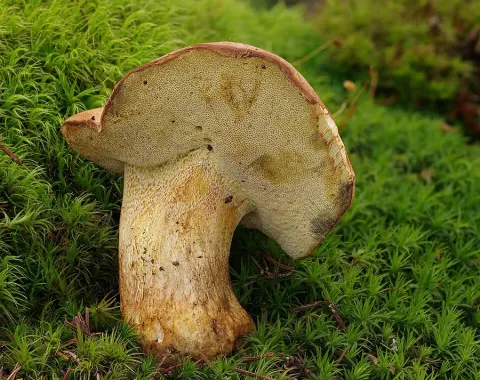
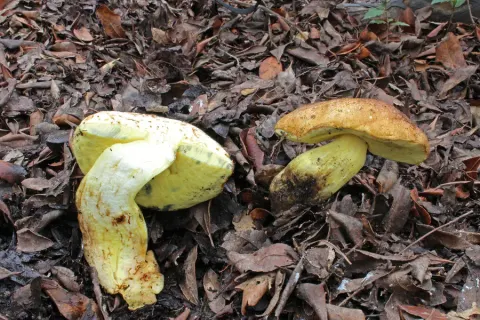
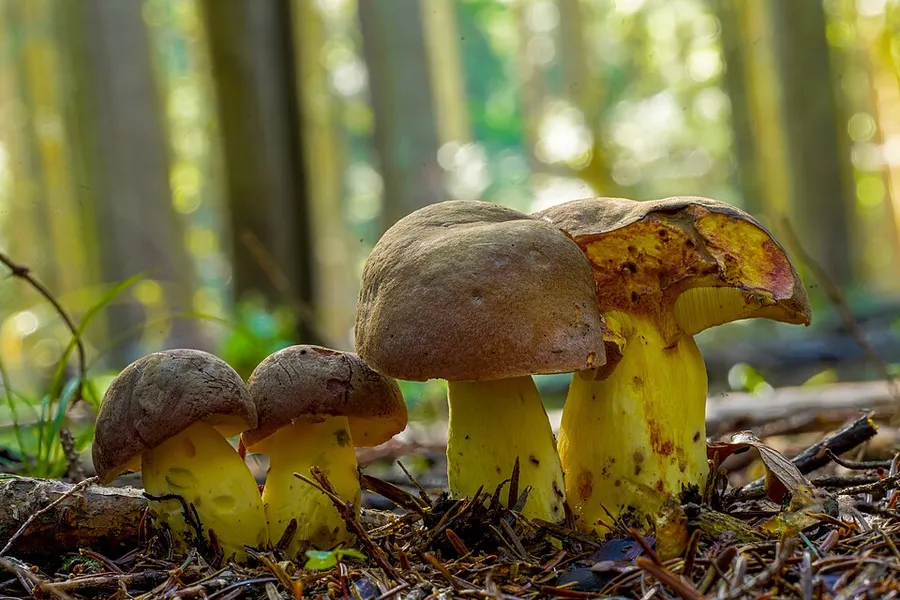
The cap (pileus) of Boletus roseogriseus is 70–120 mm in diameter at maturity, initially hemispherical before flattening to a convex or cushion-shaped form. Its surface is matte, covered in velutinous (silky) to somewhat tomentose fibres that may develop a finely floccose (wooly) to granulose texture with age, and young specimens often appear pruinose. Colouration is variable—light pink or greyish pink when young, later shifting to grey, ochraceous or brown, though pink or reddish tinges frequently persist at the margin. Beneath the cap cuticle, the flesh is yellow or light yellowish, turning brown towards the stipe base. The tubes of the hymenophore reach up to 20 mm long and the round pores up to 1 mm across; both are bright yellow and bruise greenish-blue or deep blue on contact. The stout stipe, up to 90 mm long and 50 mm wide, is uniformly yellow with a distinct yellow reticulation (web-like pattern) on its upper portion, bruising blue and sometimes staining rusty brown where damaged. Microscopically, the cap cuticle (pileipellis) forms a filamentous trichoderm of hyphae 3–8.5 μm wide, lacking conspicuous incrustations and accounting for the matt appearance. The hymenophoral trama is bilateral and boletoid. Basidia are mostly four-spored, club-shaped (clavate) cells measuring 28–44.5 × 8.5–12.5 μm. Cystidia on the gill faces (pleurocystidia) and edges (cheilocystidia) vary from cylindrical to fusiform or lageniform and can reach up to 61 μm in length. The stipe surface bears a fertile caulohymenium with caulobasidia and caulocystidia up to 58 μm long. Basidiospores are smooth, fusoid–ellipsoid with a slight suprahilar depression, typically 12–14.5 × 5.2–6.5 μm, and appear yellowish to brownish in Melzer's reagent.

Sebagian uraian ditampilkan dalam bahasa sumber; terjemahannya belum tersedia atau belum lolos pemeriksaan.

Rujukan: [1]

Pengukuran mengikuti objek, spesimen atau kultur, dan metode yang disebutkan sumber. Baca uraian asli untuk konteks lengkap.

02 / Kehidupan

Habitat dan peran ekologis

Boletus roseogriseus is known only from a few localities in the Maple Mountains near Francova Lhota in east Moravia, Czech Republic, where it fruits in submontane forest belts at 575–610 m above sea level. It appears to form ectomycorrhizal associations principally with silver fir (Abies alba), growing on the forest floor among needle and twig litter from July to early October, with peak abundance in August. Soils at these sites derive from claystone and sandstone of the Carpathian Flysch Belt and range from slightly acidic to moderately alkaline in pH. Fruit bodies occur singly or in small groups under mature fir or mixed fir–spruce stands, sometimes emerging amid bilberry (Vaccinium myrtillus) cushions. Although hazel (Corylus avellana), Scots pine (Pinus sylvestris), aspen (Populus tremula), rowan (Sorbus aucuparia), silver birch (Betula pendula), European larch (Larix decidua) and pedunculate oak (Quercus robur) are present at these sites, only silver fir appears essential for its development. As of 2014, no records of B. roseogriseus extend beyond these East Moravian microlocalities.

Sebagian uraian ditampilkan dalam bahasa sumber; terjemahannya belum tersedia atau belum lolos pemeriksaan.

Rujukan: [1]

Habitat atau konteks temuan
hutan
Substrat
Informasi belum tersedia pada sumber rilis ini.
Peran atau konteks
Mitra tumbuhan
Temukan hubungan serupa
03 / Siklus hidup

Reproduksi

Microscopically, the cap cuticle (pileipellis) forms a filamentous trichoderm of hyphae 3–8.5 μm wide, lacking conspicuous incrustations and accounting for the matt appearance. The hymenophoral trama is bilateral and boletoid. Basidia are mostly four-spored, club-shaped (clavate) cells measuring 28–44.5 × 8.5–12.5 μm. Cystidia on the gill faces (pleurocystidia) and edges (cheilocystidia) vary from cylindrical to fusiform or lageniform and can reach up to 61 μm in length. The stipe surface bears a fertile caulohymenium with caulobasidia and caulocystidia up to 58 μm long. Basidiospores are smooth, fusoid–ellipsoid with a slight suprahilar depression, typically 12–14.5 × 5.2–6.5 μm, and appear yellowish to brownish in Melzer's reagent.

Sebagian uraian ditampilkan dalam bahasa sumber; terjemahannya belum tersedia atau belum lolos pemeriksaan.

Rujukan: [1]

Sinonim menurut acuan taksonomi rilis: Boletus roseogriseus
04 / Batas informasi

Catatan identitas dan cakupan

  • Nama diterima mengikuti Catalogue of Life Base2026-09-11; uraian mempertahankan konsep dan nama sumber aslinya.
  • Original geographic, specimen and life-cycle scope retained; source import awaits individual editorial review.
  • Impor dan terjemahan otomatis belum diperiksa editorial per profil. Struktur reproduktif yang disebutkan tidak membuktikan seluruh siklus hidup diketahui.
  • Pengukuran pada uraian mengikuti spesimen, kultur, dan metode sumber; angka tidak diperluas ke semua populasi.

Catatan distribusi dalam narasi mengikuti sumbernya. Dokumentasi spesimen atau foto mengikuti catatan sumber. Bukti wilayah Indonesia dan penilaian konservasi tidak disimpulkan dari gambar.

05 / Dokumentasi

Melihat dengan konteks

Dokumentasi Butyriboletus roseogriseus dari Wikimedia Commons. Butyriboletus roseogriseus in Slovenia Identifikasi mengikuti record berkas sumber.

Jenis
Fotografi
Kredit
Matej Frančeškin
Lisensi
CC BY 4.0
Sumber media
Buka entri sumber

Gambar menunjukkan objek menurut identifikasi sumber, bukan verifikasi independen spesimen oleh Fungi. Tidak ada skala baru yang ditambahkan.

06 / Rujukan

Sumber profil

  1. [1] Butyriboletus roseogriseus — Wikipedia (en)Bagian sumber: Frozen revision 1287121555
    Tanggal penghimpunan sumber: 2026-10-12
    Teks sumber: CC BY-SA4.0 · Wikipedia contributors
  2. [2] Catalogue of Life Base2026-09-11 — Butyriboletus roseogriseusBagian sumber: ColDP NameUsage.tsv ID NZ88; accepted species; source 2073
    Tanggal penghimpunan sumber: 2026-10-12
  3. [3] Dokumentasi visual — Butyriboletus roseogriseusBagian sumber: Individual media record; identification follows the source, not independent determination
    Tanggal penghimpunan sumber: 2026-10-12
    Media sumber: CC BY 4.0 · Matej Frančeškin

Adaptasi teks: CC BY-SA 4.0. Wikipedia contributors — Butyriboletus roseogriseus — Wikipedia (en)

Uraian asli dan riwayat sumber

Riwayat atau halaman sumber

Ringkasan sumber

Butyriboletus roseogriseus is a pored mushroom in the family Boletaceae found in Europe, originally described as a species of Boletus in 2014 before being transferred to the newly created genus Butyriboletus later that same year. The fungus produces large caps 70–120 mm in diameter that start light pink or greyish-pink when young before shifting to grey, ochraceous or brown, with bright yellow tubes and pores that bruise greenish-blue on contact, and a stout yellow stipe featuring a distinctive net-like pattern.

Revisi sumber

Morfologi sumber

The cap (pileus) of Boletus roseogriseus is 70–120 mm in diameter at maturity, initially hemispherical before flattening to a convex or cushion-shaped form. Its surface is matte, covered in velutinous (silky) to somewhat tomentose fibres that may develop a finely floccose (wooly) to granulose texture with age, and young specimens often appear pruinose. Colouration is variable—light pink or greyish pink when young, later shifting to grey, ochraceous or brown, though pink or reddish tinges frequently persist at the margin. Beneath the cap cuticle, the flesh is yellow or light yellowish, turning brown towards the stipe base. The tubes of the hymenophore reach up to 20 mm long and the round pores up to 1 mm across; both are bright yellow and bruise greenish-blue or deep blue on contact. The stout stipe, up to 90 mm long and 50 mm wide, is uniformly yellow with a distinct yellow reticulation (web-like pattern) on its upper portion, bruising blue and sometimes staining rusty brown where damaged. Microscopically, the cap cuticle (pileipellis) forms a filamentous trichoderm of hyphae 3–8.5 μm wide, lacking conspicuous incrustations and accounting for the matt appearance. The hymenophoral trama is bilateral and boletoid. Basidia are mostly four-spored, club-shaped (clavate) cells measuring 28–44.5 × 8.5–12.5 μm. Cystidia on the gill faces (pleurocystidia) and edges (cheilocystidia) vary from cylindrical to fusiform or lageniform and can reach up to 61 μm in length. The stipe surface bears a fertile caulohymenium with caulobasidia and caulocystidia up to 58 μm long. Basidiospores are smooth, fusoid–ellipsoid with a slight suprahilar depression, typically 12–14.5 × 5.2–6.5 μm, and appear yellowish to brownish in Melzer's reagent.

Revisi sumber

Ekologi sumber

Boletus roseogriseus is known only from a few localities in the Maple Mountains near Francova Lhota in east Moravia, Czech Republic, where it fruits in submontane forest belts at 575–610 m above sea level. It appears to form ectomycorrhizal associations principally with silver fir (Abies alba), growing on the forest floor among needle and twig litter from July to early October, with peak abundance in August. Soils at these sites derive from claystone and sandstone of the Carpathian Flysch Belt and range from slightly acidic to moderately alkaline in pH. Fruit bodies occur singly or in small groups under mature fir or mixed fir–spruce stands, sometimes emerging amid bilberry (Vaccinium myrtillus) cushions. Although hazel (Corylus avellana), Scots pine (Pinus sylvestris), aspen (Populus tremula), rowan (Sorbus aucuparia), silver birch (Betula pendula), European larch (Larix decidua) and pedunculate oak (Quercus robur) are present at these sites, only silver fir appears essential for its development. As of 2014, no records of B. roseogriseus extend beyond these East Moravian microlocalities.

Revisi sumber

Struktur reproduksi sumber

Microscopically, the cap cuticle (pileipellis) forms a filamentous trichoderm of hyphae 3–8.5 μm wide, lacking conspicuous incrustations and accounting for the matt appearance. The hymenophoral trama is bilateral and boletoid. Basidia are mostly four-spored, club-shaped (clavate) cells measuring 28–44.5 × 8.5–12.5 μm. Cystidia on the gill faces (pleurocystidia) and edges (cheilocystidia) vary from cylindrical to fusiform or lageniform and can reach up to 61 μm in length. The stipe surface bears a fertile caulohymenium with caulobasidia and caulocystidia up to 58 μm long. Basidiospores are smooth, fusoid–ellipsoid with a slight suprahilar depression, typically 12–14.5 × 5.2–6.5 μm, and appear yellowish to brownish in Melzer's reagent.

Revisi sumber

Rujukan halaman ini

Fungi. Butyriboletus roseogriseus. Rilis data fungi-2026-10-12-expansion-2. https://fungi-atlas.mgadib.chatgpt.site/jamur/butyriboletus-roseogriseus/.

Status: impor sumber; pemeriksaan editorial per profil belum selesai. Untuk klaim biologis, gunakan rujukan pada bagian terkait dan periksa konteks sumber aslinya.