Ciri dan struktur
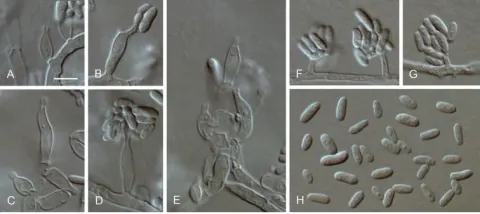
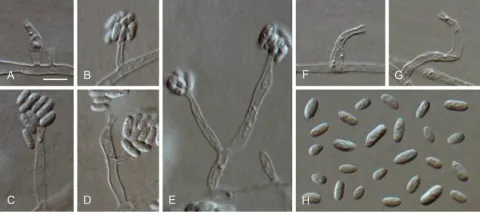
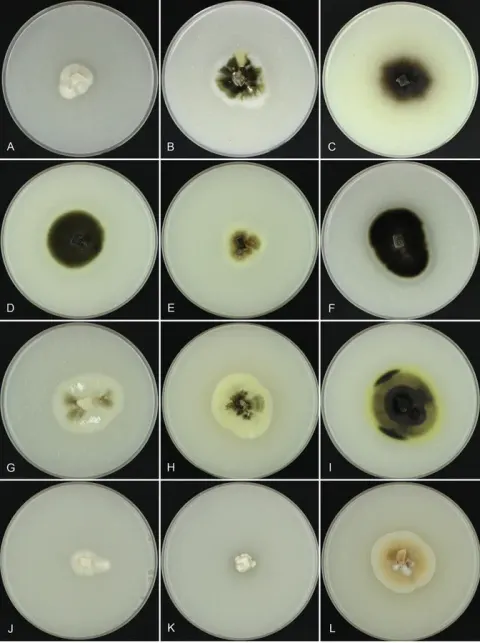
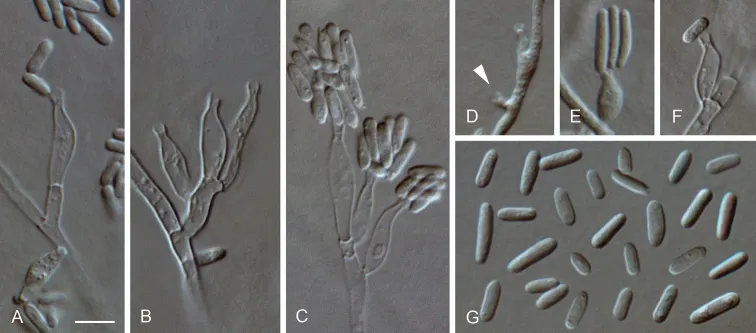
Sexual morph not observed. Asexual morph on SNA. Vegetative mycelium hyaline, smooth-walled, septate, branched, 1–10 µm wide, hyphal cells often, sometimes very strongly inflated and constricted at the septa, chlamydospores absent. Sporulation abundant, conidia formed on hyphal cells. Conidiophores hyaline, smooth-walled, simple or septate and branched, up to 40 µm long. Conidiogenous cells enteroblastic, hyaline, smooth-walled, cylindrical to ± inflated, 3–14 × 1.5–4 µm, sometimes integrated, necks cylindrical, 0.5–3 µm long, collarettes funnel-shaped, 1–1.5 µm long, 1–2 µm wide at the upper edge, opening 1–1.5 µm wide, periclinal thickening not observed. Conidia aggregated in heads, hyaline, smooth-walled, aseptate, cylindrical, rarely ellipsoidal, straight, sometimes slightly curved, both ends rounded, conidia of strain GLMC 1310 measure (2–)4–7(–8) × 1.5–2.5 µm, mean ± SD = 5.3 ± 1.4 × 2.0 ± 0.3 µm, L/W ratio = 2.7, while those of GLMC 1264 are longer, measuring (3–)5–8(–10) × 1.5–2 µm, mean ± SD = 6.4 ± 1.6 × 1.8 ± 0.2 µm, L/W ratio = 3.5. Colonies on SNA flat with an entire margin, hyaline, sometimes filter paper partly pale olivaceous to olivaceous, lacking aerial mycelium, reverse same colours, strains GLMC 1264 and GLMC 1310 5–15 mm diam., strains GLMC 517 and GLMC 1501 32–43 mm diam. in 2 wk (25 °C in the dark); Colonies on OA flat with an entire margin, buff, olivaceous buff, olivaceous to olivaceous black, lacking aerial mycelium or partly covered by pale grey aerial mycelium, reverse same colours, 28–44 mm diam. in 2 wk (25 °C in the dark).
Habitat dan peran ekologis
In total, 12 strains of C. luteo-olivacea were isolated from Prunus domestica in Baden-Württemberg (3), Lower Saxony (8) and Saxony (1). Two strains from Baden-Württemberg, two strains from Lower Saxony and the strain from Saxony had been selected for the phylogenetic analyses. The complete sequence dataset of C. luteo-olivacea, including reference strains, exhibits a variation of up to five nucleotides within ITS, up to nine nucleotides within TUB and up to 16 nucleotides within EF-1α sequences. The ITS sequences of the strains from this study are identical with those of the ex-type strain, except for GLMC 1517, which differs in five nucleotides, while all TUB sequences of our isolates differ in eight to nine nucleotides from the ex-type strain. The EF-1α sequence of all strains from this study differs in five nucleotides from the ex-type strain, except for GLMC 1264 with no differences.
- Habitat atau konteks temuan
- Informasi belum tersedia pada sumber rilis ini.
- Substrat
- Informasi belum tersedia pada sumber rilis ini.
- Peran atau konteks
- Belum dikategorikan pada rilis ini.
Reproduksi
Sexual morph not observed. Asexual morph on SNA. Vegetative mycelium hyaline, smooth-walled, septate, branched, 1–10 µm wide, hyphal cells often, sometimes very strongly inflated and constricted at the septa, chlamydospores absent. Sporulation abundant, conidia formed on hyphal cells. Conidiophores hyaline, smooth-walled, simple or septate and branched, up to 40 µm long. Conidiogenous cells enteroblastic, hyaline, smooth-walled, cylindrical to ± inflated, 3–14 × 1.5–4 µm, sometimes integrated, necks cylindrical, 0.5–3 µm long, collarettes funnel-shaped, 1–1.5 µm long, 1–2 µm wide at the upper edge, opening 1–1.5 µm wide, periclinal thickening not observed. Conidia aggregated in heads, hyaline, smooth-walled, aseptate, cylindrical, rarely ellipsoidal, straight, sometimes slightly curved, both ends rounded, conidia of strain GLMC 1310 measure (2–)4–7(–8) × 1.5–2.5 µm, mean ± SD = 5.3 ± 1.4 × 2.0 ± 0.3 µm, L/W ratio = 2.7, while those of GLMC 1264 are longer, measuring (3–)5–8(–10) × 1.5–2 µm, mean ± SD = 6.4 ± 1.6 × 1.8 ± 0.2 µm, L/W ratio = 3.5.
Catatan identitas dan cakupan
- Nama diterima mengikuti Catalogue of Life Base2026-09-11; uraian mempertahankan konsep dan nama sumber aslinya.
- Preserve original treatment localities, hosts and substrate scope. Materials examined describe documented specimens, not the full global range.
- Impor dan terjemahan otomatis belum diperiksa editorial per profil. Struktur reproduktif yang disebutkan tidak membuktikan seluruh siklus hidup diketahui.
- Pengukuran pada uraian mengikuti spesimen, kultur, dan metode sumber; angka tidak diperluas ke semua populasi.
Catatan distribusi dalam narasi mengikuti sumbernya. Dokumentasi spesimen atau foto mengikuti catatan sumber. Bukti wilayah Indonesia dan penilaian konservasi tidak disimpulkan dari gambar.
Melihat dengan konteks
Cadophora luteo-olivacea. A–F conidiophores and conidiogenous cells (arrow indicates a short neck) G conidia A–G from SNA A–G LM. Scale bar: 5 μm (A applies to B–G).
- Jenis
- Pelat ilmiah
- Kredit
- Steffen Bien, Ulrike Damm
- Lisensi
- CC BY 4.0
- Sumber media
- Buka entri sumber
Dokumentasi tambahan
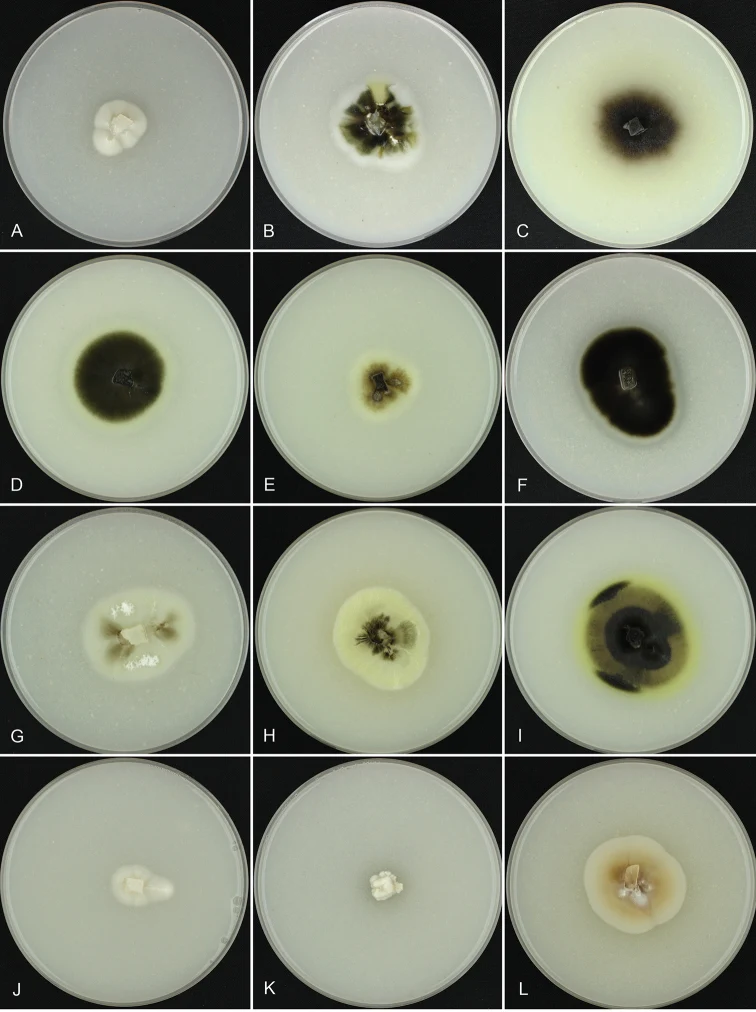
Colony surface of analysed strains on OA medium. A Arboricolonus simplex GLMC 459 T B Cadophora africana CBS 120890 T C C. bubakii CBS 198.30 T D C. luteo-olivacea GLMC 1264 E C. novi-eboraci GLMC 1472 F C. obscura CBS 269.33 G C. prunicola CBS 120891 T H C. prunicola GLMC 1633 I C. ramosa GLMC 377 T J Minutiella pruni-avium GLMC 1624 T K Proliferodiscus ingens GLMC 1751 T L Proliferodiscus sp. GLMC 460. Cultures A, J–L after 4 wk. Cultures B–I after 2 wk. Strains with a superscript T are ex-type cultures.
Kredit dan penggunaan
Steffen Bien, Ulrike Damm
Ukuran dan format gambar disesuaikan tanpa pemotongan, retus, atau penambahan skala. Lisensi sumber dipertahankan.
Sumber profil
- [1] Arboricolonus simplex gen. et sp. nov. and novelties in Cadophora, Minutiella and Proliferodiscus from Prunus wood in Germany — Cadophora luteo-olivacea
- [2] Catalogue of Life Base2026-09-11 — Cadophora luteo-olivacea
- [3] Dokumentasi visual — Cadophora luteo-olivacea
- [4] Dokumentasi visual — Cadophora luteo-olivacea
Rujukan halaman ini
Fungi. Cadophora luteo-olivacea. Rilis data fungi-2026-10-12-expansion-2. https://fungi-atlas.mgadib.chatgpt.site/jamur/cadophora-luteo-olivacea/.
Status: impor sumber; pemeriksaan editorial per profil belum selesai. Untuk klaim biologis, gunakan rujukan pada bagian terkait dan periksa konteks sumber aslinya.