Ciri dan struktur
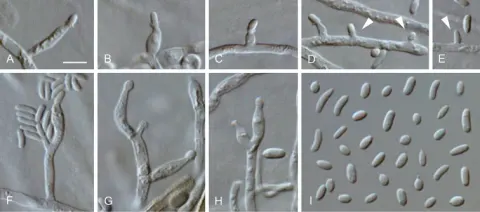
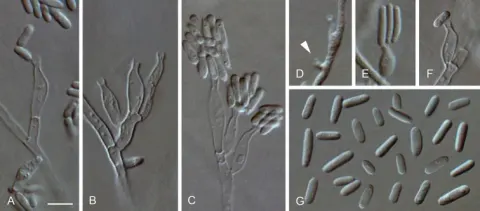
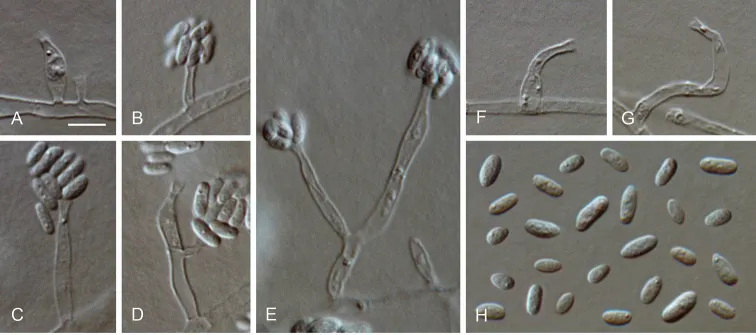
Sexual morph not observed. Asexual morph on SNA. Vegetative mycelium hyaline, septation hardly visible, branched, 1–3 µm wide, sometimes becoming brown with age, chlamydospores absent, hyphae of strain GLMC 735 in some parts inflated and restricted at the septae and up to 5 µm wide. Sporulation abundant, conidia formed on hyphal cells. Conidiophores hyaline, simple or septate and branched, up to 50 µm long. Conidiogenous cells enteroblastic, hyaline, smooth-walled, cylindrical, often inflated and bent in the upper part or attenuated at the base, delicate (disintegrating quickly), 4–15 × 1.5–2 µm, in strains GLMC 735 and GLMC 1574 sometimes integrated, necks cylindrical, 3–3.5 × 1 µm, collarettes distinct, funnel-shaped, cylindrical, 1–3 µm long, 1–2 µm wide at the upper edge, opening 1–1.5 µm wide, periclinal thickening sometimes observed. Conidia aggregated in heads, hyaline, smooth-walled, aseptate, ellipsoidal, cylindrical to ovoidal, straight, rarely slightly curved, both ends rounded, (2.5–)3–6.5(–9) × 1.5–2 µm, mean ± SD = 4.9 ± 1.8 × 1.7 ± 0.3 µm, L/W ratio = 2.8, conidia of strain GLMC 1574 smaller, measuring (2.5–)3.5–5(–6.5) × 1.5–2.5(–3) µm, mean ± SD = 4.2 ± 0.7 × 1.4 ± 0.4 µm, L/W ratio = 2.1. Colonies on SNA (strains GLMC 735, GLMC 1574 and GLMC 1633) flat with an entire to undulate margin, whitish, lacking aerial mycelium, reverse same colours, 18–27 mm diam. in 2 wk (25 °C in the dark). Colonies on OA (strains GLMC 735, GLMC 1574 and GLMC 1633) flat with an entire margin to undulate margin, buff, very pale luteus to cinnamon, lacking aerial mycelium, except for strain GLMC 1574 that was partly covered by white woolly aerial mycelium, reverse buff to fawn, 20–27 mm diam. in 2 wk (25 °C in the dark).
Habitat dan peran ekologis
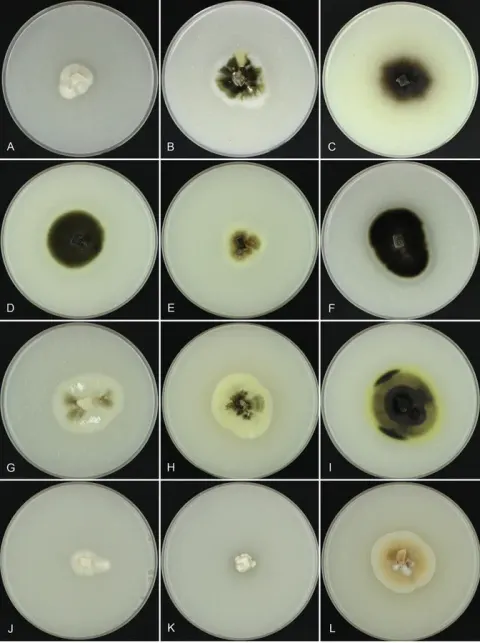
Colonies on SNA (strains GLMC 735, GLMC 1574 and GLMC 1633) flat with an entire to undulate margin, whitish, lacking aerial mycelium, reverse same colours, 18–27 mm diam. in 2 wk (25 °C in the dark). Colonies on OA (strains GLMC 735, GLMC 1574 and GLMC 1633) flat with an entire margin to undulate margin, buff, very pale luteus to cinnamon, lacking aerial mycelium, except for strain GLMC 1574 that was partly covered by white woolly aerial mycelium, reverse buff to fawn, 20–27 mm diam. in 2 wk (25 °C in the dark). Colonies on PDA (CBS 120891) flat to raised, entire margin, mycelium and surface white to very pale smoke-grey, with age turning isabelline to olivaceous in the centre, abundant velvety aerial mycelium, reverse straw to pure yellow, 18 mm diam. in 2 wk (25 °C). Colonies on MEA (CBS 120891) raised with entire margin, mycelium and surface white to very pale luteous, with age turning isabelline, abundant velvety aerial mycelium, reverse buff, honey to salmon, in diffuse daylight with a concentric apricot ring between centre and margin, 24 mm diam. in 2 wk (25 °C). Cadophora prunicola was isolated from Prunus salicina (2) in the Western Cape Province of South Africa, from P. cerasus (3) and P. domestica (2) in Saxony and P. domestica (3) in Baden-Württemberg, Germany.
- Habitat atau konteks temuan
- kultur yang didokumentasikan
- Substrat
- Informasi belum tersedia pada sumber rilis ini.
- Peran atau konteks
- Belum dikategorikan pada rilis ini.
Reproduksi
Sexual morph not observed. Asexual morph on SNA. Vegetative mycelium hyaline, septation hardly visible, branched, 1–3 µm wide, sometimes becoming brown with age, chlamydospores absent, hyphae of strain GLMC 735 in some parts inflated and restricted at the septae and up to 5 µm wide. Sporulation abundant, conidia formed on hyphal cells. Conidiophores hyaline, simple or septate and branched, up to 50 µm long. Conidiogenous cells enteroblastic, hyaline, smooth-walled, cylindrical, often inflated and bent in the upper part or attenuated at the base, delicate (disintegrating quickly), 4–15 × 1.5–2 µm, in strains GLMC 735 and GLMC 1574 sometimes integrated, necks cylindrical, 3–3.5 × 1 µm, collarettes distinct, funnel-shaped, cylindrical, 1–3 µm long, 1–2 µm wide at the upper edge, opening 1–1.5 µm wide, periclinal thickening sometimes observed.
Catatan identitas dan cakupan
- Nama diterima mengikuti Catalogue of Life Base2026-09-11; uraian mempertahankan konsep dan nama sumber aslinya.
- Preserve original treatment localities, hosts and substrate scope. Materials examined describe documented specimens, not the full global range.
- Impor dan terjemahan otomatis belum diperiksa editorial per profil. Struktur reproduktif yang disebutkan tidak membuktikan seluruh siklus hidup diketahui.
- Pengukuran pada uraian mengikuti spesimen, kultur, dan metode sumber; angka tidak diperluas ke semua populasi.
Catatan distribusi dalam narasi mengikuti sumbernya. Dokumentasi spesimen atau foto mengikuti catatan sumber. Bukti wilayah Indonesia dan penilaian konservasi tidak disimpulkan dari gambar.
Melihat dengan konteks
Cadophora prunicola sp. nov. A–G conidiophores and conidiogenous cells H conidia A–H from SNA A–H LM. Scale bar: 5 μm (A applies to B–H).
- Jenis
- Pelat ilmiah
- Kredit
- Steffen Bien, Ulrike Damm
- Lisensi
- CC BY 4.0
- Sumber media
- Buka entri sumber
Dokumentasi tambahan
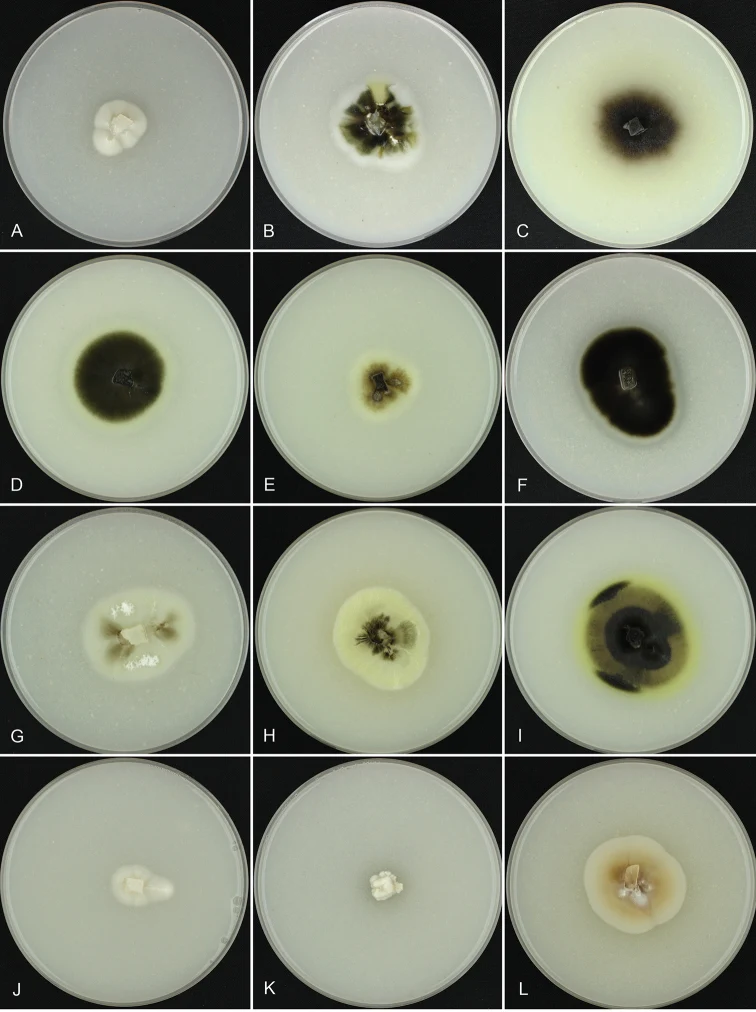
Colony surface of analysed strains on OA medium. A Arboricolonus simplex GLMC 459 T B Cadophora africana CBS 120890 T C C. bubakii CBS 198.30 T D C. luteo-olivacea GLMC 1264 E C. novi-eboraci GLMC 1472 F C. obscura CBS 269.33 G C. prunicola CBS 120891 T H C. prunicola GLMC 1633 I C. ramosa GLMC 377 T J Minutiella pruni-avium GLMC 1624 T K Proliferodiscus ingens GLMC 1751 T L Proliferodiscus sp. GLMC 460. Cultures A, J–L after 4 wk. Cultures B–I after 2 wk. Strains with a superscript T are ex-type cultures.
Kredit dan penggunaan
Steffen Bien, Ulrike Damm
Ukuran dan format gambar disesuaikan tanpa pemotongan, retus, atau penambahan skala. Lisensi sumber dipertahankan.
Sumber profil
- [1] Arboricolonus simplex gen. et sp. nov. and novelties in Cadophora, Minutiella and Proliferodiscus from Prunus wood in Germany — Cadophora prunicola
- [2] Catalogue of Life Base2026-09-11 — Cadophora prunicola
- [3] Dokumentasi visual — Cadophora prunicola
- [4] Dokumentasi visual — Cadophora prunicola
Rujukan halaman ini
Fungi. Cadophora prunicola. Rilis data fungi-2026-10-12-expansion-2. https://fungi-atlas.mgadib.chatgpt.site/jamur/cadophora-prunicola/.
Status: impor sumber; pemeriksaan editorial per profil belum selesai. Untuk klaim biologis, gunakan rujukan pada bagian terkait dan periksa konteks sumber aslinya.