01 / Morfologi

Ciri dan struktur

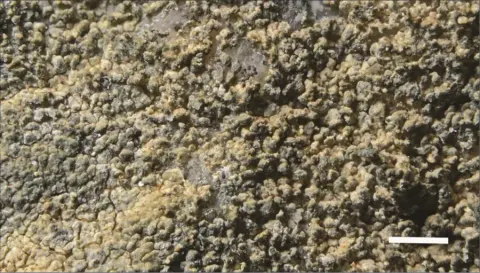
Caloplaca ahtii has a rather inconspicuous growth form. Its thallus (the main body of the lichen) is —meaning it spreads out thinly without clearly defined boundaries—and typically appears pale grey with a distinctive bluish tinge. In some populations outside of Britain, the thallus may develop small, confluent, scale-like segments (-like ) measuring 0.1–0.2 mm in diameter, though this feature is absent in British specimens. The most distinctive characteristic of this species is its reproductive structures. Rather than primarily reproducing through spore-producing bodies (apothecia), this lichen forms specialised structures called soralia. These soralia begin as small pustules that eventually rupture to reveal dark green to blue granular masses (soredia). The soralia are relatively sparse to numerous, measuring 0.1–0.15 (occasionally up to 0.2) mm in diameter. Each individual soredium ranges from 15 to 30 (sometimes up to 40) micrometres (μm) in diameter. The outer fungal filaments (hyphae) of these soredia contain a blue-green pigment that turns purple when tested with potassium hydroxide solution (K) and violet when treated with nitric acid. While apothecia have not been observed in British material, they are known to occur in specimens from other regions. When present, these apothecia are scattered across the thallus, measuring approximately 0.4 mm in diameter, and display bright yellow to orange colouration. Young apothecia may have a pale grey margin derived from the thallus (), but this typically disappears as the structure matures. The spores () produced within these apothecia measure 10.5–13 μm long by 5–7 μm wide, with a cross-wall (septum) that is 2.5–4 μm thick.

Sebagian uraian ditampilkan dalam bahasa sumber; terjemahannya belum tersedia atau belum lolos pemeriksaan.

Rujukan: [1]

Pengukuran mengikuti objek, spesimen atau kultur, dan metode yang disebutkan sumber. Baca uraian asli untuk konteks lengkap.

02 / Kehidupan

Habitat dan peran ekologis

Caloplaca ahtii is a species of corticolous (bark-dwelling) crustose lichen in the family Teloschistaceae. It was formally described as a new species in 1994 by Ulrik Søchting. The type locality was in Finland, and the type specimen was found growing on Populus. The species epithet honours Finnish lichenologist Teuvo Ahti. In 2022, the species was documented from North-Western European Russia. It is also found in North America.

Sebagian uraian ditampilkan dalam bahasa sumber; terjemahannya belum tersedia atau belum lolos pemeriksaan.

Rujukan: [1]

Habitat atau konteks temuan
Informasi belum tersedia pada sumber rilis ini.
Substrat
Informasi belum tersedia pada sumber rilis ini.
Peran atau konteks
Pembentuk liken
Temukan hubungan serupa
03 / Siklus hidup

Reproduksi

The most distinctive characteristic of this species is its reproductive structures. Rather than primarily reproducing through spore-producing bodies (apothecia), this lichen forms specialised structures called soralia. These soralia begin as small pustules that eventually rupture to reveal dark green to blue granular masses (soredia). The soralia are relatively sparse to numerous, measuring 0.1–0.15 (occasionally up to 0.2) mm in diameter. Each individual soredium ranges from 15 to 30 (sometimes up to 40) micrometres (μm) in diameter. The outer fungal filaments (hyphae) of these soredia contain a blue-green pigment that turns purple when tested with potassium hydroxide solution (K) and violet when treated with nitric acid.

Sebagian uraian ditampilkan dalam bahasa sumber; terjemahannya belum tersedia atau belum lolos pemeriksaan.

Rujukan: [1]

04 / Batas informasi

Catatan identitas dan cakupan

  • Nama diterima mengikuti Catalogue of Life Base2026-09-11; uraian mempertahankan konsep dan nama sumber aslinya.
  • Original geographic, specimen and life-cycle scope retained; source import awaits individual editorial review.
  • Impor dan terjemahan otomatis belum diperiksa editorial per profil. Struktur reproduktif yang disebutkan tidak membuktikan seluruh siklus hidup diketahui.
  • Pengukuran pada uraian mengikuti spesimen, kultur, dan metode sumber; angka tidak diperluas ke semua populasi.

Catatan distribusi dalam narasi mengikuti sumbernya. Dokumentasi spesimen atau foto mengikuti catatan sumber. Bukti wilayah Indonesia dan penilaian konservasi tidak disimpulkan dari gambar.

05 / Dokumentasi

Melihat dengan konteks

Dokumentasi visual yang memenuhi pemeriksaan subjek dan hak penggunaan belum tersedia. Foto gejala, label, dan gambar yang meragukan tidak dihitung.

06 / Rujukan

Sumber profil

  1. [1] Caloplaca ahtii — Wikipedia (en)Bagian sumber: Frozen revision 1345943683
    Tanggal penghimpunan sumber: 2026-10-12
    Teks sumber: CC BY-SA4.0 · Wikipedia contributors
  2. [2] Catalogue of Life Base2026-09-11 — Caloplaca ahtiiBagian sumber: ColDP NameUsage.tsv ID PZQ5; accepted species; source 2073
    Tanggal penghimpunan sumber: 2026-10-12

Adaptasi teks: CC BY-SA 4.0. Wikipedia contributors — Caloplaca ahtii — Wikipedia (en)

Uraian asli dan riwayat sumber

Riwayat atau halaman sumber

Ringkasan sumber

Caloplaca ahtii is a species of corticolous (bark-dwelling) crustose lichen in the family Teloschistaceae. It was formally described as a new species in 1994 by Ulrik Søchting. The type locality was in Finland, and the type specimen was found growing on Populus. The species epithet honours Finnish lichenologist Teuvo Ahti. In 2022, the species was documented from North-Western European Russia. It is also found in North America.

Revisi sumber

Morfologi sumber

Caloplaca ahtii has a rather inconspicuous growth form. Its thallus (the main body of the lichen) is —meaning it spreads out thinly without clearly defined boundaries—and typically appears pale grey with a distinctive bluish tinge. In some populations outside of Britain, the thallus may develop small, confluent, scale-like segments (-like ) measuring 0.1–0.2 mm in diameter, though this feature is absent in British specimens. The most distinctive characteristic of this species is its reproductive structures. Rather than primarily reproducing through spore-producing bodies (apothecia), this lichen forms specialised structures called soralia. These soralia begin as small pustules that eventually rupture to reveal dark green to blue granular masses (soredia). The soralia are relatively sparse to numerous, measuring 0.1–0.15 (occasionally up to 0.2) mm in diameter. Each individual soredium ranges from 15 to 30 (sometimes up to 40) micrometres (μm) in diameter. The outer fungal filaments (hyphae) of these soredia contain a blue-green pigment that turns purple when tested with potassium hydroxide solution (K) and violet when treated with nitric acid. While apothecia have not been observed in British material, they are known to occur in specimens from other regions. When present, these apothecia are scattered across the thallus, measuring approximately 0.4 mm in diameter, and display bright yellow to orange colouration. Young apothecia may have a pale grey margin derived from the thallus (), but this typically disappears as the structure matures. The spores () produced within these apothecia measure 10.5–13 μm long by 5–7 μm wide, with a cross-wall (septum) that is 2.5–4 μm thick.

Revisi sumber

Ekologi sumber

Caloplaca ahtii is a species of corticolous (bark-dwelling) crustose lichen in the family Teloschistaceae. It was formally described as a new species in 1994 by Ulrik Søchting. The type locality was in Finland, and the type specimen was found growing on Populus. The species epithet honours Finnish lichenologist Teuvo Ahti. In 2022, the species was documented from North-Western European Russia. It is also found in North America.

Revisi sumber

Struktur reproduksi sumber

The most distinctive characteristic of this species is its reproductive structures. Rather than primarily reproducing through spore-producing bodies (apothecia), this lichen forms specialised structures called soralia. These soralia begin as small pustules that eventually rupture to reveal dark green to blue granular masses (soredia). The soralia are relatively sparse to numerous, measuring 0.1–0.15 (occasionally up to 0.2) mm in diameter. Each individual soredium ranges from 15 to 30 (sometimes up to 40) micrometres (μm) in diameter. The outer fungal filaments (hyphae) of these soredia contain a blue-green pigment that turns purple when tested with potassium hydroxide solution (K) and violet when treated with nitric acid.

Revisi sumber

Rujukan halaman ini

Fungi. Caloplaca ahtii. Rilis data fungi-2026-10-12-expansion-2. https://fungi-atlas.mgadib.chatgpt.site/jamur/caloplaca-ahtii/.

Status: impor sumber; pemeriksaan editorial per profil belum selesai. Untuk klaim biologis, gunakan rujukan pada bagian terkait dan periksa konteks sumber aslinya.