Ciri dan struktur
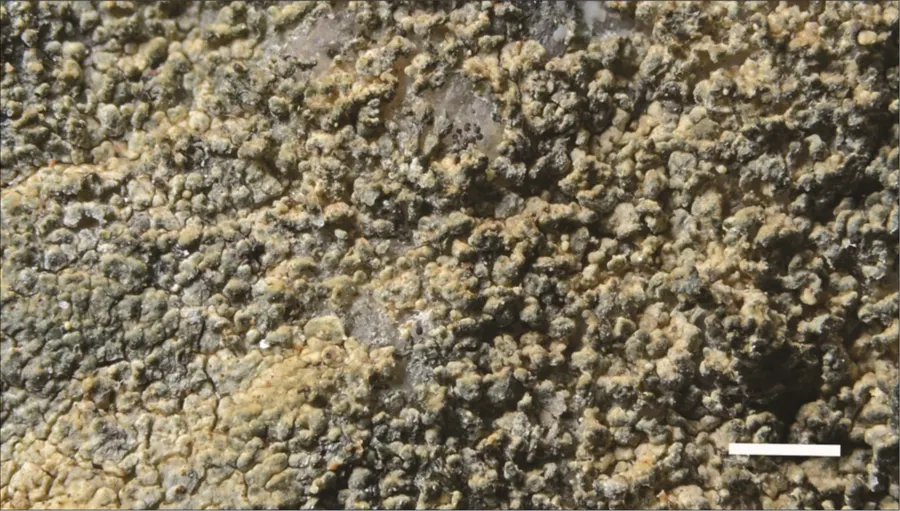
Caloplaca squamuloisidiata has a distinctive crustose thallus that is - to -, often with a defined outline. The thallus appears pale green to greyish or pale grey with dark olivaceous patches. Its margins feature small (0.5–0.7 mm long) that frequently develop into isidia—vegetative reproductive structures that are cylindrical to flattened, simple to branched or . The upper cortex is well-developed and , while a thin, usually visible appears white to brown around the thallus. The reproductive structures include rare apothecia (fruiting bodies) measuring 0.2–0.8 mm in diameter with pale to dark orange . The rim () matches the thallus colour and can be smooth to somewhat or isidiate. Microscopically, the species has colourless, ascospores measuring 10–13 by 5–8 μm and produces simple, rod-shaped conidia from inconspicuous pycnidia immersed in the thallus. When tested chemically, the thallus shows no reaction to standard chemical spot tests, though pigmented parts turn purplish with potassium hydroxide solution.
Habitat dan peran ekologis
Caloplaca squamuloisidiata is known from four localities in the Iberian Peninsula: two in Portugal (Trás-os-Montes e Alto Douro and Alentejo provinces) and two in Spain (Cáceres province). It grows on acidic rocks, including quartzite, granite, and sandstone, in inland areas at elevations from 200 to 1,000 metres. In 2021, it was reported from the Gaupne area of Sogn og Fjordane, Norway, a biodiversity hotpot for lichens. The species prefers shaded and sheltered rock faces, which are often slightly overhung and exposed to the north. It occurs in various vegetation zones of the Mediterranean region, from the thermomediterranean belt (in Alentejo, Portugal) to the mesomediterranean (in Cáceres, Spain) and supramediterranean belts (in Trás-os-Montes province, Portugal). The lichen is often found growing with other species such as Acarospora epithallina, A. hilaris, Caloplaca demissa, Ochrolechia androgyna, Ramalina pollinaria, Rinodina confragosa, Solenopsora vulturiensis, and various others, depending on the locality.
- Habitat atau konteks temuan
- Informasi belum tersedia pada sumber rilis ini.
- Substrat
- Informasi belum tersedia pada sumber rilis ini.
- Peran atau konteks
- Pembentuk liken
Reproduksi
Caloplaca squamuloisidiata has a distinctive crustose thallus that is - to -, often with a defined outline. The thallus appears pale green to greyish or pale grey with dark olivaceous patches. Its margins feature small (0.5–0.7 mm long) that frequently develop into isidia—vegetative reproductive structures that are cylindrical to flattened, simple to branched or . The upper cortex is well-developed and , while a thin, usually visible appears white to brown around the thallus. The reproductive structures include rare apothecia (fruiting bodies) measuring 0.2–0.8 mm in diameter with pale to dark orange . The rim () matches the thallus colour and can be smooth to somewhat or isidiate. Microscopically, the species has colourless, ascospores measuring 10–13 by 5–8 μm and produces simple, rod-shaped conidia from inconspicuous pycnidia immersed in the thallus.
Catatan identitas dan cakupan
- Nama diterima mengikuti Catalogue of Life Base2026-09-11; uraian mempertahankan konsep dan nama sumber aslinya.
- Original geographic, specimen and life-cycle scope retained; source import awaits individual editorial review.
- Impor dan terjemahan otomatis belum diperiksa editorial per profil. Struktur reproduktif yang disebutkan tidak membuktikan seluruh siklus hidup diketahui.
- Pengukuran pada uraian mengikuti spesimen, kultur, dan metode sumber; angka tidak diperluas ke semua populasi.
Catatan distribusi dalam narasi mengikuti sumbernya. Dokumentasi spesimen atau foto mengikuti catatan sumber. Bukti wilayah Indonesia dan penilaian konservasi tidak disimpulkan dari gambar.
Melihat dengan konteks
Dokumentasi Caloplaca squamuloisidiata dari Wikimedia Commons. The squamulose lichen Caloplaca squamuloisidiata . Original caption from source: "A sterile thallus showing the scabrous, beige to dark bluish grey surface." scale bar = 1 mm Identifikasi mengikuti record berkas sumber.
- Jenis
- Fotografi
- Kredit
- Ulf Arup
- Lisensi
- CC BY-SA 4.0
- Sumber media
- Buka entri sumber
Sumber profil
- [1] Caloplaca squamuloisidiata — Wikipedia (en)
- [2] Catalogue of Life Base2026-09-11 — Caloplaca squamuloisidiata
- [3] Dokumentasi visual — Caloplaca squamuloisidiata
Rujukan halaman ini
Fungi. Caloplaca squamuloisidiata. Rilis data fungi-2026-10-12-expansion-2. https://fungi-atlas.mgadib.chatgpt.site/jamur/caloplaca-squamuloisidiata/.
Status: impor sumber; pemeriksaan editorial per profil belum selesai. Untuk klaim biologis, gunakan rujukan pada bagian terkait dan periksa konteks sumber aslinya.
