01 / Morfologi

Ciri dan struktur

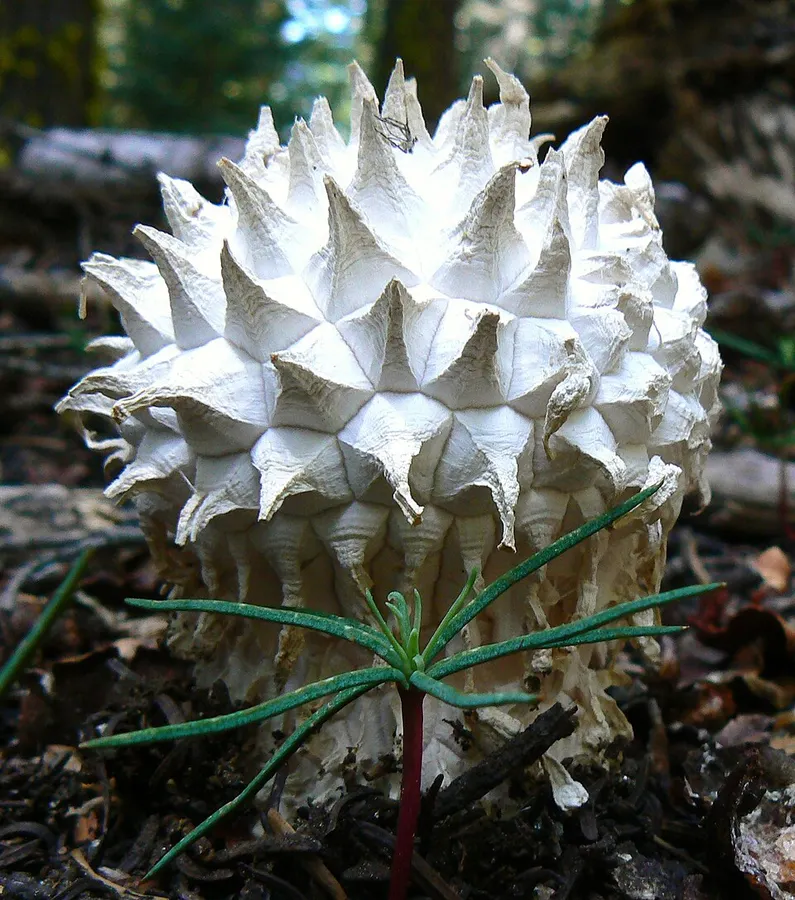
The white pear- or egg-shaped fruit body of C. sculpta may be 8 to 15 cm tall by 8 to 10 cm wide. The outer layer of tissue, known as the exoperidium, is covered on the outer surface with distinctive long, pointed, pyramid-shaped warts, either erect or bent over and sometimes connected at the tip with other warts. The warts bear parallel horizontal lines towards the base. Mycologist David Arora opined that C. sculpta resembles "a cross between a geodesic dome and a giant glob of meringue". In age, the peridium sloughs off and exposes a brownish spore mass. The interior of the puffball, the gleba, is firm and yellowish-white when young, but gradually becomes powdery and deep olive-brown as it matures. The spores are roughly spherical, thick-walled, 3–6 μm in diameter (although some specimens collected in the US range from 7.2 to 9.5 μm), and are covered with minute spines or warts. The use of scanning electron microscopy has revealed that these ornamentations on the spores are typically 0.95 μm long. Spore ultrastructure is distinctive among Calvatia species, and has been used to help verify taxonomic groupings and confirm the status of species within the genus. The capillitia (coarse, thick-walled hyphae in the gleba) are septate, with branches that are narrowed towards the tips; they are 3–8 μm in diameter. When grown in pure culture in the laboratory, C. sculpta is, under certain conditions, able to grow structures called mycelial strands. These are linear aggregates of hyphae whereby older "leading" hyphae become enclosed by coiled layers of newer "tendril" hyphae. Mycelial strands provide a conduit for transporting water and nutrients across non-nutrient material, allowing the fungus to reach new sources of food.

Sebagian uraian ditampilkan dalam bahasa sumber; terjemahannya belum tersedia atau belum lolos pemeriksaan.

Rujukan: [1]

Pengukuran mengikuti objek, spesimen atau kultur, dan metode yang disebutkan sumber. Baca uraian asli untuk konteks lengkap.

02 / Kehidupan

Habitat dan peran ekologis

Puffball yang diukir tumbuh secara solitaris atau dalam kelompok kecil di hutan. Biasanya dikaitkan dengan hutan konifer di ketinggian tinggi, lebih besar dari sekitar 750 m, di pegunungan barat seperti Sierra Nevada and Rentang Cascade. Amerika Serikat States distribution termasuk negara bagian California, Oregon, Washington, dan Idaho. An uncommon spesies, buahnya sepanjang musim semi, musim panas, dan musim gugur selama cuaca basah. Most commonly dikenal dari Amerika Utara barat, spesies ini dilaporkan tumbuh di tanah berpasir di Natal Dunes State Park in timur laut Brazilian state Rio Grande do Norte in 2008. The fruit bodies were associated with the roots of the native tree species Eugenia brasiliensis. Several hypotheses have been proposed to account for this disjunct distribution: the species may have been present before the Americas separated; it may have been introduced to Brazil by human activity, and subsequently adapted to the environment there; or the North and South American populations may represent a cryptic species complex—appearing morphologically similar but genetically distinct. Brazilian population tidak dibandingkan secara genetik dengan Utara American specimens.

Sebagian uraian ditampilkan dalam bahasa sumber; terjemahannya belum tersedia atau belum lolos pemeriksaan.

Rujukan: [1]

Habitat atau konteks temuan
hutan
Substrat
Informasi belum tersedia pada sumber rilis ini.
Peran atau konteks
Belum dikategorikan pada rilis ini.
Temukan hubungan serupa
03 / Siklus hidup

Reproduksi

The white pear- or egg-shaped fruit body of C. sculpta may be 8 to 15 cm tall by 8 to 10 cm wide. The outer layer of tissue, known as the exoperidium, is covered on the outer surface with distinctive long, pointed, pyramid-shaped warts, either erect or bent over and sometimes connected at the tip with other warts. The warts bear parallel horizontal lines towards the base. Mycologist David Arora opined that C. sculpta resembles "a cross between a geodesic dome and a giant glob of meringue". In age, the peridium sloughs off and exposes a brownish spore mass. The interior of the puffball, the gleba, is firm and yellowish-white when young, but gradually becomes powdery and deep olive-brown as it matures.

Sebagian uraian ditampilkan dalam bahasa sumber; terjemahannya belum tersedia atau belum lolos pemeriksaan.

Rujukan: [1]

Sinonim menurut acuan taksonomi rilis: Lycoperdon sculptum
04 / Batas informasi

Catatan identitas dan cakupan

  • Nama diterima mengikuti Catalogue of Life Base2026-09-11; uraian mempertahankan konsep dan nama sumber aslinya.
  • Original geographic, specimen and life-cycle scope retained; source import awaits individual editorial review.
  • Impor dan terjemahan otomatis belum diperiksa editorial per profil. Struktur reproduktif yang disebutkan tidak membuktikan seluruh siklus hidup diketahui.
  • Pengukuran pada uraian mengikuti spesimen, kultur, dan metode sumber; angka tidak diperluas ke semua populasi.

Catatan distribusi dalam narasi mengikuti sumbernya. Dokumentasi spesimen atau foto mengikuti catatan sumber. Bukti wilayah Indonesia dan penilaian konservasi tidak disimpulkan dari gambar.

05 / Dokumentasi

Melihat dengan konteks

Dokumentasi Calvatia sculpta dari Wikimedia Commons. The puffball mushroom Calvatia sculpta (Harkness) Lloyd. Photographed in Sequoia National Park , Tulare County, California, United States. "Notes: Photo taken in Sequoia National Park north of Wuksatchi Lodge on the Twin Lakes trail, at about 7500 ft elevation." Original photo cropped by uploader. Identifikasi mengikuti record berkas sumber.

Jenis
Fotografi
Kredit
Glen Parsneau
Sumber media
Buka entri sumber

Gambar menunjukkan objek menurut identifikasi sumber, bukan verifikasi independen spesimen oleh Fungi. Tidak ada skala baru yang ditambahkan.

06 / Rujukan

Sumber profil

  1. [1] Calvatia sculpta — Wikipedia (en)Bagian sumber: Frozen revision 1374208048
    Tanggal penghimpunan sumber: 2026-10-12
    Teks sumber: CC BY-SA4.0 · Wikipedia contributors
  2. [2] Catalogue of Life Base2026-09-11 — Calvatia sculptaBagian sumber: ColDP NameUsage.tsv ID Q4XJ; accepted species; source 2073
    Tanggal penghimpunan sumber: 2026-10-12
  3. [3] Dokumentasi visual — Calvatia sculptaBagian sumber: Individual media record; identification follows the source, not independent determination
    Tanggal penghimpunan sumber: 2026-10-12
    Media sumber: CC BY-SA 3.0 · Glen Parsneau

Adaptasi teks: CC BY-SA 4.0. Wikipedia contributors — Calvatia sculpta — Wikipedia (en)

Uraian asli dan riwayat sumber

Riwayat atau halaman sumber

Ringkasan sumber

Calvatia sculpta, commonly known as the sculpted puffball, the sculptured puffball, the pyramid puffball, or Sierran puffball, is a species of puffball fungus in the family Agaricaceae. Attaining dimensions of up to 8 to 15 cm tall by 8 to 10 cm wide, the pear- or egg-shaped puffball is readily recognizable because of the large pyramidal or polygonal warts covering its surface. The spores are roughly spherical and have wart-like projections on their surfaces. It may be easily confused with Calbovista subsculpta, a similar puffball that—in addition to differences observable only with a microscope—is larger, and has slightly raised warts with a felt-like texture.

Revisi sumber

Morfologi sumber

The white pear- or egg-shaped fruit body of C. sculpta may be 8 to 15 cm tall by 8 to 10 cm wide. The outer layer of tissue, known as the exoperidium, is covered on the outer surface with distinctive long, pointed, pyramid-shaped warts, either erect or bent over and sometimes connected at the tip with other warts. The warts bear parallel horizontal lines towards the base. Mycologist David Arora opined that C. sculpta resembles "a cross between a geodesic dome and a giant glob of meringue". In age, the peridium sloughs off and exposes a brownish spore mass. The interior of the puffball, the gleba, is firm and yellowish-white when young, but gradually becomes powdery and deep olive-brown as it matures. The spores are roughly spherical, thick-walled, 3–6 μm in diameter (although some specimens collected in the US range from 7.2 to 9.5 μm), and are covered with minute spines or warts. The use of scanning electron microscopy has revealed that these ornamentations on the spores are typically 0.95 μm long. Spore ultrastructure is distinctive among Calvatia species, and has been used to help verify taxonomic groupings and confirm the status of species within the genus. The capillitia (coarse, thick-walled hyphae in the gleba) are septate, with branches that are narrowed towards the tips; they are 3–8 μm in diameter. When grown in pure culture in the laboratory, C. sculpta is, under certain conditions, able to grow structures called mycelial strands. These are linear aggregates of hyphae whereby older "leading" hyphae become enclosed by coiled layers of newer "tendril" hyphae. Mycelial strands provide a conduit for transporting water and nutrients across non-nutrient material, allowing the fungus to reach new sources of food.

Revisi sumber

Ekologi sumber

The sculptured puffball grows solitarily or in small groups in forest duff. It is typically associated with coniferous forests at high elevations, greater than about 750 m, on western mountains like the Sierra Nevada and the Cascade Range. The United States distribution includes the states of California, Oregon, Washington, and Idaho. An uncommon species, it fruits throughout spring, summer, and fall during wet weather. Most commonly known from western North America, the species was reported growing on sandy soil in Natal Dunes State Park in the northeastern Brazilian state of Rio Grande do Norte in 2008. The fruit bodies were associated with the roots of the native tree species Eugenia brasiliensis. Several hypotheses have been proposed to account for this disjunct distribution: the species may have been present before the Americas separated; it may have been introduced to Brazil by human activity, and subsequently adapted to the environment there; or the North and South American populations may represent a cryptic species complex—appearing morphologically similar but genetically distinct. The Brazilian population has not been compared genetically with North American specimens.

Revisi sumber

Struktur reproduksi sumber

The white pear- or egg-shaped fruit body of C. sculpta may be 8 to 15 cm tall by 8 to 10 cm wide. The outer layer of tissue, known as the exoperidium, is covered on the outer surface with distinctive long, pointed, pyramid-shaped warts, either erect or bent over and sometimes connected at the tip with other warts. The warts bear parallel horizontal lines towards the base. Mycologist David Arora opined that C. sculpta resembles "a cross between a geodesic dome and a giant glob of meringue". In age, the peridium sloughs off and exposes a brownish spore mass. The interior of the puffball, the gleba, is firm and yellowish-white when young, but gradually becomes powdery and deep olive-brown as it matures.

Revisi sumber

Rujukan halaman ini

Fungi. Calvatia sculpta. Rilis data fungi-2026-10-12-expansion-2. https://fungi-atlas.mgadib.chatgpt.site/jamur/calvatia-sculpta/.

Status: impor sumber; pemeriksaan editorial per profil belum selesai. Untuk klaim biologis, gunakan rujukan pada bagian terkait dan periksa konteks sumber aslinya.