01 / Morfologi

Ciri dan struktur

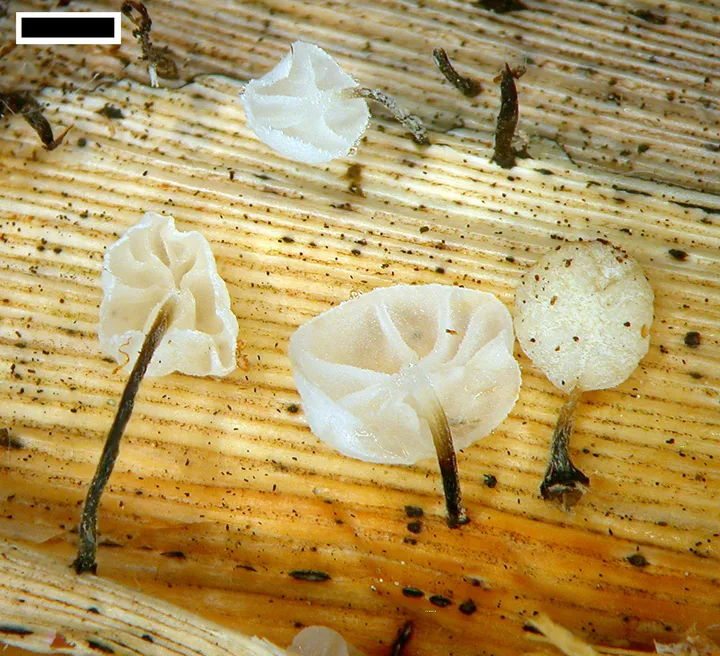
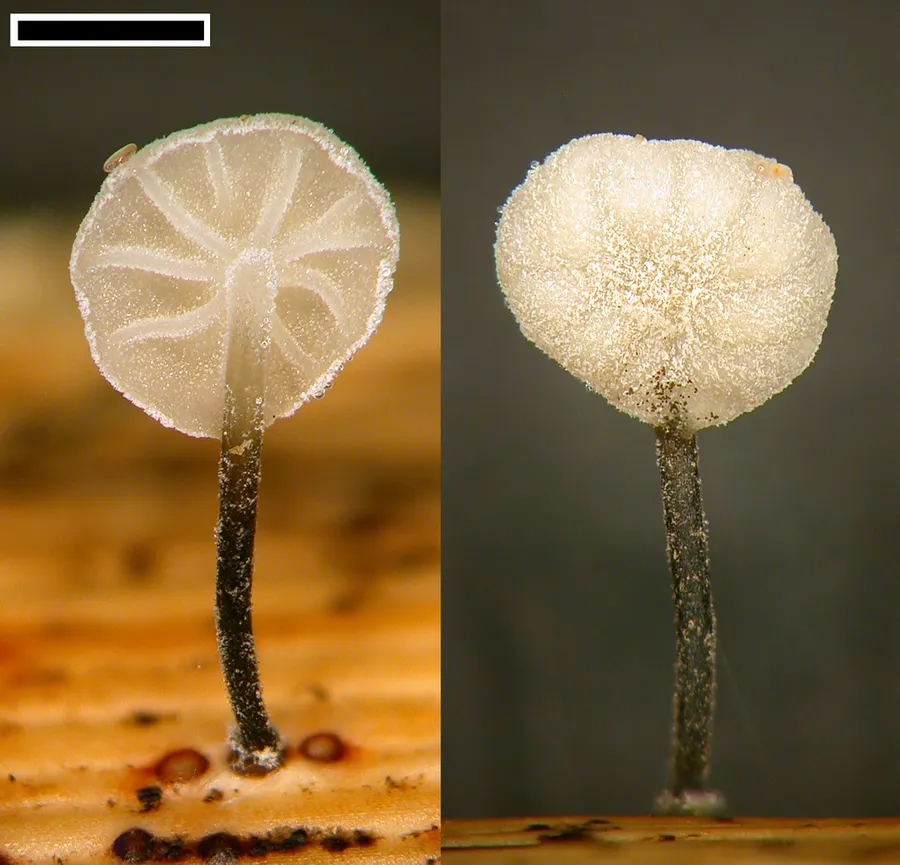
Pileus 4-10 mm diam., gelatinous texture, pure white, downy, dry, radially grooved following the outline of the lamellae, margin slightly incurved, drying ochraceous to sepia, depending on age. Lamellae white, thick and fold-like, well-spaced, 1-2 series, 5-6 reaching the stipe in small basidiomes, 8-10 in larger ones, sparsely furcate to intervenose at a lower level. Stipe 8-15 x 2 mm, more or less central, white at apex shading through yellow brown and sepia to black at the base, dry, even in diameter, cystidiate, insititious, tough, stipes often remaining attached to the substratum when the rest of the basidiome has disappeared. Taste and smell unknown. Spore print unknown. Spores 10-13 x 6-9 (11.9 x 7) µm, Q=1.7, ellipsoid, lacrymoid, sometimes humped on abaxial side in lateral view, hyaline, smooth, thin-walled, inamyloid, not dextrinoid, acyanophilic, with a distinct apiculus with a terminal, dark scar. Basidia 30-35 x 11-13 µm broadly clavate, clamped at the base, 2-, 3-,.or 4-spored, sterigmata short and fat, -3 µm long. Pleurocystidia absent. Cheilocystidia 30-40 x 6-11 µm, in the form of cystidioles, cylindrical to lageniform, sometimes nodulose at the apex, thin-walled, infrequent. Trama of sub-gelatinous, more or less parallel, narrow hyphae 3-4 µm diam. Subhymenium of filamentous, slightly coralloid hyphae. Context of narrow (2 µm.diam.) gelatinised, interwoven hyphae. Pileipellis of repent hyphae with well developed rameales to asterostromelloid structure, with short diverticulations 1 µm diam. Stipitipellis of narrow (-3 µm), brown, repent hyphae with short, hyaline, thin-walled, simple or shortly diverticulate projections.

Sebagian uraian ditampilkan dalam bahasa sumber; terjemahannya belum tersedia atau belum lolos pemeriksaan.

Rujukan: [1]

Pengukuran mengikuti objek, spesimen atau kultur, dan metode yang disebutkan sumber. Baca uraian asli untuk konteks lengkap.

02 / Kehidupan

Habitat dan peran ekologis

Habitat: On old dead leaves of New Zealand flax (Phormium tenax), growing in damp swampy areas.

Sebagian uraian ditampilkan dalam bahasa sumber; terjemahannya belum tersedia atau belum lolos pemeriksaan.

Rujukan: [1]

Habitat atau konteks temuan
Informasi belum tersedia pada sumber rilis ini.
Substrat
Informasi belum tersedia pada sumber rilis ini.
Peran atau konteks
Belum dikategorikan pada rilis ini.
Temukan hubungan serupa
03 / Siklus hidup

Reproduksi

Pileus 4-10 mm diam., gelatinous texture, pure white, downy, dry, radially grooved following the outline of the lamellae, margin slightly incurved, drying ochraceous to sepia, depending on age. Lamellae white, thick and fold-like, well-spaced, 1-2 series, 5-6 reaching the stipe in small basidiomes, 8-10 in larger ones, sparsely furcate to intervenose at a lower level. Stipe 8-15 x 2 mm, more or less central, white at apex shading through yellow brown and sepia to black at the base, dry, even in diameter, cystidiate, insititious, tough, stipes often remaining attached to the substratum when the rest of the basidiome has disappeared. Taste and smell unknown. Spore print unknown. Spores 10-13 x 6-9 (11.9 x 7) µm, Q=1.7, ellipsoid, lacrymoid, sometimes humped on abaxial side in lateral view, hyaline, smooth, thin-walled, inamyloid, not dextrinoid, acyanophilic, with a distinct apiculus with a terminal, dark scar.

Sebagian uraian ditampilkan dalam bahasa sumber; terjemahannya belum tersedia atau belum lolos pemeriksaan.

Rujukan: [1]

Sinonim menurut acuan taksonomi rilis: Marasmiellus bonii
04 / Batas informasi

Catatan identitas dan cakupan

  • Nama diterima mengikuti Catalogue of Life Base2026-09-11; uraian mempertahankan konsep dan nama sumber aslinya.
  • Historical description as cited by BiotaNZ. Preserve explicit New Zealand/locality, host and specimen qualifiers. Distribution is the cited source scope, not a current global range.
  • Impor dan terjemahan otomatis belum diperiksa editorial per profil. Struktur reproduktif yang disebutkan tidak membuktikan seluruh siklus hidup diketahui.
  • Pengukuran pada uraian mengikuti spesimen, kultur, dan metode sumber; angka tidak diperluas ke semua populasi.

Catatan distribusi dalam narasi mengikuti sumbernya. Dokumentasi spesimen atau foto mengikuti catatan sumber. Bukti wilayah Indonesia dan penilaian konservasi tidak disimpulkan dari gambar.

05 / Dokumentasi

Melihat dengan konteks

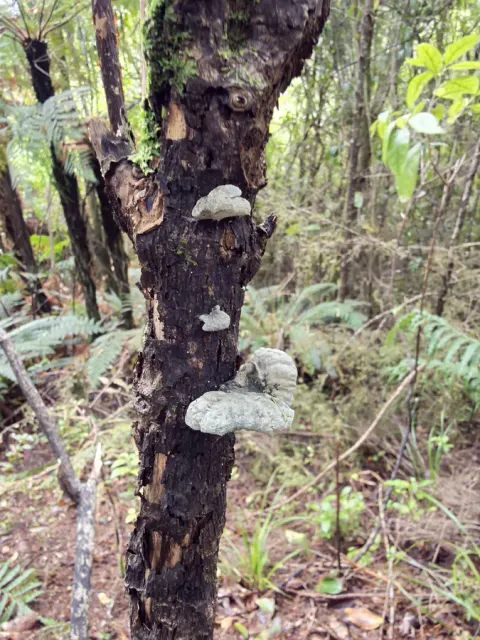
Dokumentasi Campanella bonii menurut asosiasi foto pada record takson iNaturalist. Kredit: Jerry Cooper. Identitas mengikuti sumber; bukan penentuan spesimen independen.

Jenis
Fotografi
Kredit
(c) Jerry Cooper, some rights reserved (CC BY), uploaded by Jerry Cooper
Lisensi
CC BY 4.0
Sumber media
Buka entri sumber

Gambar menunjukkan objek menurut identifikasi sumber, bukan verifikasi independen spesimen oleh Fungi. Tidak ada skala baru yang ditambahkan.

Dokumentasi tambahan

06 / Rujukan

Sumber profil

  1. [1] Segedin, B.P. 1995: A new species of Marasmiellus from New Zealand. Documents Mycologiques 25(98-100): 437-440. — Marasmiellus boniiBagian sumber: biota:1cb0fae6-36b9-11d5-9548-00d0592d548c:1cb1922f-36b9-11d5-9548-00d0592d548c
    Tanggal penghimpunan sumber: 2026-10-12
    Teks sumber: CC BY 4.0 · Segedin, B.P. 1995: A new species of Marasmiellus from New Zealand. Documents Mycologiques 25(98-100): 437-440.
  2. [2] Catalogue of Life Base2026-09-11 — Campanella boniiBagian sumber: ColDP NameUsage.tsv ID C98ZZ; accepted species; source 2073
    Tanggal penghimpunan sumber: 2026-10-12
  3. [3] Dokumentasi visual — Campanella boniiBagian sumber: Identitas mengikuti sumber dokumentasi; bukan penentuan spesimen independen.
    Tanggal penghimpunan sumber: 2026-10-17
    Media sumber: CC BY 4.0 · (c) Jerry Cooper, some rights reserved (CC BY), uploaded by Jerry Cooper
  4. [4] Dokumentasi visual — Campanella boniiBagian sumber: Identitas mengikuti sumber dokumentasi; bukan penentuan spesimen independen.
    Tanggal penghimpunan sumber: 2026-10-17
    Teks sumber: CC BY 4.0 · (c) Jerry Cooper, some rights reserved (CC BY), uploaded by Jerry Cooper

Adaptasi teks: CC BY 4.0. Segedin, B.P. 1995: A new species of Marasmiellus from New Zealand. Documents Mycologiques 25(98-100): 437-440. — Segedin, B.P. 1995: A new species of Marasmiellus from New Zealand. Documents Mycologiques 25(98-100): 437-440. — Marasmiellus bonii

Uraian asli dan riwayat sumber

Riwayat atau halaman sumber

Ringkasan sumber

Pileus 4-10 mm diam., gelatinous texture, pure white, downy, dry, radially grooved following the outline of the lamellae, margin slightly incurved, drying ochraceous to sepia, depending on age. Lamellae white, thick and fold-like, well-spaced, 1-2 series, 5-6 reaching the stipe in small basidiomes, 8-10 in larger ones, sparsely furcate to intervenose at a lower level. Stipe 8-15 x 2 mm, more or less central, white at apex shading through yellow brown and sepia to black at the base, dry, even in diameter, cystidiate, insititious, tough, stipes often remaining attached to the substratum when the rest of the basidiome has disappeared.

Revisi sumber

Morfologi sumber

Pileus 4-10 mm diam., gelatinous texture, pure white, downy, dry, radially grooved following the outline of the lamellae, margin slightly incurved, drying ochraceous to sepia, depending on age. Lamellae white, thick and fold-like, well-spaced, 1-2 series, 5-6 reaching the stipe in small basidiomes, 8-10 in larger ones, sparsely furcate to intervenose at a lower level. Stipe 8-15 x 2 mm, more or less central, white at apex shading through yellow brown and sepia to black at the base, dry, even in diameter, cystidiate, insititious, tough, stipes often remaining attached to the substratum when the rest of the basidiome has disappeared. Taste and smell unknown. Spore print unknown. Spores 10-13 x 6-9 (11.9 x 7) µm, Q=1.7, ellipsoid, lacrymoid, sometimes humped on abaxial side in lateral view, hyaline, smooth, thin-walled, inamyloid, not dextrinoid, acyanophilic, with a distinct apiculus with a terminal, dark scar. Basidia 30-35 x 11-13 µm broadly clavate, clamped at the base, 2-, 3-,.or 4-spored, sterigmata short and fat, -3 µm long. Pleurocystidia absent. Cheilocystidia 30-40 x 6-11 µm, in the form of cystidioles, cylindrical to lageniform, sometimes nodulose at the apex, thin-walled, infrequent. Trama of sub-gelatinous, more or less parallel, narrow hyphae 3-4 µm diam. Subhymenium of filamentous, slightly coralloid hyphae. Context of narrow (2 µm.diam.) gelatinised, interwoven hyphae. Pileipellis of repent hyphae with well developed rameales to asterostromelloid structure, with short diverticulations 1 µm diam. Stipitipellis of narrow (-3 µm), brown, repent hyphae with short, hyaline, thin-walled, simple or shortly diverticulate projections.

Revisi sumber

Ekologi sumber

Habitat: On old dead leaves of New Zealand flax (Phormium tenax), growing in damp swampy areas.

Revisi sumber

Struktur reproduksi sumber

Pileus 4-10 mm diam., gelatinous texture, pure white, downy, dry, radially grooved following the outline of the lamellae, margin slightly incurved, drying ochraceous to sepia, depending on age. Lamellae white, thick and fold-like, well-spaced, 1-2 series, 5-6 reaching the stipe in small basidiomes, 8-10 in larger ones, sparsely furcate to intervenose at a lower level. Stipe 8-15 x 2 mm, more or less central, white at apex shading through yellow brown and sepia to black at the base, dry, even in diameter, cystidiate, insititious, tough, stipes often remaining attached to the substratum when the rest of the basidiome has disappeared. Taste and smell unknown. Spore print unknown. Spores 10-13 x 6-9 (11.9 x 7) µm, Q=1.7, ellipsoid, lacrymoid, sometimes humped on abaxial side in lateral view, hyaline, smooth, thin-walled, inamyloid, not dextrinoid, acyanophilic, with a distinct apiculus with a terminal, dark scar.

Revisi sumber

Rujukan halaman ini

Fungi. Campanella bonii. Rilis data fungi-2026-10-12-expansion-2. https://fungi-atlas.mgadib.chatgpt.site/jamur/campanella-bonii/.

Status: impor sumber; pemeriksaan editorial per profil belum selesai. Untuk klaim biologis, gunakan rujukan pada bagian terkait dan periksa konteks sumber aslinya.