01 / Morfologi

Ciri dan struktur

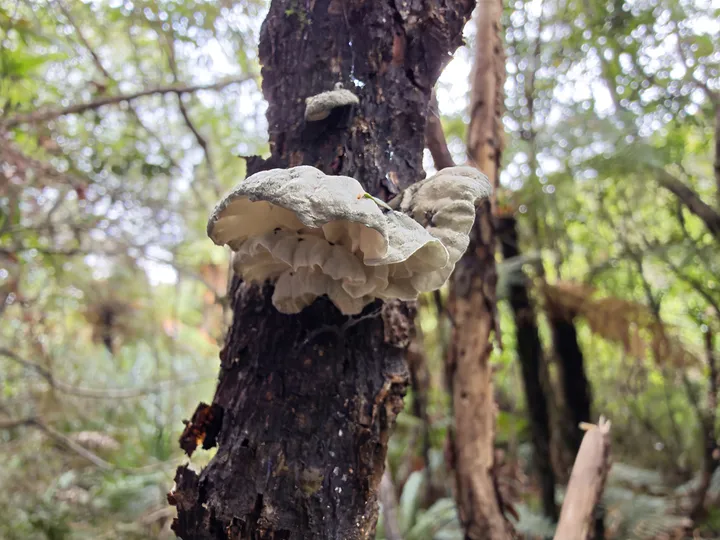
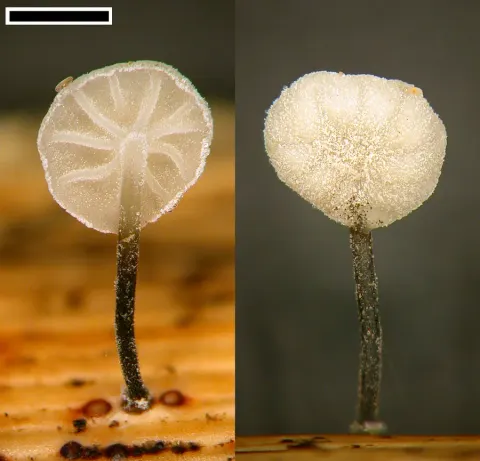
Description based on the type material, together with additional information from further collections Pileus 4-30 mm diam., semi-orbicular to reniform, surface drab white, cream or pale grey, turning glaucous or greenish-grey and finally black with age, drying buff to ochraceous, moist, flabby to gelatinous in texture, translucent when wet, floccose when dry, surface tessellate, following outline of lamellae, margin inrolled. Hymenophore of well-spaced lamellae, simple or intervenose, white, becoming dingy, staining verdigris, greenish or black when aged, drying chrome. Lamellae attached to slightly decurrent when stipe obvious, thin, simple, in one series in smaller basidiomes, forking or strongly intervenose in larger ones, cross-veining usually slightly below the level of the radiating main veins. Stipe 2-3 x 1 mm, lateral or excentric, fibrous, downy fibrillose, straight or more often geotropically curved, even, sometimes attached to the substratum by pad of mycelium. Spore print white. Smell none, taste unknown. Spores 8.0-10.5 x 5.5-7.0 (8.5 x 6.0) µm, Q = 1.4, somewhat variable in shape and size, broadly ellipsoid to humped on the abaxial side, hyaline, inamyloid, not dextrinoid, acyanophilic, thin-walled, sometimes with one large guttule or many, apiculus broad. Spores appear to shrivel easily developing the longitudinal ridges depicted by Stevenson (1964) for R. dorotheae. Basidia 20-35 x 5-10 µm, clavate, with 4 sterigmata 4.5 µm long. Cheilocystidia on the lamellar margin 30-40 x 3 µm, versiform but basically clavate, sometimes with various short protuberances, in clusters of 3-6 but not very plentiful.

Sebagian uraian ditampilkan dalam bahasa sumber; terjemahannya belum tersedia atau belum lolos pemeriksaan.

Rujukan: [1]

Pengukuran mengikuti objek, spesimen atau kultur, dan metode yang disebutkan sumber. Baca uraian asli untuk konteks lengkap.

02 / Kehidupan

Habitat dan peran ekologis

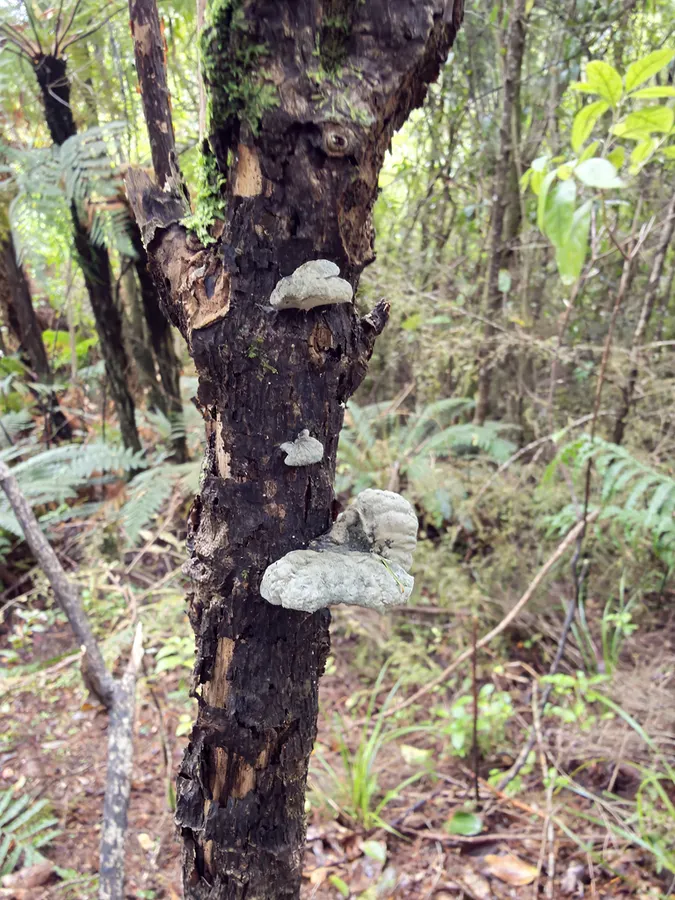
Caespitose and gregarious on dead wood of the indigenous species Beilschmiedia tawa (A. Cunn.) Benth. & Hook. f. ex Kirk (tawa), Geniostoma ligustrifolium A. Cunn. (hangehange), Rhipogonum scandens J. R. & G. Forst. (supplejack), Kunzea ericoides (A. Rich.) J. Thompson (kanuka), Freycinetia baueriana Endl. ssp. banksii (A. Cunn.) Stone (kiekie), in mixed podocarp-dicotyledonous forest.

Sebagian uraian ditampilkan dalam bahasa sumber; terjemahannya belum tersedia atau belum lolos pemeriksaan.

Rujukan: [1]

Habitat atau konteks temuan
hutan
Substrat
kayu
Peran atau konteks
Belum dikategorikan pada rilis ini.
Temukan hubungan serupa
03 / Siklus hidup

Reproduksi

Description based on the type material, together with additional information from further collections Pileus 4-30 mm diam., semi-orbicular to reniform, surface drab white, cream or pale grey, turning glaucous or greenish-grey and finally black with age, drying buff to ochraceous, moist, flabby to gelatinous in texture, translucent when wet, floccose when dry, surface tessellate, following outline of lamellae, margin inrolled. Hymenophore of well-spaced lamellae, simple or intervenose, white, becoming dingy, staining verdigris, greenish or black when aged, drying chrome. Lamellae attached to slightly decurrent when stipe obvious, thin, simple, in one series in smaller basidiomes, forking or strongly intervenose in larger ones, cross-veining usually slightly below the level of the radiating main veins.

Sebagian uraian ditampilkan dalam bahasa sumber; terjemahannya belum tersedia atau belum lolos pemeriksaan.

Rujukan: [1]

Sinonim menurut acuan taksonomi rilis: Marasmiellus tristis; Resupinatus tristis
04 / Batas informasi

Catatan identitas dan cakupan

  • Nama diterima mengikuti Catalogue of Life Base2026-09-11; uraian mempertahankan konsep dan nama sumber aslinya.
  • Historical description as cited by BiotaNZ. Preserve explicit New Zealand/locality, host and specimen qualifiers. Distribution is the cited source scope, not a current global range.
  • Impor dan terjemahan otomatis belum diperiksa editorial per profil. Struktur reproduktif yang disebutkan tidak membuktikan seluruh siklus hidup diketahui.
  • Pengukuran pada uraian mengikuti spesimen, kultur, dan metode sumber; angka tidak diperluas ke semua populasi.

Catatan distribusi dalam narasi mengikuti sumbernya. Dokumentasi spesimen atau foto mengikuti catatan sumber. Bukti wilayah Indonesia dan penilaian konservasi tidak disimpulkan dari gambar.

05 / Dokumentasi

Melihat dengan konteks

Dokumentasi Campanella tristis menurut asosiasi foto pada record takson iNaturalist. Kredit: Jeremy Rolfe. Identitas mengikuti sumber; bukan penentuan spesimen independen.

Jenis
Fotografi
Kredit
(c) Jeremy Rolfe, some rights reserved (CC BY)
Lisensi
CC BY 4.0
Sumber media
Buka entri sumber

Gambar menunjukkan objek menurut identifikasi sumber, bukan verifikasi independen spesimen oleh Fungi. Tidak ada skala baru yang ditambahkan.

Dokumentasi tambahan

06 / Rujukan

Sumber profil

  1. [1] Segedin, B.P. 1993: Studies in the Agaricales of New Zealand: some new and revised species of Campanella (Tricholomataceae: Collybieae). New Zealand Journal of Botany 31: 375-384. — Campanella tristisBagian sumber: biota:1cb0fae9-36b9-11d5-9548-00d0592d548c:1cb18077-36b9-11d5-9548-00d0592d548c
    Tanggal penghimpunan sumber: 2026-10-12
    Teks sumber: CC BY 4.0 · Segedin, B.P. 1993: Studies in the Agaricales of New Zealand: some new and revised species of Campanella (Tricholomataceae: Collybieae). New Zealand Journal of Botany 31: 375-384.
  2. [2] Catalogue of Life Base2026-09-11 — Campanella tristisBagian sumber: ColDP NameUsage.tsv ID 5X92J; accepted species; source 2073
    Tanggal penghimpunan sumber: 2026-10-12
  3. [3] Dokumentasi visual — Campanella tristisBagian sumber: Identitas mengikuti sumber dokumentasi; bukan penentuan spesimen independen.
    Tanggal penghimpunan sumber: 2026-10-17
    Media sumber: CC BY 4.0 · (c) Jeremy Rolfe, some rights reserved (CC BY)
  4. [4] Dokumentasi visual — Campanella tristisBagian sumber: Identitas mengikuti sumber dokumentasi; bukan penentuan spesimen independen.
    Tanggal penghimpunan sumber: 2026-10-17
    Teks sumber: CC BY 4.0 · (c) Jeremy Rolfe, some rights reserved (CC BY)

Adaptasi teks: CC BY 4.0. Segedin, B.P. 1993: Studies in the Agaricales of New Zealand: some new and revised species of Campanella (Tricholomataceae: Collybieae). New Zealand Journal of Botany 31: 375-384. — Segedin, B.P. 1993: Studies in the Agaricales of New Zealand: some new and revised species of Campanella (Tricholomataceae: Collybieae). New Zealand Journal of Botany 31: 375-384. — Campanella tristis

Uraian asli dan riwayat sumber

Riwayat atau halaman sumber

Ringkasan sumber

Description based on the type material, together with additional information from further collections Pileus 4-30 mm diam., semi-orbicular to reniform, surface drab white, cream or pale grey, turning glaucous or greenish-grey and finally black with age, drying buff to ochraceous, moist, flabby to gelatinous in texture, translucent when wet, floccose when dry, surface tessellate, following outline of lamellae, margin inrolled. Hymenophore of well-spaced lamellae, simple or intervenose, white, becoming dingy, staining verdigris, greenish or black when aged, drying chrome.

Revisi sumber

Morfologi sumber

Description based on the type material, together with additional information from further collections Pileus 4-30 mm diam., semi-orbicular to reniform, surface drab white, cream or pale grey, turning glaucous or greenish-grey and finally black with age, drying buff to ochraceous, moist, flabby to gelatinous in texture, translucent when wet, floccose when dry, surface tessellate, following outline of lamellae, margin inrolled. Hymenophore of well-spaced lamellae, simple or intervenose, white, becoming dingy, staining verdigris, greenish or black when aged, drying chrome. Lamellae attached to slightly decurrent when stipe obvious, thin, simple, in one series in smaller basidiomes, forking or strongly intervenose in larger ones, cross-veining usually slightly below the level of the radiating main veins. Stipe 2-3 x 1 mm, lateral or excentric, fibrous, downy fibrillose, straight or more often geotropically curved, even, sometimes attached to the substratum by pad of mycelium. Spore print white. Smell none, taste unknown. Spores 8.0-10.5 x 5.5-7.0 (8.5 x 6.0) µm, Q = 1.4, somewhat variable in shape and size, broadly ellipsoid to humped on the abaxial side, hyaline, inamyloid, not dextrinoid, acyanophilic, thin-walled, sometimes with one large guttule or many, apiculus broad. Spores appear to shrivel easily developing the longitudinal ridges depicted by Stevenson (1964) for R. dorotheae. Basidia 20-35 x 5-10 µm, clavate, with 4 sterigmata 4.5 µm long. Cheilocystidia on the lamellar margin 30-40 x 3 µm, versiform but basically clavate, sometimes with various short protuberances, in clusters of 3-6 but not very plentiful.

Revisi sumber

Ekologi sumber

Caespitose and gregarious on dead wood of the indigenous species Beilschmiedia tawa (A. Cunn.) Benth. & Hook. f. ex Kirk (tawa), Geniostoma ligustrifolium A. Cunn. (hangehange), Rhipogonum scandens J. R. & G. Forst. (supplejack), Kunzea ericoides (A. Rich.) J. Thompson (kanuka), Freycinetia baueriana Endl. ssp. banksii (A. Cunn.) Stone (kiekie), in mixed podocarp-dicotyledonous forest.

Revisi sumber

Struktur reproduksi sumber

Description based on the type material, together with additional information from further collections Pileus 4-30 mm diam., semi-orbicular to reniform, surface drab white, cream or pale grey, turning glaucous or greenish-grey and finally black with age, drying buff to ochraceous, moist, flabby to gelatinous in texture, translucent when wet, floccose when dry, surface tessellate, following outline of lamellae, margin inrolled. Hymenophore of well-spaced lamellae, simple or intervenose, white, becoming dingy, staining verdigris, greenish or black when aged, drying chrome. Lamellae attached to slightly decurrent when stipe obvious, thin, simple, in one series in smaller basidiomes, forking or strongly intervenose in larger ones, cross-veining usually slightly below the level of the radiating main veins.

Revisi sumber

Rujukan halaman ini

Fungi. Campanella tristis. Rilis data fungi-2026-10-12-expansion-2. https://fungi-atlas.mgadib.chatgpt.site/jamur/campanella-tristis/.

Status: impor sumber; pemeriksaan editorial per profil belum selesai. Untuk klaim biologis, gunakan rujukan pada bagian terkait dan periksa konteks sumber aslinya.