01 / Morfologi

Ciri dan struktur

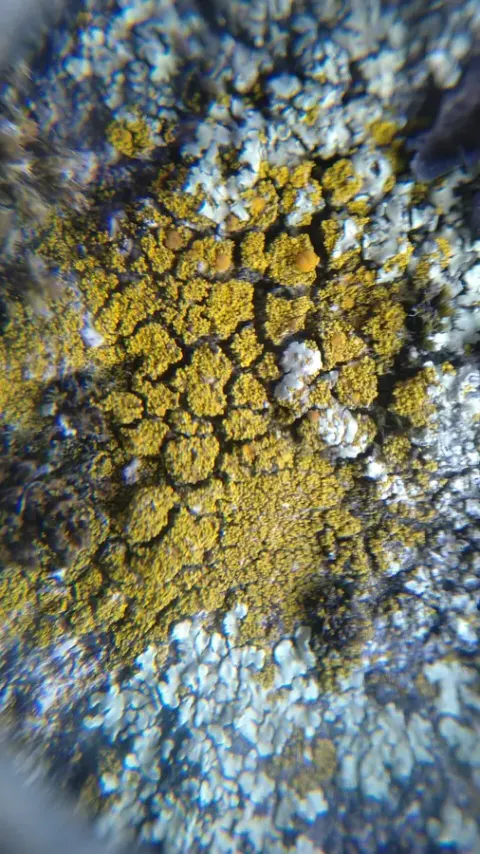
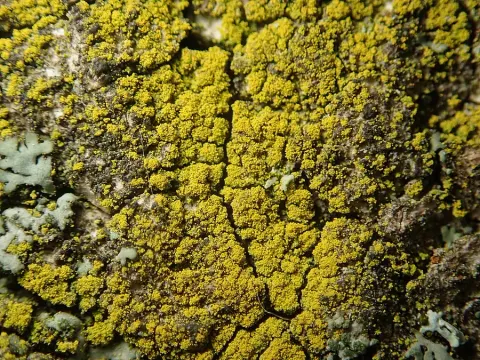
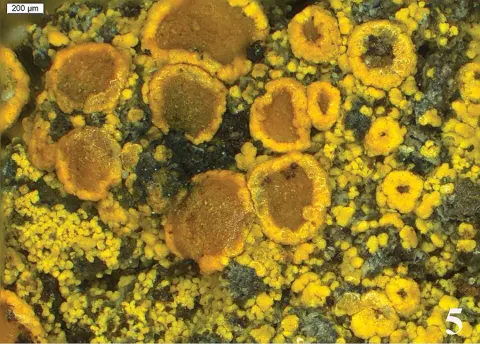
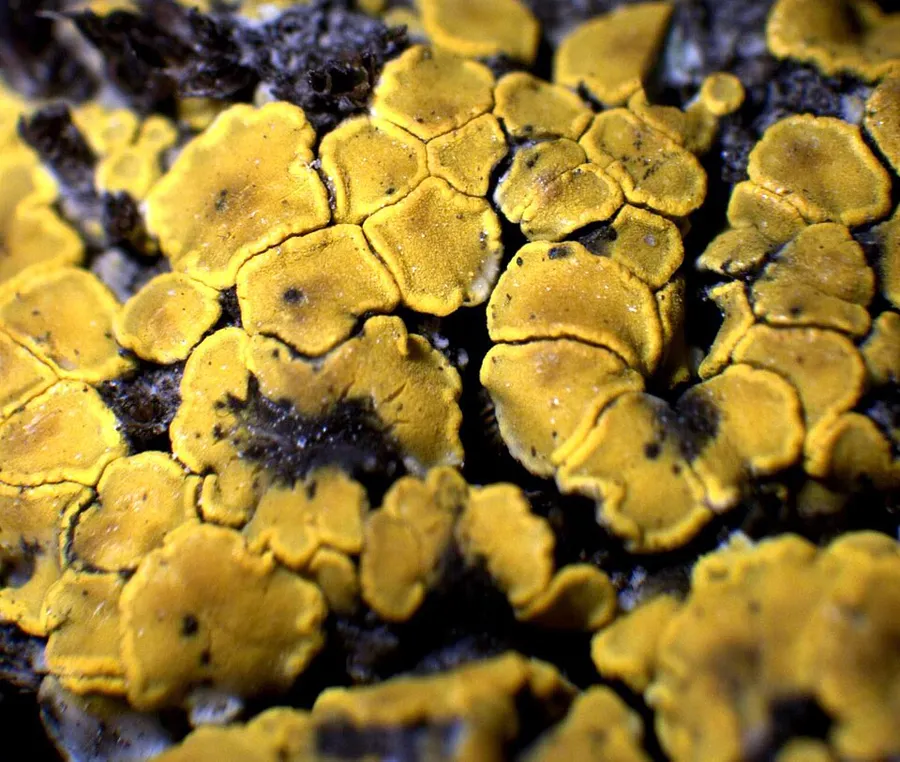
The thallus (the lichen body) forms a thin crust scattered as bright egg-yolk-yellow or tiny scales that sit flat on the substrate; in older material it may persist mainly as a yellow rim around the fruiting bodies. Apothecia (the disc-like spore-producing structures) begin immersed, then become exposed, usually flat and round but often developing lobed outlines, reaching about 2 mm across or a little more. The are yellow to ochre-yellow, often with a persistent, thick (a raised rim formed by the thallus). A compact (the apothecial wall) of elongated, thick-walled cells underlies the hymenium. The apothecial surface carries a fine dusting () of minute brownish-yellow crystals. The hymenium (spore-bearing layer) is about 80 micrometres (μm) high; asci are of the Candelaria-type and contain eight spores. Ascospores are characteristically long sausage-shaped (), typically 20–28 (less often up to 32) × 5–7.5 μm, with simple to sparsely branched paraphyses about 2 μm wide. Secondary metabolites detected by high-performance thin-layer chromatography analysis include calycin, pulvinic acid, and pulvic acid lactone. spot tests results on thallus material are K+ (slightly reddish), KC−, and C−. Some geographic variation has been noted: alpine and Scandinavian specimens tend to have somewhat shorter spores (often 18–24 μm), and paraphysis tips can differ subtly between Caucasian and northern material.

Sebagian uraian ditampilkan dalam bahasa sumber; terjemahannya belum tersedia atau belum lolos pemeriksaan.

Rujukan: [1]

Pengukuran mengikuti objek, spesimen atau kultur, dan metode yang disebutkan sumber. Baca uraian asli untuk konteks lengkap.

02 / Kehidupan

Habitat dan peran ekologis

This is an arctic–alpine species of calcareous terrain. It grows on soil and plant detritus over lime-rich ground, for example across fissures in calcareous rocks, typically above tree line. Confirmed records are from the alpine belt of the Caucasus and the Alps, a few high-elevation localities in Scandinavia, and Novaya Zemlya in the Russian Arctic.

Sebagian uraian ditampilkan dalam bahasa sumber; terjemahannya belum tersedia atau belum lolos pemeriksaan.

Rujukan: [1]

Habitat atau konteks temuan
Informasi belum tersedia pada sumber rilis ini.
Substrat
tanah
Peran atau konteks
Pembentuk liken
Temukan hubungan serupa
03 / Siklus hidup

Reproduksi

The thallus (the lichen body) forms a thin crust scattered as bright egg-yolk-yellow or tiny scales that sit flat on the substrate; in older material it may persist mainly as a yellow rim around the fruiting bodies. Apothecia (the disc-like spore-producing structures) begin immersed, then become exposed, usually flat and round but often developing lobed outlines, reaching about 2 mm across or a little more. The are yellow to ochre-yellow, often with a persistent, thick (a raised rim formed by the thallus). A compact (the apothecial wall) of elongated, thick-walled cells underlies the hymenium. The apothecial surface carries a fine dusting () of minute brownish-yellow crystals. The hymenium (spore-bearing layer) is about 80 micrometres (μm) high; asci are of the Candelaria-type and contain eight spores.

Sebagian uraian ditampilkan dalam bahasa sumber; terjemahannya belum tersedia atau belum lolos pemeriksaan.

Rujukan: [1]

04 / Batas informasi

Catatan identitas dan cakupan

  • Nama diterima mengikuti Catalogue of Life Base2026-09-11; uraian mempertahankan konsep dan nama sumber aslinya.
  • Original geographic, specimen and life-cycle scope retained; source import awaits individual editorial review.
  • Impor dan terjemahan otomatis belum diperiksa editorial per profil. Struktur reproduktif yang disebutkan tidak membuktikan seluruh siklus hidup diketahui.
  • Pengukuran pada uraian mengikuti spesimen, kultur, dan metode sumber; angka tidak diperluas ke semua populasi.

Catatan distribusi dalam narasi mengikuti sumbernya. Dokumentasi spesimen atau foto mengikuti catatan sumber. Bukti wilayah Indonesia dan penilaian konservasi tidak disimpulkan dari gambar.

05 / Dokumentasi

Melihat dengan konteks

Dokumentasi Candelariella commutata dari Wikimedia Commons. Closeup of the thallus of the ground-dwelling crustose lichen Candelariella commutata Identifikasi mengikuti record berkas sumber.

Jenis
Fotografi
Kredit
Pier Luigi Nimis
Sumber media
Buka entri sumber

Gambar menunjukkan objek menurut identifikasi sumber, bukan verifikasi independen spesimen oleh Fungi. Tidak ada skala baru yang ditambahkan.

06 / Rujukan

Sumber profil

  1. [1] Candelariella commutata — Wikipedia (en)Bagian sumber: Frozen revision 1326207413
    Tanggal penghimpunan sumber: 2026-10-12
    Teks sumber: CC BY-SA4.0 · Wikipedia contributors
  2. [2] Catalogue of Life Base2026-09-11 — Candelariella commutataBagian sumber: ColDP NameUsage.tsv ID 5X9T3; accepted species; source 2073
    Tanggal penghimpunan sumber: 2026-10-12
  3. [3] Dokumentasi visual — Candelariella commutataBagian sumber: Individual media record; identification follows the source, not independent determination
    Tanggal penghimpunan sumber: 2026-10-12
    Media sumber: CC BY-SA 4.0 · Pier Luigi Nimis

Adaptasi teks: CC BY-SA 4.0. Wikipedia contributors — Candelariella commutata — Wikipedia (en)

Uraian asli dan riwayat sumber

Riwayat atau halaman sumber

Ringkasan sumber

Candelariella commutata is a species of arctic–alpine, ground-dwelling, yellow crustose lichen in the family Candelariaceae. Formally described as new in 2013, the lichen forms bright egg-yolk-yellow crusts on calcareous soil and rock debris, typically growing above the tree line in arctic and alpine environments. It is known from the Caucasus, the Alps, high-elevation sites in Scandinavia, and the Russian Arctic, where it inhabits lime-rich ground in mountain fissures and detritus.

Revisi sumber

Morfologi sumber

The thallus (the lichen body) forms a thin crust scattered as bright egg-yolk-yellow or tiny scales that sit flat on the substrate; in older material it may persist mainly as a yellow rim around the fruiting bodies. Apothecia (the disc-like spore-producing structures) begin immersed, then become exposed, usually flat and round but often developing lobed outlines, reaching about 2 mm across or a little more. The are yellow to ochre-yellow, often with a persistent, thick (a raised rim formed by the thallus). A compact (the apothecial wall) of elongated, thick-walled cells underlies the hymenium. The apothecial surface carries a fine dusting () of minute brownish-yellow crystals. The hymenium (spore-bearing layer) is about 80 micrometres (μm) high; asci are of the Candelaria-type and contain eight spores. Ascospores are characteristically long sausage-shaped (), typically 20–28 (less often up to 32) × 5–7.5 μm, with simple to sparsely branched paraphyses about 2 μm wide. Secondary metabolites detected by high-performance thin-layer chromatography analysis include calycin, pulvinic acid, and pulvic acid lactone. spot tests results on thallus material are K+ (slightly reddish), KC−, and C−. Some geographic variation has been noted: alpine and Scandinavian specimens tend to have somewhat shorter spores (often 18–24 μm), and paraphysis tips can differ subtly between Caucasian and northern material.

Revisi sumber

Ekologi sumber

This is an arctic–alpine species of calcareous terrain. It grows on soil and plant detritus over lime-rich ground, for example across fissures in calcareous rocks, typically above tree line. Confirmed records are from the alpine belt of the Caucasus and the Alps, a few high-elevation localities in Scandinavia, and Novaya Zemlya in the Russian Arctic.

Revisi sumber

Struktur reproduksi sumber

The thallus (the lichen body) forms a thin crust scattered as bright egg-yolk-yellow or tiny scales that sit flat on the substrate; in older material it may persist mainly as a yellow rim around the fruiting bodies. Apothecia (the disc-like spore-producing structures) begin immersed, then become exposed, usually flat and round but often developing lobed outlines, reaching about 2 mm across or a little more. The are yellow to ochre-yellow, often with a persistent, thick (a raised rim formed by the thallus). A compact (the apothecial wall) of elongated, thick-walled cells underlies the hymenium. The apothecial surface carries a fine dusting () of minute brownish-yellow crystals. The hymenium (spore-bearing layer) is about 80 micrometres (μm) high; asci are of the Candelaria-type and contain eight spores.

Revisi sumber

Rujukan halaman ini

Fungi. Candelariella commutata. Rilis data fungi-2026-10-12-expansion-2. https://fungi-atlas.mgadib.chatgpt.site/jamur/candelariella-commutata/.

Status: impor sumber; pemeriksaan editorial per profil belum selesai. Untuk klaim biologis, gunakan rujukan pada bagian terkait dan periksa konteks sumber aslinya.