Ciri dan struktur
Differs from its closest Asian and North American relatives in the variously coloured but often bright lemon yellow pileus, similarly tinted stipe and smaller size, as well as in differences in sequence data produced for the transcription elongation factor (tef -1). Basidiomata dispersed in small groups or fascicles. Pileus 4–20 mm broad, convex, with involute margin when young, then plane or infundibuliform with depressed centre and inflexed to straight, smooth margin, irregularly undulate when old, hygrophanous, finely tomentose when very young, soon glabrescent and smooth or slightly rugulose, uniformly coloured, light yellow, orange yellow to light orange (3–4A6, 4–5A5–7), sometimes with greyish yellow tinge when old. Hymenophore composed of thick vein-like folds, sometimes strongly decurrent in a reticulate pattern on upper stipe, often not reaching the pileus margin, forking or with rare lamellulae, transversely anastomosed in between, white to whitish (3A2); edges concolorous. Stipe 4–22 × 1–3(–4) mm, slightly tapering towards base when young, then cylindrical, sometimes curved, finely pubescent when young, later glabrescent, smooth, concolorous with pileus or slightly paler. Context thin, yellowish, fibrillose-hollow and yellowish whitish in stipe when old, with a spicy apricot smell and mild taste. Spore print not obtained. Basidiospores ellipsoid, (7.3–)7.6– 8.24 –8.4(–8.8) × (5.1–)5.4– 5.67 –5.9(–6.1) μm, Q = (1.32–)1.34– 1.42 –1.50(–1.56), smooth, thin-walled. Basidia mostly (42–)66–80 × 8 μm, 4–5(–6)-spored, narrowly clavate; basidiola subcylindrical and slender when young, undulate-wavy in outline, later becoming narrowly clavate, subfusoid, sometimes irregular, rarely submoniliform, thin-walled.
Habitat dan peran ekologis
On soil near Quercus mongolica Fisch. ex Ledeb., Q. acutissima Carruth., Quercus sp., Castanea crenata Siebold & Zucc., Carpinus laxiflora (Siebold & Zucc.) Blume and Abies koreana E.H. Wilson.
- Habitat atau konteks temuan
- Informasi belum tersedia pada sumber rilis ini.
- Substrat
- tanah
- Peran atau konteks
- Belum dikategorikan pada rilis ini.
Reproduksi
Basidiomata dispersed in small groups or fascicles. Pileus 4–20 mm broad, convex, with involute margin when young, then plane or infundibuliform with depressed centre and inflexed to straight, smooth margin, irregularly undulate when old, hygrophanous, finely tomentose when very young, soon glabrescent and smooth or slightly rugulose, uniformly coloured, light yellow, orange yellow to light orange (3–4A6, 4–5A5–7), sometimes with greyish yellow tinge when old. Hymenophore composed of thick vein-like folds, sometimes strongly decurrent in a reticulate pattern on upper stipe, often not reaching the pileus margin, forking or with rare lamellulae, transversely anastomosed in between, white to whitish (3A2); edges concolorous.
Catatan identitas dan cakupan
- Nama diterima mengikuti Catalogue of Life Base2026-09-11; uraian mempertahankan konsep dan nama sumber aslinya.
- Preserve original treatment localities, hosts and substrate scope. Materials examined describe documented specimens, not the full global range.
- Impor dan terjemahan otomatis belum diperiksa editorial per profil. Struktur reproduktif yang disebutkan tidak membuktikan seluruh siklus hidup diketahui.
- Pengukuran pada uraian mengikuti spesimen, kultur, dan metode sumber; angka tidak diperluas ke semua populasi.
Catatan distribusi dalam narasi mengikuti sumbernya. Dokumentasi spesimen atau foto mengikuti catatan sumber. Bukti wilayah Indonesia dan penilaian konservasi tidak disimpulkan dari gambar.
Melihat dengan konteks
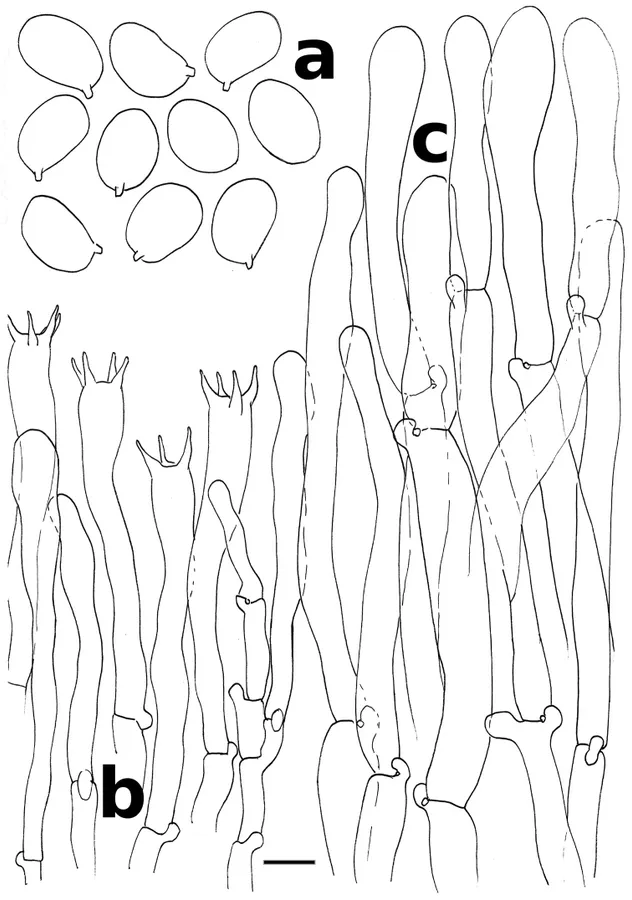
Cantharellus citrinus (holotype) a spores b basidia and basidiola c hyphal extremities of the pileipellis near mid-radius. Scale bar: 10 μm, but only 5 μm for spores. Drawings B. Buyck.
- Jenis
- Pelat ilmiah
- Kredit
- Bart Buyck, Valérie Hofstetter, Rhim Ryoo, Kang-Hyeon Ka, Vladimír Antonín
- Lisensi
- CC BY 4.0
- Sumber media
- Buka entri sumber
Dokumentasi tambahan
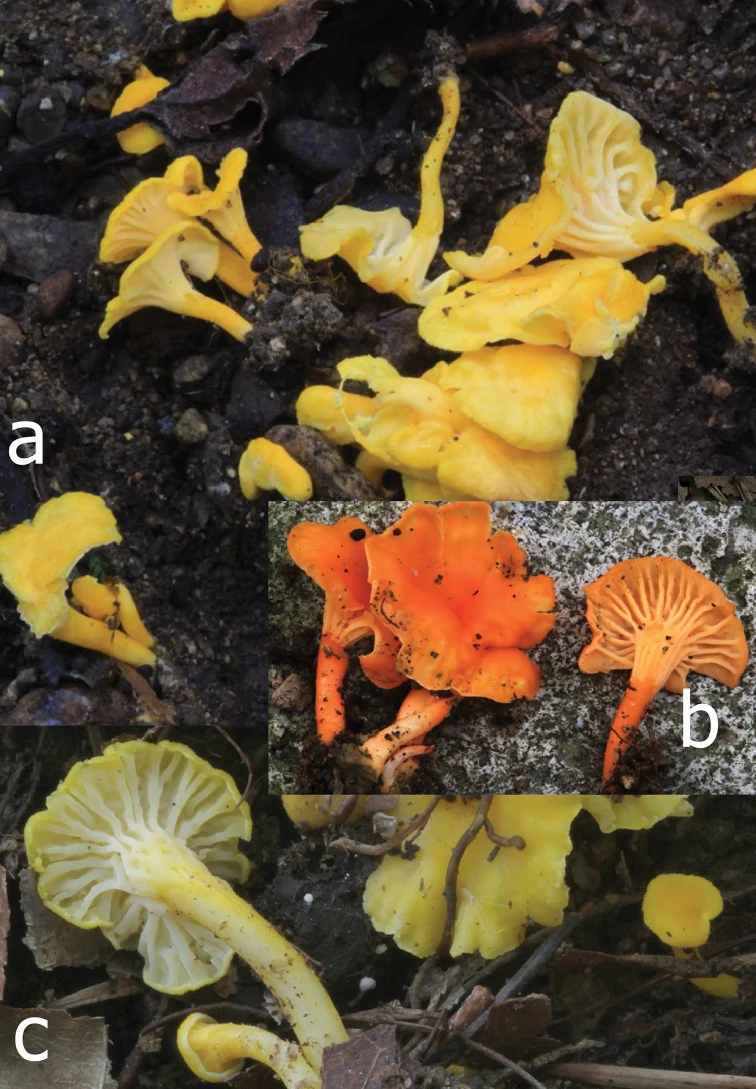
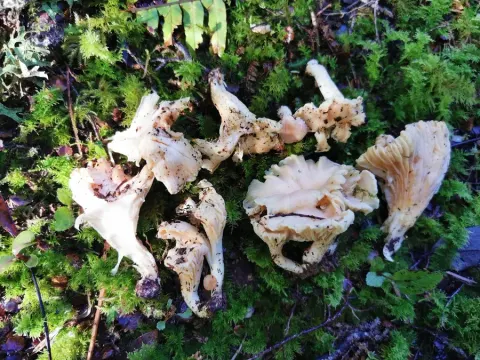
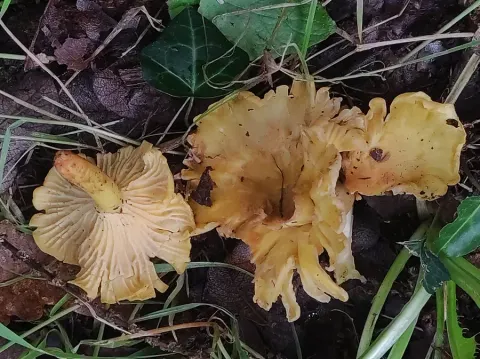
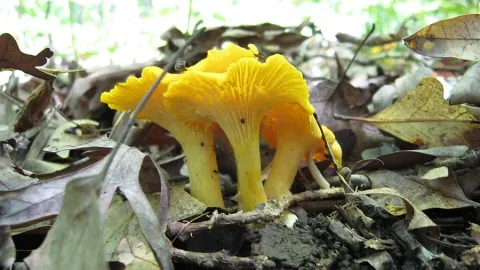
a–c Cantharellus citrinus, yellow, more common form a (VA 13.170) b C. citrinus, reddish orange form (VA 16.169) c (VA 13.156, holotype). Photos V. Antonín.
Kredit dan penggunaan
Bart Buyck, Valérie Hofstetter, Rhim Ryoo, Kang-Hyeon Ka, Vladimír Antonín
Ukuran dan format gambar disesuaikan tanpa pemotongan, retus, atau penambahan skala. Lisensi sumber dipertahankan.
Sumber profil
- [1] New Cantharellus species from South Korea — Cantharellus citrinus
- [2] Catalogue of Life Base2026-09-11 — Cantharellus citrinus
- [3] Dokumentasi visual — Cantharellus citrinus
- [4] Dokumentasi visual — Cantharellus citrinus
Rujukan halaman ini
Fungi. Cantharellus citrinus. Rilis data fungi-2026-10-12-expansion-2. https://fungi-atlas.mgadib.chatgpt.site/jamur/cantharellus-citrinus/.
Status: impor sumber; pemeriksaan editorial per profil belum selesai. Untuk klaim biologis, gunakan rujukan pada bagian terkait dan periksa konteks sumber aslinya.