Ciri dan struktur
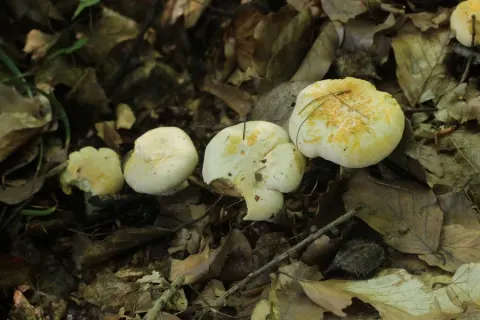
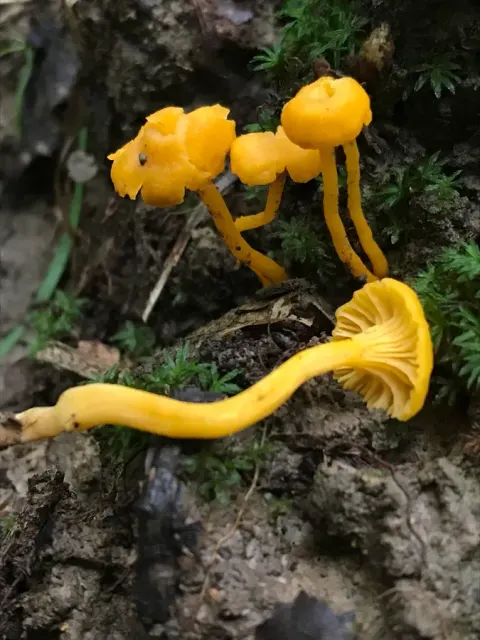
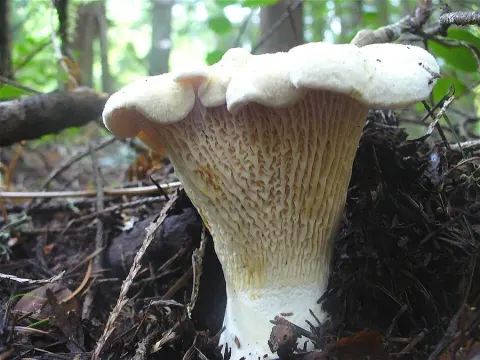
“ Pileo carnoso-coriaceo, centro depresso, margine incurvato, luteo; furfuraceo brunneo, 3,5–4 cm. lato; stipite cylindrico-solido, glabro, concolori, 3 × 0,5–0,7 cm, lamellis deccurentibus, luteis; sporis ovoideis 5–6 × 3,5–4 μm, carne lutea. ” (freely translated from French) “Pileus rather thick, 49 mm diam., soon depressed, concave with rounded, then straight margin, bright lemon yellow, punctuated – particularly in the center – with minute brownish squamules. Stipe 30 × 6 mm, [30–50 × 5–11 mm], cylindrical, solid inside, yellow, finally rusty, faintly covered from brownish scales. Gills very crowded, deeply decurrent, very narrow, 0.5–11 mm wide (sic!), yellow, irregularly forked, interconnected by rather abundant transversal anastomoses. Context firm, bright yellow, more orangish near the stipe base. Taste strong, bitter. Spore print white. Exsiccatum orangish brown-ochre. Spores hyaline, shortly ellipsoid, 4.9–6.0 (7.5) × 3.8–4.6 (5) μm, granular inside, thin-walled, not amyloid, with a small apiculus. Basidia narrowly clavate, 30–40 × 6.7–9.5 μm, 4-spored, perhaps sometimes 6-spored. Hymenium not or only slightly accrescent. Subhymenium narrow. Pseudoparenchyma composed of very long and slender elements, mixed with some oleiferous hyphae that do not color in Congo Red. Pileipellis undifferentiated; squamules formed of hyphae united in bundles made up of yellowish to pinkish cells; terminal cells lanceolate or clavate, 6–13 μm diam. Hyphae not amyloid.” Basidiomata scattered to occasionally caespitose. Pileus up to 65(–75) mm diam., initially broadly convex with shallow depression, extending outward and upward with age, becoming increasingly infundibuliform with downturned margin, deep golden yellow (2–3A4), beset with minute, conical erect tufts, these flesh-brown, more concentrated over the disc but extending and gradually more widely dispersed toward margin; intervening surface shiny-glabrous; margin irregularly crenulate, slightly wavy.
Habitat dan peran ekologis
Cantharellus luteopunctatus is a species of fungus in the genus Cantharellus. Found in Africa, it was described as new to science in 1928 by Belgian mycologist Maurice Beeli as Lentinus luteopunctatus. Paul Heinemann transferred it to Cantharellus in 1958.
- Habitat atau konteks temuan
- Informasi belum tersedia pada sumber rilis ini.
- Substrat
- Informasi belum tersedia pada sumber rilis ini.
- Peran atau konteks
- Belum dikategorikan pada rilis ini.
Reproduksi
“ Pileo carnoso-coriaceo, centro depresso, margine incurvato, luteo; furfuraceo brunneo, 3,5–4 cm. lato; stipite cylindrico-solido, glabro, concolori, 3 × 0,5–0,7 cm, lamellis deccurentibus, luteis; sporis ovoideis 5–6 × 3,5–4 μm, carne lutea. ” (freely translated from French) “Pileus rather thick, 49 mm diam., soon depressed, concave with rounded, then straight margin, bright lemon yellow, punctuated – particularly in the center – with minute brownish squamules. Stipe 30 × 6 mm, [30–50 × 5–11 mm], cylindrical, solid inside, yellow, finally rusty, faintly covered from brownish scales. Gills very crowded, deeply decurrent, very narrow, 0.5–11 mm wide (sic!), yellow, irregularly forked, interconnected by rather abundant transversal anastomoses.
Catatan identitas dan cakupan
- Nama diterima mengikuti Catalogue of Life Base2026-09-11; uraian mempertahankan konsep dan nama sumber aslinya.
- Uraian digabungkan dari sumber spesies yang sama; lingkup geografis, bahan, dan kultur setiap sumber dipertahankan. Preserve original treatment localities, hosts and substrate scope. Materials examined describe documented specimens, not the full global range. Original geographic, specimen and life-cycle scope retained; source import awaits individual editorial review.
- Impor dan terjemahan otomatis belum diperiksa editorial per profil. Struktur reproduktif yang disebutkan tidak membuktikan seluruh siklus hidup diketahui.
- Pengukuran pada uraian mengikuti spesimen, kultur, dan metode sumber; angka tidak diperluas ke semua populasi.
Catatan distribusi dalam narasi mengikuti sumbernya. Dokumentasi spesimen atau foto mengikuti catatan sumber. Bukti wilayah Indonesia dan penilaian konservasi tidak disimpulkan dari gambar.
Melihat dengan konteks
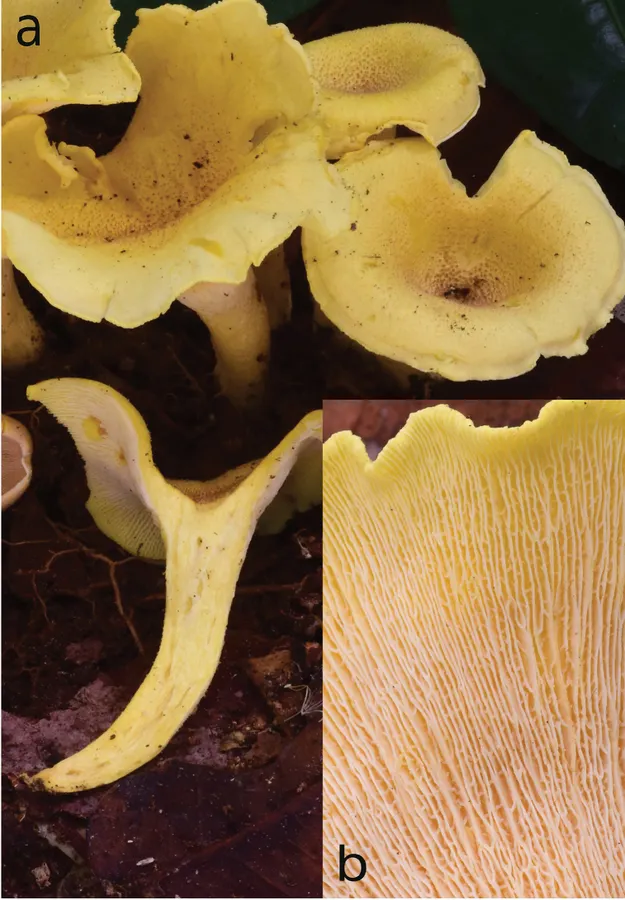
Cantharellus luteopunctatus (TH 10442). a Field habit of a collection that is more intensely yellow with distinctly yellowing context b detail of the hymenophore showing the crowded, thin and strongly anastomosing gill folds. Based on photos by Noah Siegel.
- Jenis
- Pelat ilmiah
- Kredit
- Bart Buyck, Terry W. Henkel, Valérie Hofstetter
- Lisensi
- CC BY 4.0
- Sumber media
- Buka entri sumber
Dokumentasi tambahan
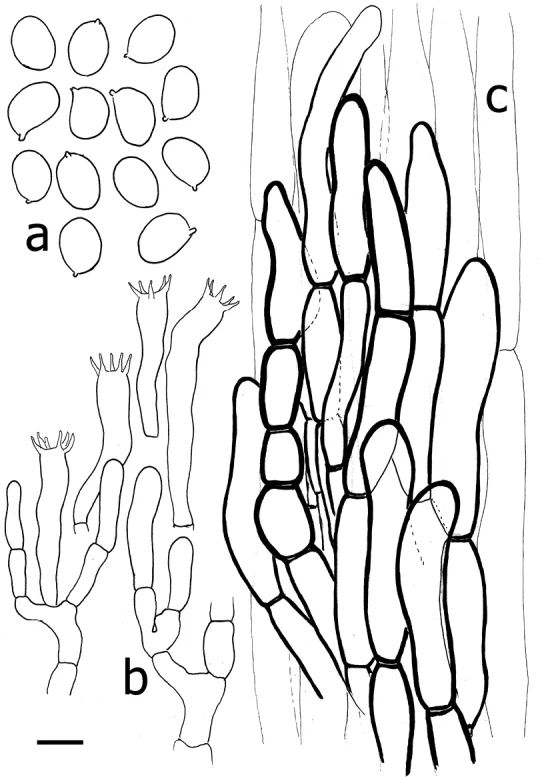
Cantharellus luteopunctatus. Microscopic features: a basidiospores b basidia and basidiola c detail of part of a squamula showing the terminal, thin- to slightly thick-walled hyphal extremities overlying the pileipellis. Scale bar: 10 µm but only 5 µm for basidiospores. Drawings: B. Buyck.
Kredit dan penggunaan
Bart Buyck, Terry W. Henkel, Valérie Hofstetter
Ukuran dan format gambar disesuaikan tanpa pemotongan, retus, atau penambahan skala. Lisensi sumber dipertahankan.
Sumber profil
- [1] Epitypification of the Central African Cantharellus densifolius and C. luteopunctatus allows for the recognition of two additional species — Cantharellus luteopunctatus
- [2] Cantharellus luteopunctatus — Wikipedia (en)
- [3] Catalogue of Life Base2026-09-11 — Cantharellus luteopunctatus
- [4] Dokumentasi visual — Cantharellus luteopunctatus
- [5] Dokumentasi visual — Cantharellus luteopunctatus
Rujukan halaman ini
Fungi. Cantharellus luteopunctatus. Rilis data fungi-2026-10-12-expansion-2. https://fungi-atlas.mgadib.chatgpt.site/jamur/cantharellus-luteopunctatus/.
Status: impor sumber; pemeriksaan editorial per profil belum selesai. Untuk klaim biologis, gunakan rujukan pada bagian terkait dan periksa konteks sumber aslinya.