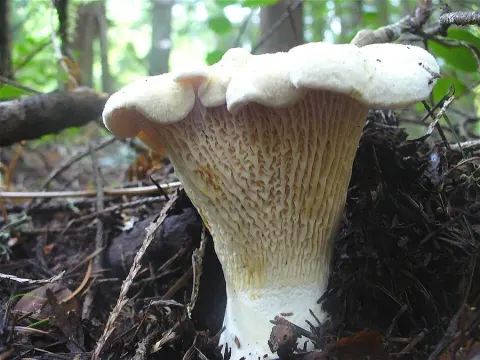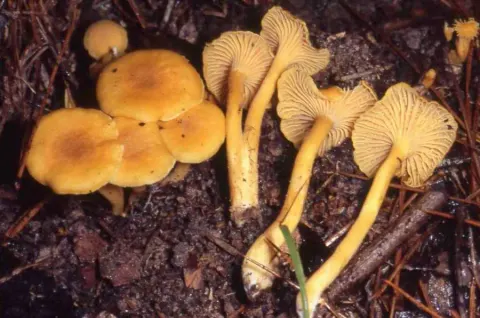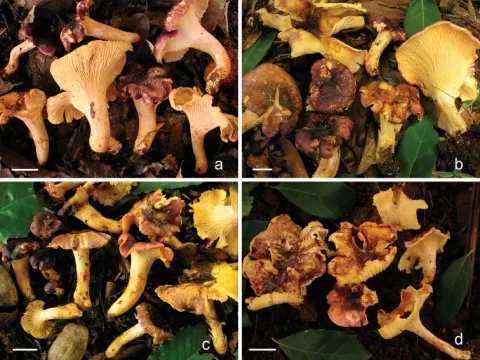
Ciri dan struktur
Differing from other related Cantharellus species (subgenus Parvocantharellus) by the pileus surface with appressed fibrils at center, broadly ellipsoid basidiospores 6–9 (–9.5) × 4.5–5 µm [ Q –= 1.52–1.57 (n=3)], pileipellis terminal hyphae (23–) 25–75 (–80) µm × (3.5–) 4–8 µm, mostly cylindrical, often subclaviform, subventricose or somewhat narrowly utriform. Pileus 6–26 mm diam, subhemispheric in young, becoming convex to plane convex and centrally depressed, some finally irregularly infundibuliform; margin incurved when young, becoming inflexed to somewhat straight, undulate or irregular or more or less crenate, not or obscurely translucid striate; surface dry, with appressed fibrils at center when young, glabrous at remaining areas, with waxy appearance, bright yellow-orange (5A5–A8) with tiny white to light yellow scales in the center when young, paler at edge when young. Hymenophore decurrent or shortly decurrent, with gill-like folds up to 2 mm deep, subdistant to more frequently distant, at times forked, moderately thick with margin entire or often irregular or eroded, frequently intervenose, some specimens (especially towards the stipe) with irregular low and sinuous veins, often with lower irregular anastomosis among the folds, in some specimens the anastomosis occur practically in the whole hymenophore, while in others only at some areas, especially at pileus margin, with some short lamellulae-like folds, concolorous with the pileus. Stipe (10–) 15–42 × 2–6 mm, broadened towards the apex, somewhat fused, compressed at times or furrowed, solid but soon fistulous to hollow, glabrous, concolorous with pileus.
Habitat dan peran ekologis
Solitary to gregarious, rare in the study area, on soil, in tropical oak forest, under Quercus oleoides, September-October, known in the coastal plain of central Veracruz State, east coast of Mexico.
- Habitat atau konteks temuan
- hutan
- Substrat
- tanah
- Peran atau konteks
- Belum dikategorikan pada rilis ini.
Reproduksi
Differing from other related Cantharellus species (subgenus Parvocantharellus) by the pileus surface with appressed fibrils at center, broadly ellipsoid basidiospores 6–9 (–9.5) × 4.5–5 µm [ Q –= 1.52–1.57 (n=3)], pileipellis terminal hyphae (23–) 25–75 (–80) µm × (3.5–) 4–8 µm, mostly cylindrical, often subclaviform, subventricose or somewhat narrowly utriform. Pileus 6–26 mm diam, subhemispheric in young, becoming convex to plane convex and centrally depressed, some finally irregularly infundibuliform; margin incurved when young, becoming inflexed to somewhat straight, undulate or irregular or more or less crenate, not or obscurely translucid striate; surface dry, with appressed fibrils at center when young, glabrous at remaining areas, with waxy appearance, bright yellow-orange (5A5–A8) with tiny white to light yellow scales in the center when young, paler at edge when young.
Catatan identitas dan cakupan
- Nama diterima mengikuti Catalogue of Life Base2026-09-11; uraian mempertahankan konsep dan nama sumber aslinya.
- Preserve original treatment localities, hosts and substrate scope. Materials examined describe documented specimens, not the full global range.
- Impor dan terjemahan otomatis belum diperiksa editorial per profil. Struktur reproduktif yang disebutkan tidak membuktikan seluruh siklus hidup diketahui.
- Pengukuran pada uraian mengikuti spesimen, kultur, dan metode sumber; angka tidak diperluas ke semua populasi.
Catatan distribusi dalam narasi mengikuti sumbernya. Dokumentasi spesimen atau foto mengikuti catatan sumber. Bukti wilayah Indonesia dan penilaian konservasi tidak disimpulkan dari gambar.
Melihat dengan konteks
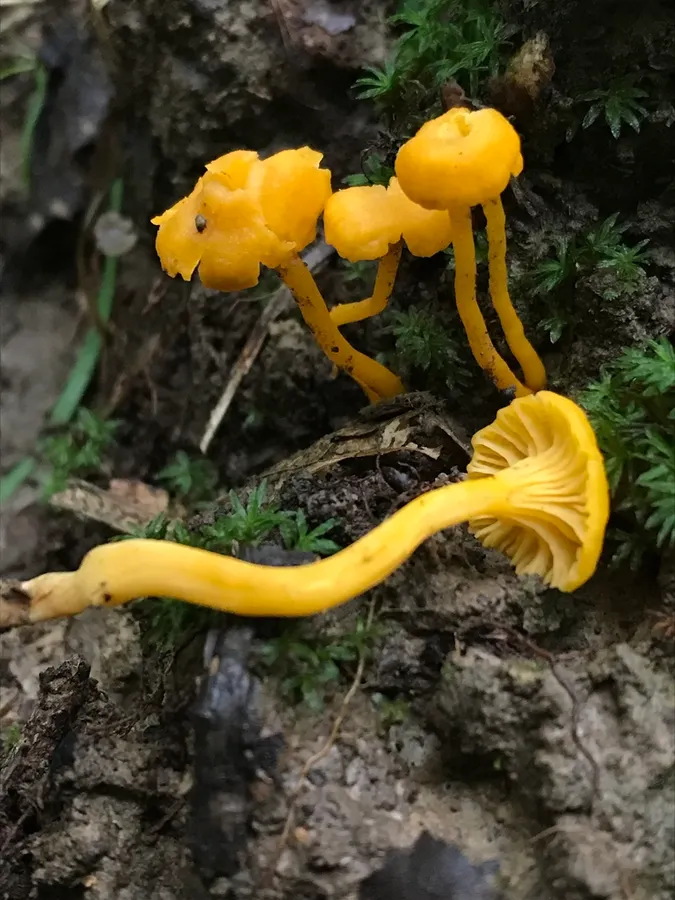
Dokumentasi Cantharellus parvoflavus menurut asosiasi foto pada record takson iNaturalist. Kredit: Brian C. Hunt. Identitas mengikuti sumber; bukan penentuan spesimen independen.
- Jenis
- Fotografi
- Kredit
- (c) Brian C. Hunt, some rights reserved (CC BY), uploaded by Brian C. Hunt
- Lisensi
- CC BY 4.0
- Sumber media
- Buka entri sumber
Dokumentasi tambahan
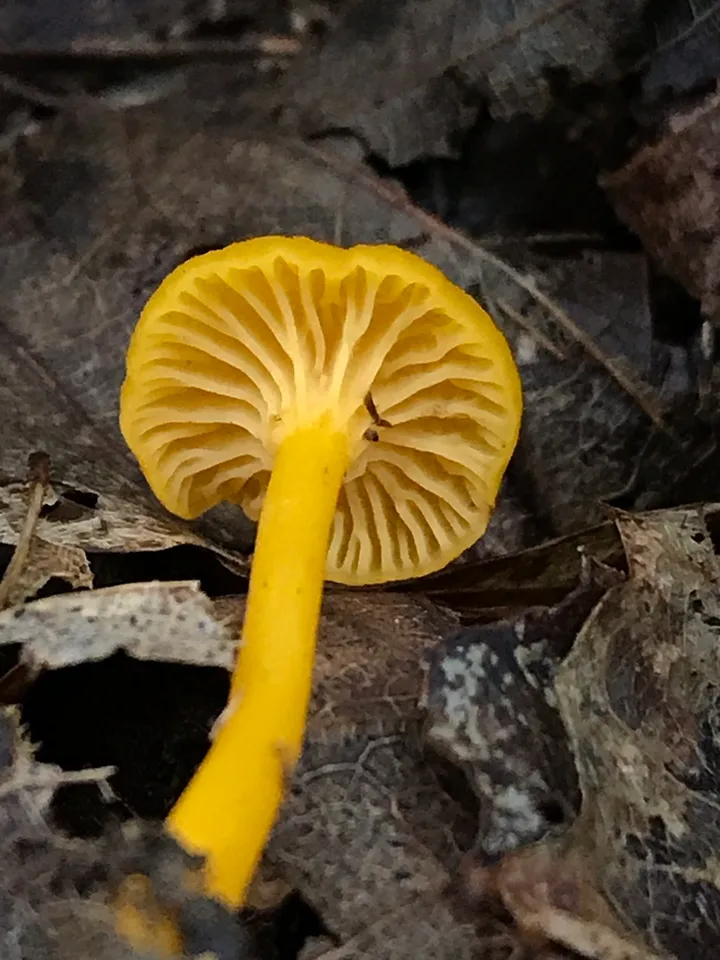
Foto yang diasosiasikan dengan Cantharellus parvoflavus pada iNaturalist. Identifikasi mengikuti sumber; bukan penentuan spesimen independen.
Kredit dan penggunaan
(c) Brian C. Hunt, some rights reserved (CC BY), uploaded by Brian C. Hunt
Ukuran dan format gambar disesuaikan tanpa pemotongan, retus, atau penambahan skala. Lisensi sumber dipertahankan.
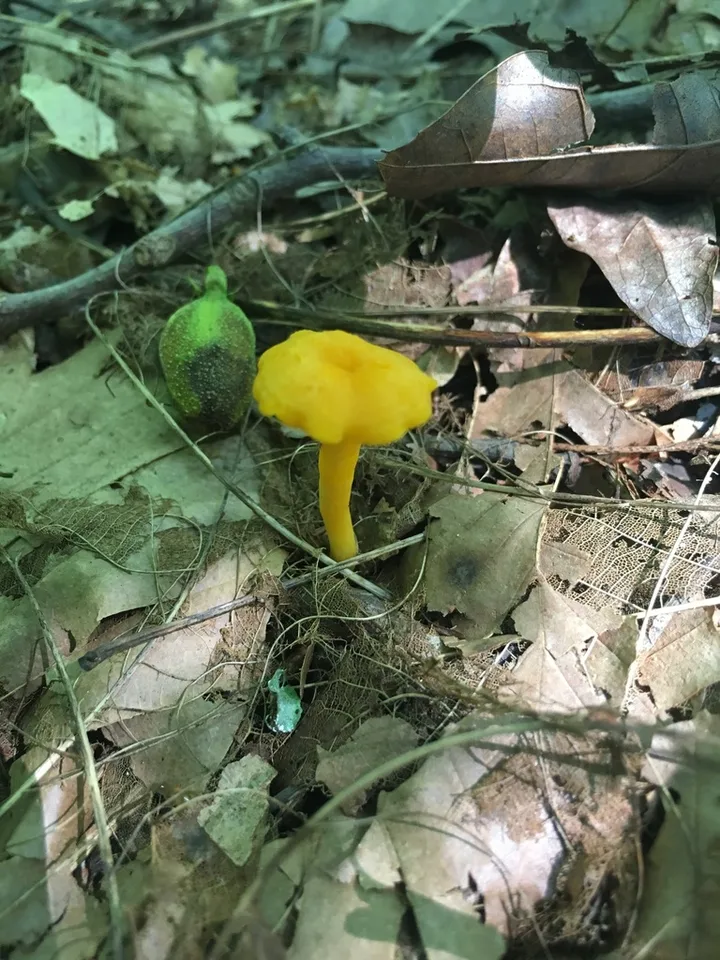
Foto yang diasosiasikan dengan Cantharellus parvoflavus pada iNaturalist. Identifikasi mengikuti sumber; bukan penentuan spesimen independen.
Kredit dan penggunaan
no rights reserved, uploaded by Robert Simcox
Ukuran dan format gambar disesuaikan tanpa pemotongan, retus, atau penambahan skala. Lisensi sumber dipertahankan.
Sumber profil
- [1] Two new species and a new record of yellow Cantharellus from tropical Quercus forests in eastern Mexico with the proposal of a new name for the replacement of Craterellus confluens — Cantharellus parvoflavus
- [2] Catalogue of Life Base2026-09-11 — Cantharellus parvoflavus
- [3] Dokumentasi visual — Cantharellus parvoflavus
- [4] Dokumentasi visual — Cantharellus parvoflavus
- [5] Dokumentasi visual — Cantharellus parvoflavus
Rujukan halaman ini
Fungi. Cantharellus parvoflavus. Rilis data fungi-2026-10-12-expansion-2. https://fungi-atlas.mgadib.chatgpt.site/jamur/cantharellus-parvoflavus/.
Status: impor sumber; pemeriksaan editorial per profil belum selesai. Untuk klaim biologis, gunakan rujukan pada bagian terkait dan periksa konteks sumber aslinya.