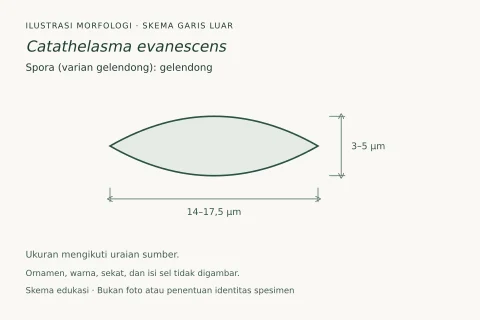
01 / Morfologi

Ciri dan struktur

The fruit bodies are agaricoid with a pileus (cap) that is convex and sticky at first becoming flat or slightly depressed and dry, 8–40 cm in diameter, orange brown to hazel brown, with darker patches. The lamellae (gills) are whitish to cream, decurrent, crowded, and sometimes forked. The stipe (stem) is compact, 5–18 cm long, tapering to the base, often rooting and partly buried, pale brown with a double ring. The fruit body has a mealy or cucumber-like smell. The spore print is white. Microscopically, the spores are subcylindrical, often fusoid, 12.5–16.0 × 5.0–6.5 μm, smooth, and amyloid. The hyphae have clamp connections.

Sebagian uraian ditampilkan dalam bahasa sumber; terjemahannya belum tersedia atau belum lolos pemeriksaan.

Rujukan: [1]

Pengukuran mengikuti objek, spesimen atau kultur, dan metode yang disebutkan sumber. Baca uraian asli untuk konteks lengkap.

02 / Kehidupan

Habitat dan peran ekologis

Catathelasma imperiale is an ectomycorrhizal species, forming an association with conifers, particularly spruce. Originally described dari Skandinavia, telah tercatat dari sebagian besar negara-negara utara di benua Europe as jauh di selatan seperti Italia. Hal ini juga telah direkam di Asia from China, Korea, dan Jepang. Records from Utara America are tidak pasti, karena urutan DNA spesimen yang ditentukan sebagai "C. imperiale" telah (sehingga saat ini) terbukti milik C. evanescens atau C. ventricosum.

Sebagian uraian ditampilkan dalam bahasa sumber; terjemahannya belum tersedia atau belum lolos pemeriksaan.

Rujukan: [1]

Habitat atau konteks temuan
Informasi belum tersedia pada sumber rilis ini.
Substrat
Informasi belum tersedia pada sumber rilis ini.
Peran atau konteks
Mitra tumbuhan
Temukan hubungan serupa
03 / Siklus hidup

Reproduksi

The fruit bodies are agaricoid with a pileus (cap) that is convex and sticky at first becoming flat or slightly depressed and dry, 8–40 cm in diameter, orange brown to hazel brown, with darker patches. The lamellae (gills) are whitish to cream, decurrent, crowded, and sometimes forked. The stipe (stem) is compact, 5–18 cm long, tapering to the base, often rooting and partly buried, pale brown with a double ring. The fruit body has a mealy or cucumber-like smell. The spore print is white. Microscopically, the spores are subcylindrical, often fusoid, 12.5–16.0 × 5.0–6.5 μm, smooth, and amyloid. The hyphae have clamp connections.

Sebagian uraian ditampilkan dalam bahasa sumber; terjemahannya belum tersedia atau belum lolos pemeriksaan.

Rujukan: [1]

Sinonim menurut acuan taksonomi rilis: Agaricus biarmillatus; Agaricus imperialis; Armillaria imperialis; Armillaria nobilis; Armillariella imperialis; Biannularia imperialis; Clitocybe imperialis; Mastoleucomyces imperialis; Omphalia imperialis
04 / Batas informasi

Catatan identitas dan cakupan

  • Nama diterima mengikuti Catalogue of Life Base2026-09-11; uraian mempertahankan konsep dan nama sumber aslinya.
  • Original geographic, specimen and life-cycle scope retained; source import awaits individual editorial review.
  • Impor dan terjemahan otomatis belum diperiksa editorial per profil. Struktur reproduktif yang disebutkan tidak membuktikan seluruh siklus hidup diketahui.
  • Pengukuran pada uraian mengikuti spesimen, kultur, dan metode sumber; angka tidak diperluas ke semua populasi.

Catatan distribusi dalam narasi mengikuti sumbernya. Dokumentasi spesimen atau foto mengikuti catatan sumber. Bukti wilayah Indonesia dan penilaian konservasi tidak disimpulkan dari gambar.

05 / Dokumentasi

Melihat dengan konteks

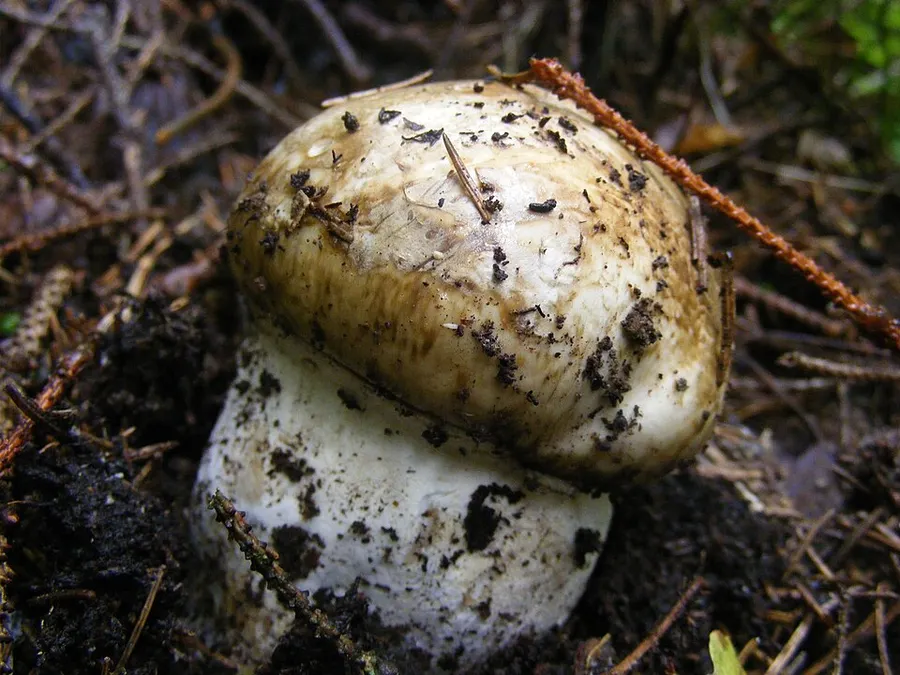
Dokumentasi Catathelasma imperiale dari Wikimedia Commons. Catathelasma imperiale Identifikasi mengikuti record berkas sumber.

Jenis
Fotografi
Kredit
Szabi237
Lisensi
CC BY 3.0
Sumber media
Buka entri sumber

Gambar menunjukkan objek menurut identifikasi sumber, bukan verifikasi independen spesimen oleh Fungi. Tidak ada skala baru yang ditambahkan.

06 / Rujukan

Sumber profil

  1. [1] Catathelasma imperiale — Wikipedia (en)Bagian sumber: Frozen revision 1339586801
    Tanggal penghimpunan sumber: 2026-10-12
    Teks sumber: CC BY-SA4.0 · Wikipedia contributors
  2. [2] Catalogue of Life Base2026-09-11 — Catathelasma imperialeBagian sumber: ColDP NameUsage.tsv ID RTB7; accepted species; source 2073
    Tanggal penghimpunan sumber: 2026-10-12
  3. [3] Dokumentasi visual — Catathelasma imperialeBagian sumber: Individual media record; identification follows the source, not independent determination
    Tanggal penghimpunan sumber: 2026-10-12
    Media sumber: CC BY 3.0 · Szabi237

Adaptasi teks: CC BY-SA 4.0. Wikipedia contributors — Catathelasma imperiale — Wikipedia (en)

Uraian asli dan riwayat sumber

Riwayat atau halaman sumber

Ringkasan sumber

{{Speciesbox The species is ectomycorrhizal with conifers and is found in continental Europe and Asia. Reports from North America are unconfirmed and may refer to Catathelasma evanescens or similar species. The fruit bodies are edible and collected for food in China and elsewhere. The species is widespread but uncommon and is assessed as globally "near threatened" on the IUCN Red List of Threatened Species.

Revisi sumber

Morfologi sumber

The fruit bodies are agaricoid with a pileus (cap) that is convex and sticky at first becoming flat or slightly depressed and dry, 8–40 cm in diameter, orange brown to hazel brown, with darker patches. The lamellae (gills) are whitish to cream, decurrent, crowded, and sometimes forked. The stipe (stem) is compact, 5–18 cm long, tapering to the base, often rooting and partly buried, pale brown with a double ring. The fruit body has a mealy or cucumber-like smell. The spore print is white. Microscopically, the spores are subcylindrical, often fusoid, 12.5–16.0 × 5.0–6.5 μm, smooth, and amyloid. The hyphae have clamp connections.

Revisi sumber

Ekologi sumber

Catathelasma imperiale is an ectomycorrhizal species, forming an association with conifers, particularly spruce. Originally described from Scandinavia, it has been recorded from most northern countries in continental Europe as far south as Italy. It has also been recorded in Asia from China, Korea, and Japan. Records from North America are uncertain, since DNA sequencing of specimens determined as "C. imperiale" have (to date) proven to belong to C. evanescens or C. ventricosum.

Revisi sumber

Struktur reproduksi sumber

The fruit bodies are agaricoid with a pileus (cap) that is convex and sticky at first becoming flat or slightly depressed and dry, 8–40 cm in diameter, orange brown to hazel brown, with darker patches. The lamellae (gills) are whitish to cream, decurrent, crowded, and sometimes forked. The stipe (stem) is compact, 5–18 cm long, tapering to the base, often rooting and partly buried, pale brown with a double ring. The fruit body has a mealy or cucumber-like smell. The spore print is white. Microscopically, the spores are subcylindrical, often fusoid, 12.5–16.0 × 5.0–6.5 μm, smooth, and amyloid. The hyphae have clamp connections.

Revisi sumber

Rujukan halaman ini

Fungi. Catathelasma imperiale. Rilis data fungi-2026-10-12-expansion-2. https://fungi-atlas.mgadib.chatgpt.site/jamur/catathelasma-imperiale/.

Status: impor sumber; pemeriksaan editorial per profil belum selesai. Untuk klaim biologis, gunakan rujukan pada bagian terkait dan periksa konteks sumber aslinya.