01 / Morfologi

Ciri dan struktur

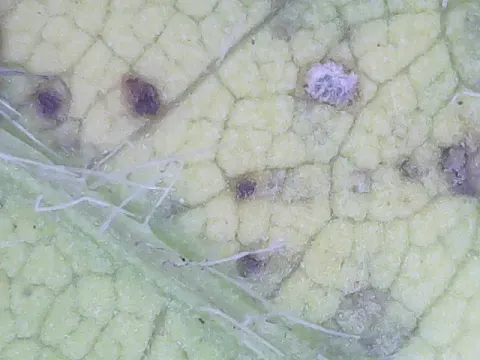
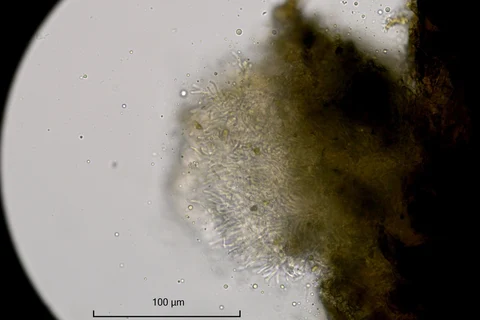
Leaf spots amphigenous, subcircular to irregularly angular, 2.5–8(–12) mm diam., more or less limited by veins, whitish grey to greyish brown, with a narrow to wide dark brown margin on the adaxial surface, less conspicuous on the abaxial surface. Caespituli amphigenous, mainly epiphyllous, scattered, brown to dark brown. Mycelium internal, indistinct. External hyphae absent. Stromata lacking or formed by few aggregated swollen hyphal cells, immersed in the mesophyll or in substomatal cavities. Conidiophores in small, loose fascicles of up to 6, arising from internal hyphae of small hyphal aggregations, breaking through the adaxial epidermis of the leaves or penetrating through stomatal openings, or solitarily arising through stomatal openings, erect, rarely branched, straight to geniculate or subcylindrical to mostly attenuated towards the tips, conical or irregularly shaped, (18–)21.5–94(–102) × (3.5–)4–5 μm, 1–6-septate, smooth, brown to dark brown. Conidiogenous cells terminal, monoblastic or polyblastic; loci distinct, up to 2.5 μm wide, thickened and darkened. Conidia solitary, narrowly obclavate to subacicular, straight to curved, (16–)19–94(–105.5) × 2.5–3.5 μm, 2–7-septate, hyaline to subhyaline, smooth, apex subacute or acute, base truncate to short obconically truncate, up 2.5 μm wide, hila thickened and darkened.

Sebagian uraian ditampilkan dalam bahasa sumber; terjemahannya belum tersedia atau belum lolos pemeriksaan.

Rujukan: [1]

Pengukuran mengikuti objek, spesimen atau kultur, dan metode yang disebutkan sumber. Baca uraian asli untuk konteks lengkap.

02 / Kehidupan

Habitat dan peran ekologis

On Phaseolus lunatus from USA, Alabama, Tuskegee (type locality) (Braun and Crous 2005). This species is cited here for the first time for Benin. Thereby, it is cited for the first time for West Africa. Vigna radiata is a new host species.

Sebagian uraian ditampilkan dalam bahasa sumber; terjemahannya belum tersedia atau belum lolos pemeriksaan.

Rujukan: [1]

Habitat atau konteks temuan
Informasi belum tersedia pada sumber rilis ini.
Substrat
Informasi belum tersedia pada sumber rilis ini.
Peran atau konteks
Belum dikategorikan pada rilis ini.
Temukan hubungan serupa
03 / Siklus hidup

Reproduksi

Leaf spots amphigenous, subcircular to irregularly angular, 2.5–8(–12) mm diam., more or less limited by veins, whitish grey to greyish brown, with a narrow to wide dark brown margin on the adaxial surface, less conspicuous on the abaxial surface. Caespituli amphigenous, mainly epiphyllous, scattered, brown to dark brown. Mycelium internal, indistinct. External hyphae absent. Stromata lacking or formed by few aggregated swollen hyphal cells, immersed in the mesophyll or in substomatal cavities. Conidiophores in small, loose fascicles of up to 6, arising from internal hyphae of small hyphal aggregations, breaking through the adaxial epidermis of the leaves or penetrating through stomatal openings, or solitarily arising through stomatal openings, erect, rarely branched, straight to geniculate or subcylindrical to mostly attenuated towards the tips, conical or irregularly shaped, (18–)21.5–94(–102) × (3.5–)4–5 μm, 1–6-septate, smooth, brown to dark brown.

Sebagian uraian ditampilkan dalam bahasa sumber; terjemahannya belum tersedia atau belum lolos pemeriksaan.

Rujukan: [1]

04 / Batas informasi

Catatan identitas dan cakupan

  • Nama diterima mengikuti Catalogue of Life Base2026-09-11; uraian mempertahankan konsep dan nama sumber aslinya.
  • Preserve original treatment localities, hosts and substrate scope. Materials examined describe documented specimens, not the full global range.
  • Impor dan terjemahan otomatis belum diperiksa editorial per profil. Struktur reproduktif yang disebutkan tidak membuktikan seluruh siklus hidup diketahui.
  • Pengukuran pada uraian mengikuti spesimen, kultur, dan metode sumber; angka tidak diperluas ke semua populasi.

Catatan distribusi dalam narasi mengikuti sumbernya. Dokumentasi spesimen atau foto mengikuti catatan sumber. Bukti wilayah Indonesia dan penilaian konservasi tidak disimpulkan dari gambar.

05 / Dokumentasi

Melihat dengan konteks

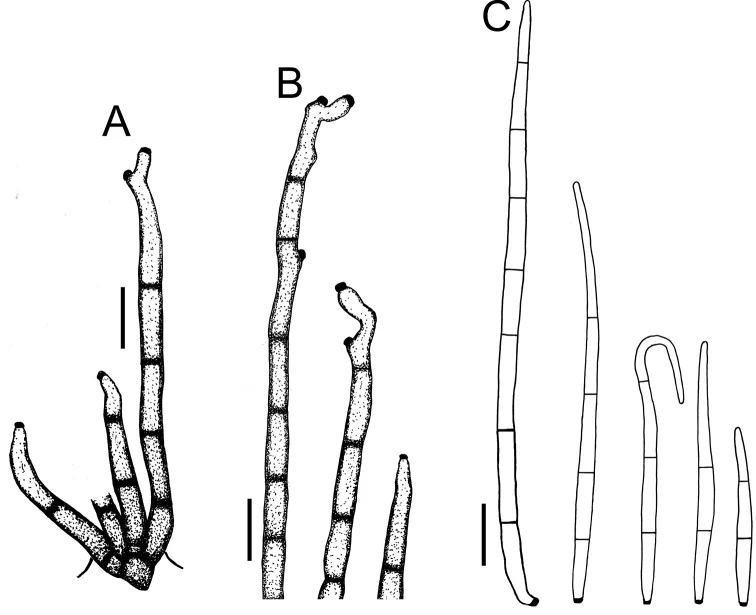
Cercospora phaseoli-lunati on Vigna radiata (YMM289) A small fascicle of conidiophores B solitary conidiophores C conidia. Scale bars: 12 μm (A); 10 μm (B, C).

Jenis
Pelat ilmiah
Kredit
Yalemwork Meswaet, Ralph Mangelsdorff, Nourou S. Yorou, Meike Piepenbring
Lisensi
CC BY 4.0
Sumber media
Buka entri sumber

Gambar menunjukkan objek menurut identifikasi sumber, bukan verifikasi independen spesimen oleh Fungi. Tidak ada skala baru yang ditambahkan.

06 / Rujukan

Sumber profil

  1. [1] Unravelling unexplored diversity of cercosporoid fungi (Mycosphaerellaceae, Mycosphaerellales, Ascomycota) in tropical Africa — Cercospora phaseoli-lunatiBagian sumber: PMC8225595_section_46
    Tanggal penghimpunan sumber: 2026-10-12
    Teks sumber: CC BY 4.0 · Meswaet Y, Mangelsdorff R, Yorou NS, Piepenbring M.
  2. [2] Catalogue of Life Base2026-09-11 — Cercospora phaseoli-lunatiBagian sumber: ColDP NameUsage.tsv ID 69LYJ; accepted species; source 2073
    Tanggal penghimpunan sumber: 2026-10-12
  3. [3] Dokumentasi visual — Cercospora phaseoli-lunatiBagian sumber: Identitas mengikuti sumber dokumentasi; bukan penentuan spesimen independen.
    Tanggal penghimpunan sumber: 2026-10-17
    Media sumber: CC BY 4.0 · Yalemwork Meswaet, Ralph Mangelsdorff, Nourou S. Yorou, Meike Piepenbring

Adaptasi teks: CC BY 4.0. Meswaet Y, Mangelsdorff R, Yorou NS, Piepenbring M. — Unravelling unexplored diversity of cercosporoid fungi (Mycosphaerellaceae, Mycosphaerellales, Ascomycota) in tropical Africa — Cercospora phaseoli-lunati

Uraian asli dan riwayat sumber

Riwayat atau halaman sumber

Ringkasan sumber

Leaf spots amphigenous, subcircular to irregularly angular, 2.5–8(–12) mm diam., more or less limited by veins, whitish grey to greyish brown, with a narrow to wide dark brown margin on the adaxial surface, less conspicuous on the abaxial surface. Caespituli amphigenous, mainly epiphyllous, scattered, brown to dark brown. Mycelium internal, indistinct. External hyphae absent. Stromata lacking or formed by few aggregated swollen hyphal cells, immersed in the mesophyll or in substomatal cavities. Conidiophores in small, loose fascicles of up to 6, arising from internal hyphae of small hyphal aggregations, breaking through the adaxial epidermis of the leaves or penetrating through stomatal openings, or solitarily arising through stomatal openings, erect, rarely branched, straight to geniculate or subcylindrical to mostly attenuated towards the tips, conical or irregularly shaped, (18–)21.5–94(–102) × (3.5–)4–5 μm, 1–6-septate, smooth, brown to dark brown.

Revisi sumber

Morfologi sumber

Leaf spots amphigenous, subcircular to irregularly angular, 2.5–8(–12) mm diam., more or less limited by veins, whitish grey to greyish brown, with a narrow to wide dark brown margin on the adaxial surface, less conspicuous on the abaxial surface. Caespituli amphigenous, mainly epiphyllous, scattered, brown to dark brown. Mycelium internal, indistinct. External hyphae absent. Stromata lacking or formed by few aggregated swollen hyphal cells, immersed in the mesophyll or in substomatal cavities. Conidiophores in small, loose fascicles of up to 6, arising from internal hyphae of small hyphal aggregations, breaking through the adaxial epidermis of the leaves or penetrating through stomatal openings, or solitarily arising through stomatal openings, erect, rarely branched, straight to geniculate or subcylindrical to mostly attenuated towards the tips, conical or irregularly shaped, (18–)21.5–94(–102) × (3.5–)4–5 μm, 1–6-septate, smooth, brown to dark brown. Conidiogenous cells terminal, monoblastic or polyblastic; loci distinct, up to 2.5 μm wide, thickened and darkened. Conidia solitary, narrowly obclavate to subacicular, straight to curved, (16–)19–94(–105.5) × 2.5–3.5 μm, 2–7-septate, hyaline to subhyaline, smooth, apex subacute or acute, base truncate to short obconically truncate, up 2.5 μm wide, hila thickened and darkened.

Revisi sumber

Ekologi sumber

On Phaseolus lunatus from USA, Alabama, Tuskegee (type locality) (Braun and Crous 2005). This species is cited here for the first time for Benin. Thereby, it is cited for the first time for West Africa. Vigna radiata is a new host species.

Revisi sumber

Struktur reproduksi sumber

Leaf spots amphigenous, subcircular to irregularly angular, 2.5–8(–12) mm diam., more or less limited by veins, whitish grey to greyish brown, with a narrow to wide dark brown margin on the adaxial surface, less conspicuous on the abaxial surface. Caespituli amphigenous, mainly epiphyllous, scattered, brown to dark brown. Mycelium internal, indistinct. External hyphae absent. Stromata lacking or formed by few aggregated swollen hyphal cells, immersed in the mesophyll or in substomatal cavities. Conidiophores in small, loose fascicles of up to 6, arising from internal hyphae of small hyphal aggregations, breaking through the adaxial epidermis of the leaves or penetrating through stomatal openings, or solitarily arising through stomatal openings, erect, rarely branched, straight to geniculate or subcylindrical to mostly attenuated towards the tips, conical or irregularly shaped, (18–)21.5–94(–102) × (3.5–)4–5 μm, 1–6-septate, smooth, brown to dark brown.

Revisi sumber

Rujukan halaman ini

Fungi. Cercospora phaseoli-lunati. Rilis data fungi-2026-10-12-expansion-2. https://fungi-atlas.mgadib.chatgpt.site/jamur/cercospora-phaseoli-lunati/.

Status: impor sumber; pemeriksaan editorial per profil belum selesai. Untuk klaim biologis, gunakan rujukan pada bagian terkait dan periksa konteks sumber aslinya.