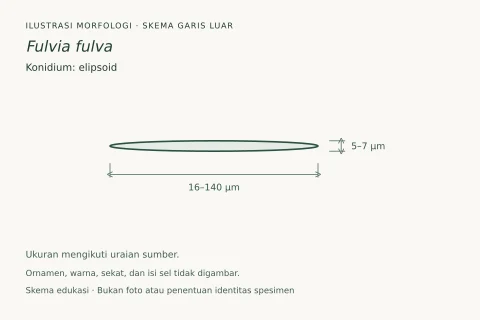
Ciri dan struktur
Conidia of Mycosphaerella coffeicola diproduksi sepanjang tahun dan masuk ke tanaman kopi melalui stomata di bagian bawah daun, atau melalui kutikul epidermal di permukaan daun atas. Pertumbuhan inter- dan intra-sel hifa menciptakan lesi vegetatif di mana sporulasi terjadi. Conidiophores and konidia terbentuk di sini, dan kemudian dibuang oleh angin atau oleh air. Spora dapat meluncur dari satu daun ke daun lain, atau ke bunga dan buah beri menyebabkan infeksi sekunder. Genus Cercospora shows memiliki berbagai proses infeksi; bahkan satu spesies dapat menunjukkan pola yang berbeda pada inang yang berbeda. Faktor One unifying adalah spesies Cercospora produce perilenquinon fotoaktif yang disebut cercosporin. Di gelap, cercosporin tidak beracun tetapi ketika terkena cahaya, ia diubah menjadi bentuk toksik oksigen aktif. Hal ini merusak lipid membran yang mengakibatkan kematian sel dan kebocoran nutrisi. Patogen menggunakan nutrisi yang bocor sebagai sumber energi. M. coffeicola adalah patogen yang diturunkan angin yang menggunakan cercosporin untuk menginfeksi buah dan daun tanaman kopi. Lesions on infected berries produce conidia 17 days after inoculation. If on daun, konidia diproduksi 38 days setelah diinokulasi.
Habitat dan peran ekologis
Ada spesies 40 dalam genus Coffea (keluarga Rubiaceae) yang rentan terhadap penyakit yang disebabkan oleh M. coffeicola, tetapi hanya beberapa yang relevan secara komersial. Arabica coffee (Coffea arabica L.) adalah spesies yang paling signifikan dari spesies yang rentan, mempengaruhi 70% produksi kopi di dunia. Coffea arabica memiliki kebiasaan tumbuh dari semak hingga pohon kecil dan memiliki daun berwarna bertelur, berkilau, tajam, dengan kembang putih berkelompok. Tanda-tanda ini sering memiliki pusat cahaya yang berwarna-warni di mana sporulasi dapat terjadi, dan banyak memiliki "halo" kuning di sekitar margin. Halo ini disebabkan oleh toksin cercosporin, yang diproduksi oleh Cercospora species. Not all lesions have distinct edges or a halo, however, and some occur in concentric rings. Secara umum, lesi spesies ini mampu bergabung, dan dapat membentuk area besar tidak teratur jaringan nekrotis. Leaves may drop in extreme cases. Fruit symptoms biasanya muncul 90 days setelah berbunga. Pada buah berry hijau, ini termasuk bentuk tidak teratur cokelat, luka tenggelam yang dikelilingi oleh halo ungu. Infected red ceri juga memiliki area besar, gelap daging tenggelam. Pada tahap ini, buah mudah diserang oleh bakteri dan jamur oportunis (seperti Colletotrichum gloeosporioides), meskipun gejala dari organisme ini tidak harus salah dikaitkan dengan M. coffeicola.
- Habitat atau konteks temuan
- Informasi belum tersedia pada sumber rilis ini.
- Substrat
- Informasi belum tersedia pada sumber rilis ini.
- Peran atau konteks
- Belum dikategorikan pada rilis ini.
Reproduksi
Mycosphaerella coffeicola adalah patogen tumbuhan jamur yang mereproduksi secara seksual. Hal ini paling sering disebut sebagai organisme asexual Cercospora coffeicola. Ada spesies 40 dalam genus Coffea (keluarga Rubiaceae) yang rentan terhadap penyakit yang disebabkan oleh M. coffeicola, tetapi hanya beberapa yang relevan secara komersial. Arabica coffee (Coffea arabica L.) adalah spesies yang paling signifikan dari spesies yang rentan, mempengaruhi 70% produksi kopi di dunia. Coffea arabica memiliki kebiasaan tumbuh dari semak hingga pohon kecil dan memiliki daun berwarna bertelur, berkilau, tajam, dengan kembang putih berkelompok. Tanda-tanda ini sering memiliki pusat cahaya yang berwarna-warni di mana sporulasi dapat terjadi, dan banyak memiliki "halo" kuning di sekitar margin.
Catatan identitas dan cakupan
- Nama diterima mengikuti Catalogue of Life Base2026-09-11; uraian mempertahankan konsep dan nama sumber aslinya.
- Original geographic, specimen and life-cycle scope retained; source import awaits individual editorial review.
- Impor dan terjemahan otomatis belum diperiksa editorial per profil. Struktur reproduktif yang disebutkan tidak membuktikan seluruh siklus hidup diketahui.
- Pengukuran pada uraian mengikuti spesimen, kultur, dan metode sumber; angka tidak diperluas ke semua populasi.
Catatan distribusi dalam narasi mengikuti sumbernya. Dokumentasi spesimen atau foto mengikuti catatan sumber. Bukti wilayah Indonesia dan penilaian konservasi tidak disimpulkan dari gambar.
Melihat dengan konteks
Dokumentasi visual yang memenuhi pemeriksaan subjek dan hak penggunaan belum tersedia. Foto gejala, label, dan gambar yang meragukan tidak dihitung.
Sumber profil
- [1] Mycosphaerella coffeicola — Wikipedia (en)
- [2] Catalogue of Life Base2026-09-11 — Cercosporina coffeicola
Rujukan halaman ini
Fungi. Cercosporina coffeicola. Rilis data fungi-2026-10-12-expansion-2. https://fungi-atlas.mgadib.chatgpt.site/jamur/cercosporina-coffeicola/.
Status: impor sumber; pemeriksaan editorial per profil belum selesai. Untuk klaim biologis, gunakan rujukan pada bagian terkait dan periksa konteks sumber aslinya.