01 / Morfologi

Ciri dan struktur

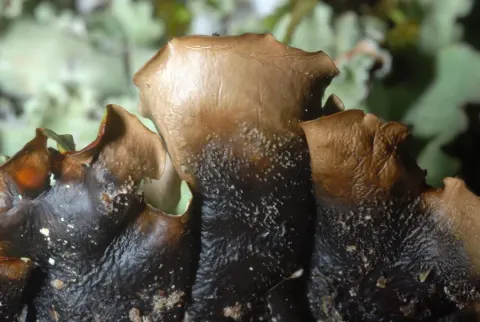
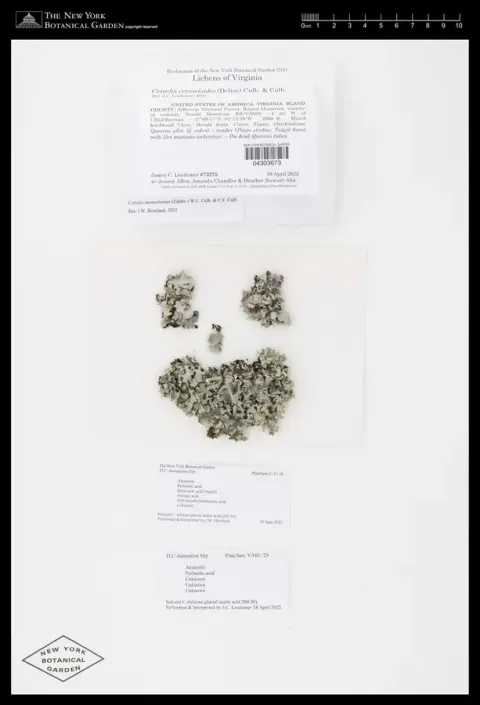
Thallus foliose, heteromerous, dorsiventral, loosely attached, forming wavy, wide-spreading, usually orbicular, wide rosettes. Upper surface greenish-gray to glaucous-gray, lower surface black in the central part to brown at the lobe edges. Lobes broad and round, to 20 mm wide, with raised margins. Pseudocyphellae punctiform on upper surface, which are rather large and usually not raised, also developed in the older, central parts of thallus; pseudocyphellae on the lower surface not developed, or appearing as very small white dots. Soralia primarily marginal on strongly twisted lobes, giving the lobe-ends a somewhat nibbled appearance, usually smooth, with coarse soredia (25–55 µm). Lower surface rather regularly ridged, with scattered, simple, black rhizines and a rhizine-free zone along the margin. Never found fertile in Italy.

Sebagian uraian ditampilkan dalam bahasa sumber; terjemahannya belum tersedia atau belum lolos pemeriksaan.

Rujukan: [1]

Pengukuran mengikuti objek, spesimen atau kultur, dan metode yang disebutkan sumber. Baca uraian asli untuk konteks lengkap.

02 / Kehidupan

Habitat dan peran ekologis

Central-eastern Alps (10 specimens from 7 sites): Friuli Venezia Giulia (2 specimens from 2 sites), Veneto (3 specimens from 1 site), Trentino Alto Adige (2 specimens from 2 sites), Lombardia (3 specimens from 2 sites); Northern Apennines (2 specimens from 2 sites): Liguria (1 specimen from 1 site), Emilia Romagna (1 specimen from 1 site). Fig. 2. Beech or mixed beech-coniferous forests in the montane belt (650–1450 m a.s.l.), moist due to frequent rainfall and/or fog, often near waterbodies (streams, lakes).

Sebagian uraian ditampilkan dalam bahasa sumber; terjemahannya belum tersedia atau belum lolos pemeriksaan.

Rujukan: [1]

Habitat atau konteks temuan
hutan
Substrat
Informasi belum tersedia pada sumber rilis ini.
Peran atau konteks
Pembentuk liken
Temukan hubungan serupa
03 / Siklus hidup

Reproduksi

Thallus foliose, heteromerous, dorsiventral, loosely attached, forming wavy, wide-spreading, usually orbicular, wide rosettes. Upper surface greenish-gray to glaucous-gray, lower surface black in the central part to brown at the lobe edges. Lobes broad and round, to 20 mm wide, with raised margins. Pseudocyphellae punctiform on upper surface, which are rather large and usually not raised, also developed in the older, central parts of thallus; pseudocyphellae on the lower surface not developed, or appearing as very small white dots. Soralia primarily marginal on strongly twisted lobes, giving the lobe-ends a somewhat nibbled appearance, usually smooth, with coarse soredia (25–55 µm). Lower surface rather regularly ridged, with scattered, simple, black rhizines and a rhizine-free zone along the margin.

Sebagian uraian ditampilkan dalam bahasa sumber; terjemahannya belum tersedia atau belum lolos pemeriksaan.

Rujukan: [1]

Sinonim menurut acuan taksonomi rilis: Imbricaria olivetorum; Imbricaria perforata var. olivetorum; Imbricaria perlata var. olivetorum; Parmelia cetrarioides var. rubescens; Parmelia olivaria; Parmelia olivaria var. olivetorum; Parmelia olivetorum; Parmelia perlata rubescens; Parmelia perlata var. olivaria; Parmelia perlata var. olivetorum; Parmotrema cetrarioides subsp. rubescens; Rimelia olivaria
04 / Batas informasi

Catatan identitas dan cakupan

  • Nama diterima mengikuti Catalogue of Life Base2026-09-11; uraian mempertahankan konsep dan nama sumber aslinya.
  • Preserve original treatment localities, hosts and substrate scope. Materials examined describe documented specimens, not the full global range.
  • Impor dan terjemahan otomatis belum diperiksa editorial per profil. Struktur reproduktif yang disebutkan tidak membuktikan seluruh siklus hidup diketahui.
  • Pengukuran pada uraian mengikuti spesimen, kultur, dan metode sumber; angka tidak diperluas ke semua populasi.

Catatan distribusi dalam narasi mengikuti sumbernya. Dokumentasi spesimen atau foto mengikuti catatan sumber. Bukti wilayah Indonesia dan penilaian konservasi tidak disimpulkan dari gambar.

05 / Dokumentasi

Melihat dengan konteks

Dokumentasi visual yang memenuhi pemeriksaan subjek dan hak penggunaan belum tersedia. Foto gejala, label, dan gambar yang meragukan tidak dihitung.

06 / Rujukan

Sumber profil

  1. [1] Towards a better knowledge and conservation of cryptic macrolichens in Italy: a revision of the genus Cetrelia (Parmeliaceae, Lecanorales, lichenized Ascomycota) — Cetrelia olivetorumBagian sumber: PMC12357148_section_36
    Tanggal penghimpunan sumber: 2026-10-12
    Teks sumber: CC BY 4.0 · Gheza G, Vallese C, Di Nuzzo L, Corneti S, Benesperi R, Bianchi E, Canali G, Del Vecchio S, Francesconi L, Giordani P, Nimis PL, Obermayer W, Pistocchi C, Mayrhofer H, Nascimbene J.
  2. [2] Catalogue of Life Base2026-09-11 — Cetrelia olivetorumBagian sumber: ColDP NameUsage.tsv ID 69MPK; accepted species; source 2073
    Tanggal penghimpunan sumber: 2026-10-12

Adaptasi teks: CC BY 4.0. Gheza G, Vallese C, Di Nuzzo L, Corneti S, Benesperi R, Bianchi E, Canali G, Del Vecchio S, Francesconi L, Giordani P, Nimis PL, Obermayer W, Pistocchi C, Mayrhofer H, Nascimbene J. — Towards a better knowledge and conservation of cryptic macrolichens in Italy: a revision of the genus Cetrelia (Parmeliaceae, Lecanorales, lichenized Ascomycota) — Cetrelia olivetorum

Uraian asli dan riwayat sumber

Riwayat atau halaman sumber

Ringkasan sumber

Thallus foliose, heteromerous, dorsiventral, loosely attached, forming wavy, wide-spreading, usually orbicular, wide rosettes. Upper surface greenish-gray to glaucous-gray, lower surface black in the central part to brown at the lobe edges. Lobes broad and round, to 20 mm wide, with raised margins. Pseudocyphellae punctiform on upper surface, which are rather large and usually not raised, also developed in the older, central parts of thallus; pseudocyphellae on the lower surface not developed, or appearing as very small white dots.

Revisi sumber

Morfologi sumber

Thallus foliose, heteromerous, dorsiventral, loosely attached, forming wavy, wide-spreading, usually orbicular, wide rosettes. Upper surface greenish-gray to glaucous-gray, lower surface black in the central part to brown at the lobe edges. Lobes broad and round, to 20 mm wide, with raised margins. Pseudocyphellae punctiform on upper surface, which are rather large and usually not raised, also developed in the older, central parts of thallus; pseudocyphellae on the lower surface not developed, or appearing as very small white dots. Soralia primarily marginal on strongly twisted lobes, giving the lobe-ends a somewhat nibbled appearance, usually smooth, with coarse soredia (25–55 µm). Lower surface rather regularly ridged, with scattered, simple, black rhizines and a rhizine-free zone along the margin. Never found fertile in Italy.

Revisi sumber

Ekologi sumber

Central-eastern Alps (10 specimens from 7 sites): Friuli Venezia Giulia (2 specimens from 2 sites), Veneto (3 specimens from 1 site), Trentino Alto Adige (2 specimens from 2 sites), Lombardia (3 specimens from 2 sites); Northern Apennines (2 specimens from 2 sites): Liguria (1 specimen from 1 site), Emilia Romagna (1 specimen from 1 site). Fig. 2. Beech or mixed beech-coniferous forests in the montane belt (650–1450 m a.s.l.), moist due to frequent rainfall and/or fog, often near waterbodies (streams, lakes).

Revisi sumber

Struktur reproduksi sumber

Thallus foliose, heteromerous, dorsiventral, loosely attached, forming wavy, wide-spreading, usually orbicular, wide rosettes. Upper surface greenish-gray to glaucous-gray, lower surface black in the central part to brown at the lobe edges. Lobes broad and round, to 20 mm wide, with raised margins. Pseudocyphellae punctiform on upper surface, which are rather large and usually not raised, also developed in the older, central parts of thallus; pseudocyphellae on the lower surface not developed, or appearing as very small white dots. Soralia primarily marginal on strongly twisted lobes, giving the lobe-ends a somewhat nibbled appearance, usually smooth, with coarse soredia (25–55 µm). Lower surface rather regularly ridged, with scattered, simple, black rhizines and a rhizine-free zone along the margin.

Revisi sumber

Rujukan halaman ini

Fungi. Cetrelia olivetorum. Rilis data fungi-2026-10-12-expansion-2. https://fungi-atlas.mgadib.chatgpt.site/jamur/cetrelia-olivetorum/.

Status: impor sumber; pemeriksaan editorial per profil belum selesai. Untuk klaim biologis, gunakan rujukan pada bagian terkait dan periksa konteks sumber aslinya.